


Working Time Society consensus statements: A multi-level approach to managing occupational sleep-related fatigue
- PMID: 30700672
- PMCID: PMC6449631
- DOI: 10.2486/indhealth.SW-6
Working Time Society consensus statements: A multi-level approach to managing occupational sleep-related fatigue
Abstract
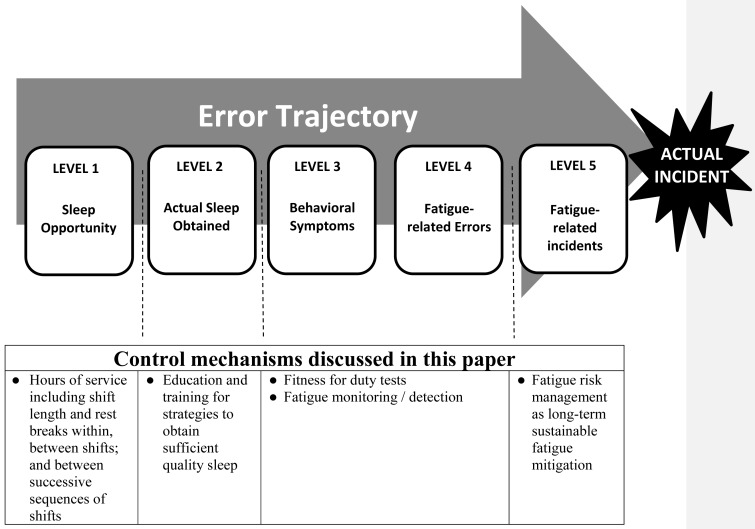
A substantial body of literature indicates that shift workers have a significantly higher risk of workplace accidents and injuries, compared to workers in regular daytime schedules. This can be attributed to work during nights which require workers to stay awake during normal sleeping hours and sleep during natural waking hours, leading to circadian desynchronization, sleep disruption and cognitive impairment. A fatigue-risk trajectory model developed by Dawson and McCulloch has been used to describe the series of events which may precede fatigue-related incidents. This includes insufficient sleep opportunities, impaired sleep, fatigue-behavioral symptoms, and fatigue-related errors. The purpose of this paper is to provide examples of control measures along each level of the fatigue-risk trajectory, which include: (i) work scheduling strategies to include breaks for adequate sleep opportunities; (ii) training and educational programs to help workers make best use of recovery times for quality sleep; (iii) fatigue-detection devices to alert workers and safety managers of fatigue-related behaviors and errors. A brief introduction to Fatigue-Risk Management systems is also included as a long-term sustainable strategy to maintain shift worker health and safety. The key statements in this paper represent a consensus among the Working Time Society regarding a multi-level approach to managing occupational sleep-related fatigue.
Keywords: Fatigue-risk trajectory; Nonstandard shifts; Safety interventions; Shift work.
Figures
References
-
- Wong IS, McLeod CB, Demers PA. (2011) Shift work trends and risk of work injury among Canadian workers. Scand J Work Environ Health 37, 54–61. - PubMed
-
- Wagstaff AS, Sigstad Lie JA. (2011) Shift and night work and long working hours—a systematic review of safety implications. Scand J Work Environ Health 37, 173–85. - PubMed
-
- Lombardi DA, Folkard S, Willetts JL, Smith GS. (2010) Daily sleep, weekly working hours, and risk of work-related injury: US National Health Interview Survey (2004–2008). Chronobiol Int 27, 1013–30. - PubMed
-
- Tucker P, Folkard S .(2012) Working time, health and safety: a research synthesis paper. ILO, Geneva.
-
- Akerstedt T, Folkard S, Portin C. (2004) Predictions from the three-process model of alertness. Aviat Space Environ Med 75 Suppl, A75–83. - PubMed
