


The evolutionary consequences for seawater performance and its hormonal control when anadromous Atlantic salmon become landlocked
- PMID: 30700821
- PMCID: PMC6353943
- DOI: 10.1038/s41598-018-37608-1
The evolutionary consequences for seawater performance and its hormonal control when anadromous Atlantic salmon become landlocked
Erratum in
-
Author Correction: The evolutionary consequences for seawater performance and its hormonal control when anadromous Atlantic salmon become landlocked.Sci Rep. 2019 Dec 24;9(1):20189. doi: 10.1038/s41598-019-55962-6. Sci Rep. 2019. PMID: 31874988 Free PMC article.
Abstract
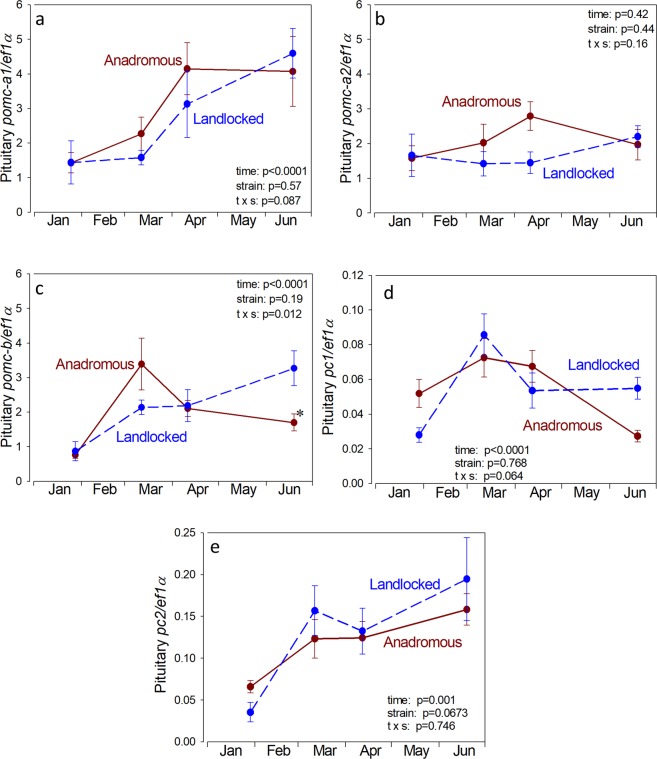
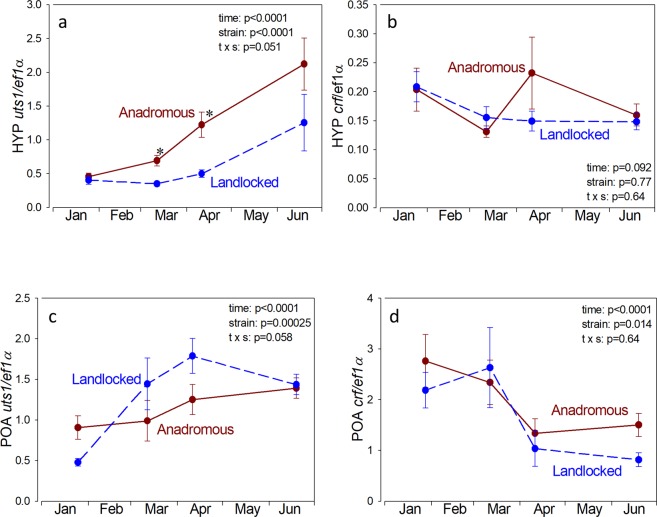
Populations of anadromous fish have become landlocked in relatively recent geological history (<14,000 years), but the evolutionary impacts of this altered lifecycle on traits underlying seawater performance have not been established. In order to examine the effects of relaxed selection on seawater traits, anadromous and landlocked Atlantic salmon were reared under identical conditions and examined for differences in seawater performance and its underlying physiological and endocrine control during the time of spring downstream migration. Salinity tolerance, survival and initial growth in seawater were greater in anadromous than in landlocked salmon. Abundance of the seawater isoform of gill Na+/K+-ATPase increased in spring in both strains but was greater in anadromous salmon. Hormones associated with seawater acclimation (adrenocorticotropic hormone, cortisol and growth hormone) increased in spring in both strains but were higher in anadromous salmon, whereas plasma thyroid hormones did not differ. Hypothalamic urotensin I mRNA levels also increased in spring and were higher in the anadromous strain. The results provide evidence that salinity tolerance and associated physiological traits are regulated by seasonal stimulation of the hypothalamic-pituitary-interrenal axis, and that relaxed selection on seawater entry traits has decreased this stimulation in landlocked salmon.
Conflict of interest statement
The authors declare no competing interests.
Figures


References
-
- Crespi EJ, Williams TD, Jessop TS, Delehanty B. Life history and the ecology of stress: how do glucocorticoid hormones influence life-history variation in animals? Funct. Ecol. 2015;27:93–106. doi: 10.1111/1365-2435.12009. - DOI
-
- Pigliucci, M. Phenotypic Plasticity, Johns Hopkins University Press (2001).
Publication types
MeSH terms
Substances
LinkOut - more resources
Full Text Sources
Medical
