


Is Albumin-based Resuscitation in Severe Sepsis and Septic Shock Justifiable? An Evidence from a Cost-effectiveness Evaluation
- PMID: 30700954
- PMCID: PMC6341442
- DOI: 10.4314/ejhs.v29i1.8
Is Albumin-based Resuscitation in Severe Sepsis and Septic Shock Justifiable? An Evidence from a Cost-effectiveness Evaluation
Abstract
Background: Fluid and antimicrobial therapy are the essential parts of sepsis management. The type of fluid to resuscitate with is an unsettled issue in the treatment of severe sepsis and septic shock. The objective of this study was to evaluate the cost-effectiveness of albumin-based resuscitation over crystalloids.
Methods: A cost-effectiveness analysis was conducted by extracting data from a database of Sina Hospital, Islamic Republic of Iran. A decision tree was constructed by using Tree Age Pro 2011. The patients were grouped based on the types of fluids used for resuscitation into crystalloid alone or crystalloid + albumin groups at the initial decision node. The patients were followed from the onset of severe sepsis and septic shock upto 28 days. The healthcare payers' perspective was considered in constructing the model. The cost was measured in US dollars and the effectiveness was measured by life years gained.
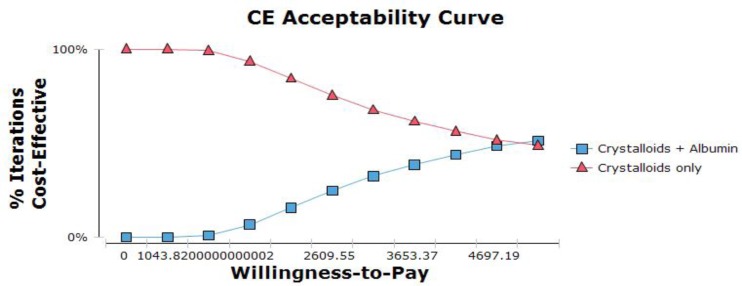
Results: The addition of albumin during resuscitation of patients with severe sepsis and septic shock has an effectiveness gain of 0.09 life years and cost increment of 495.00 USD. The estimated ICER for this analysis was 5500.00 USD per life year gained. The probability that albumin is cost-effective at one GDP per capita is 49.5%.
Conclusion: Albumin-based resuscitation is not cost-effective in Iran when a GDP per capita was considered for a life year gain. The cost-effectiveness was insensitive to the cost of standard care. We recomend the caustious use albumin as per the Surviving Sepsis Campaign guideline.
Keywords: Albumin; cost-effectiveness; crystalloids; economic; evaluation.
Figures

Similar articles
-
A Cost-effectiveness Analysis of Albumin in Septic Shock: A Patient-level Data Analysis.Clin Ther. 2019 Nov;41(11):2297-2307.e2. doi: 10.1016/j.clinthera.2019.08.023. Epub 2019 Oct 25. Clin Ther. 2019. PMID: 31668842
-
Economic model of albumin infusion in septic shock: The EMAISS study.Acta Anaesthesiol Scand. 2020 Jul;64(6):781-788. doi: 10.1111/aas.13559. Epub 2020 Mar 9. Acta Anaesthesiol Scand. 2020. PMID: 32037505
-
What is the Preferred Resuscitation Fluid for Patients with Severe Sepsis and Septic Shock?J Emerg Med. 2017 Dec;53(6):928-939. doi: 10.1016/j.jemermed.2017.08.093. Epub 2017 Oct 25. J Emerg Med. 2017. PMID: 29079487 Review.
-
Cost-effectiveness of intravenous resuscitation fluids in sepsis patients: a patient-level data analysis in Jordan.J Med Econ. 2024 Jan-Dec;27(1):126-133. doi: 10.1080/13696998.2023.2296196. Epub 2023 Dec 26. J Med Econ. 2024. PMID: 38105744
-
Fluid management in sepsis: The potential beneficial effects of albumin.J Crit Care. 2016 Oct;35:161-7. doi: 10.1016/j.jcrc.2016.04.019. Epub 2016 Apr 27. J Crit Care. 2016. PMID: 27481753 Review.
Cited by
-
European Society of Intensive Care Medicine clinical practice guideline on fluid therapy in adult critically ill patients. Part 1: the choice of resuscitation fluids.Intensive Care Med. 2024 Jun;50(6):813-831. doi: 10.1007/s00134-024-07369-9. Epub 2024 May 21. Intensive Care Med. 2024. PMID: 38771364
-
Cost-effectiveness of emergency care interventions in low and middle-income countries: a systematic review.Bull World Health Organ. 2020 May 1;98(5):341-352. doi: 10.2471/BLT.19.241158. Epub 2020 Feb 25. Bull World Health Organ. 2020. PMID: 32514199 Free PMC article.
-
Factors influencing DVT formation in sepsis.Thromb J. 2024 Jan 16;22(1):11. doi: 10.1186/s12959-024-00582-y. Thromb J. 2024. PMID: 38229151 Free PMC article.
References
-
- Sagy M, Al-Qaqaa Y, Kim P. Definitions and pathophysiology of sepsis. Current problems in pediatric and adolescent health care. 2013;43(10):260–263. - PubMed
-
- Howell MD, Davis AM, Management of. sepsis and septic shock. Jama. 2017;317(8):847–848. - PubMed
-
- Silversides JA, Major E, Ferguson AJ, Mann EE, McAuley DF, Marshall JC, et al. Conservative fluid management or deresuscitation for patients with sepsis or acute respiratory distress syndrome following the resuscitation phase of critical illness: a systematic review and meta-analysis. Intensive care medicine. 2017;43(2):155–170. - PubMed
MeSH terms
Substances
LinkOut - more resources
Full Text Sources
Medical