Biomarkers for the detection of apparent and subclinical cancer therapy-related cardiotoxicity
- PMID: 30701097
- PMCID: PMC6328390
- DOI: 10.21037/jtd.2018.08.15
Biomarkers for the detection of apparent and subclinical cancer therapy-related cardiotoxicity
Abstract
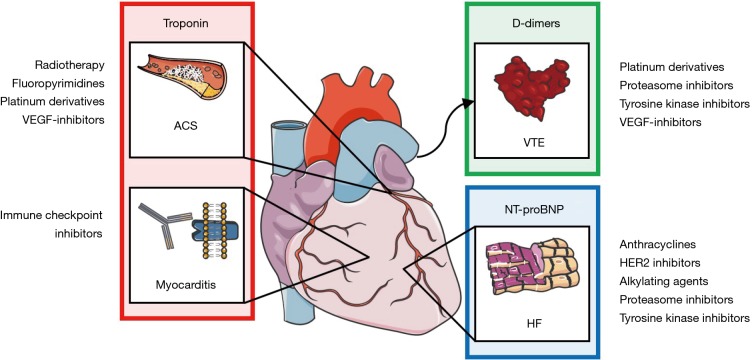
Progress in cancer therapy over the past decades improved long-term survival but increased cancer therapy-related cardiotoxicity. Many novel treatment options have been implemented with yet incompletely characterized cardiovascular side effects including heart failure, coronary artery disease, arrhythmias, valvular disease, venous thromboembolism and myocarditis. Diagnosis of potential cardiotoxic side effects is essential for an optimal treatment but remains challenging. Cardiac biomarkers troponin and brain natriuretic peptide/N-terminal proBNP (BNP/NT-proBNP) have been extensively studied in heart failure and acute coronary syndromes. Emerging evidence implicates a significant role in the detection of cardiotoxicity and guidance of therapy in cancer patients. Elevated troponin or BNP/NT-proBNP levels were associated with increased all-cause mortality in cancer patients and have been shown to predict manifest heart failure. BNP/NT-proBNP may be useful for the prediction of cancer therapy-related heart failure and response to heart failure therapy in adult and pediatric cancer patients while troponin can indicate acute myocardial infarction in patients with cancer therapy-related risk for coronary artery disease. Furthermore, troponin may be used for the identification of immune checkpoint inhibitor-related myocarditis with very high sensitivity. Finally, even D-dimer levels have been shown to improve risk stratification and diagnosis in cancer-associated venous thromboembolism. This review aims to summarize the current knowledge about biomarkers in cancer therapy-related cardiotoxicity. We also outline possible clinical recommendations for the detection and treatment of subclinical and clinically apparent cardiotoxic effects using biomarkers.
Keywords: Biomarker; brain natriuretic peptide (BNP); cardio-oncology; cardiotoxicity; troponin.
Conflict of interest statement
Conflicts of Interest: The authors have no conflicts of interest to declare.
Figures
References
-
- Deutschland DSB. Häufigste Todesursachen 2015. 2017. Available online: https://www.destatis.de/DE/ZahlenFakten/GesellschaftStaat/Gesundheit/Tod...
-
- USA NCfHS. Health United States: Number of deaths for leading causes of death. 2015. Available online: https://www.cdc.gov/nchs/fastats/leading-causes-of-death.htm
-
- SEER Cancer Statistics Review, 1975-2015 [database on the Internet]. National Cancer Institute. 2018. Accessed: 06/2018. Available online: https://seer.cancer.gov/csr/1975_2015/
-
- Zamorano JL, Lancellotti P, Rodriguez Munoz D, et al. 2016 ESC Position Paper on cancer treatments and cardiovascular toxicity developed under the auspices of the ESC Committee for Practice Guidelines: The Task Force for cancer treatments and cardiovascular toxicity of the European Society of Cardiology (ESC). Eur Heart J 2016;37:2768-801. 10.1093/eurheartj/ehw211 - DOI - PubMed
Publication types
LinkOut - more resources
Full Text Sources
Other Literature Sources
Research Materials
Miscellaneous