. 2019 Jan 25:2:36.
doi: 10.1038/s42003-018-0278-1. eCollection 2019.

Action and mechanism of the colistin resistance enzyme MCR-4

Affiliations

Action and mechanism of the colistin resistance enzyme MCR-4

Huimin Zhang et al. Commun Biol. .

Abstract

Colistin is the last-resort antibiotic against lethal infections with multidrug-resistant bacterial pathogens. A rainbow coalition of mobile colistin resistance (mcr) genes raises global health concerns. Here, we describe the action and mechanism of colistin resistance imparted by MCR-4, a recently-identified member from the broader MCR family. We found that MCR-4 originates from the silenced variant of Shewanella frigidimarina via progressive evolution and forms a phylogenetically-distinct group from the well-studied MCR-1/2 family. Domain-swapping experiments further confirmed that MCR-1 and MCR-4 transmembrane and catalytic domains are not functionally-interchangeable. However, structural and functional analyses demonstrated that MCR-4 possesses a similar PE lipid substrate-recognizable cavity and exploits an almost-identical ping-pong catalysis mechanism. MCR-4 also can alleviate colistin-triggered accumulation of reactive oxygen species (ROS). Taken together, this finding constitutes a functional proof that MCR-4 proceeds in a distinct evolutionary path to fulfill a consistent molecular mechanism, resulting in phenotypic colistin resistance.


Conflict of interest statement

The authors declare no competing interests.

Figures

Fig. 1
Fig. 1
Phylogeny of MCR-4 and its variants. a An unrooted radial phylogram of MCR-4 and its homologs Amino acid sequences of close homologs of MCR-4, in combination with those from MCR-1/2 homologs have been included in the analysis. Three distinct phylogenetic groups refer to MCR-4 variants (in orange), MCR-3 variants (in yellow), and MCR-1/2 variants (in pink), respectively. In particular, a chromosomally-encoded colistin resistance determinant, Neisseria eptA is distinct member. Z1140 is an experimentally-verified non-functional PE transferase and acts as an internal reference in this phylogeny,. b Rooted phylogenetic tree of MCR-4 and its close homologs. Two distinct closely-clustered subclades have been indicated, including MCR-4 variants (highlighted in red with orange background) and MCR-4 homologs from Shewanella species (in a light blue background). The tree has been rooted with Z1140, an experimentally-verified non-functional PE transferase,. A protein sequence-based phylogenetic analysis of MCR-4 was constructed using the maximum likelihood method. Sequences were aligned using MUSCLE and phylogenetic trees here have been inferred using the LG model. A discrete gamma distribution was used to model evolutionary rate differences among sites with some evolutionarily invariable sites. The percentages of replicate trees in which the associated taxa are clustered in the bootstrap test (1000 replicates) is shown next to the branches. The tree is drawn to scale, with branch lengths measured in the number of substitutions per site. Protein accession numbers have been indicated in the figure. *mcr-4.3 is renamed from a duplicated mcr-4.2, and then found to be an inactive version. The scale of bar in the phylogenetic tree is 0.20
Fig. 2
Fig. 2
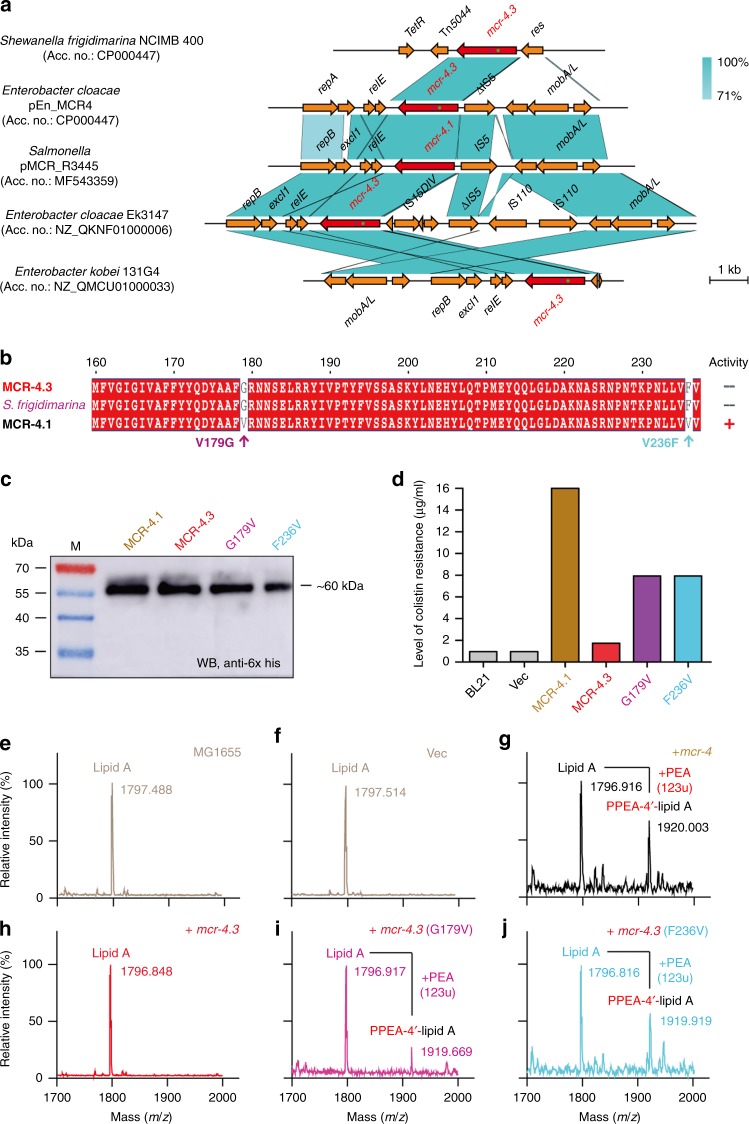
Integrative evidence that MCR-4 probably originated from the chromosomally-encoded, non-functional variant (MCR-4.3) of Shewanella frigidimarina. a Comparison of the mcr-4.1 (mcr-4.3)-neighboring genetic context in the representative plasmids and/or S. frigidimarina chromosome Easyfig (https://omictools.com/easyfig-tool) was utilized for genomic analyses of plasmids. Colored arrows indicate ORFs and the mcr-4 genes are highlighted in red. The shaded region depicts sequence similarity. mcr-4.1 carried by pMCR-R3445 (Accession entry: MF543359) is the prototype for mcr-4, whereas mcr-4.3 of pEn_MCR4 (Accession entry: MF061380) is determined to be an inactive variant of mcr-4 with only two point-mutations. Of note, mcr-4.3 was also detected on the S. frigidimarina chromosome. b Sequence alignment of a certain region in MCR-4.1 (and MCR-4.3) covering the two aforementioned point-mutations (V179G and V236F). c Expression analyses of mcr-4.1, mcr-4.3, and the two revertant mutants of mcr-4.3 (G179V and F236V) in E. coli. The mid-log phase cultures (1 ml) were collected by spinning, dissolved in 100 μl protein loading buffer, and heated in boiling water for 20 mins. 5 μl of resulting crude extract sample was loaded into 15% SDS-PAGE for protein separation, and anti-6x His rabbit serum is the primary antibody used in Western blot. Western blot-based detection for expression of mcr-4 variants is pre-requisite for the established relevance of bacterial viability on the condition of colistin resistance to MCR-4. M denotes pre-stained protein ladder (Thermo Scientific). The original blot is available in Supplementary Figure 15a. d Level of colistin resistance in E. coli expressing MCR-4.1, MCR-4.3, and their derivatives. No less than three independent experiments of bacterial viability were conducted with LBA plates with colistin addition. Given that bacterial growth is consistently similar, a representative result is given. MALDI-TOF mass spectrometry of lipid A species in the negative-control strains MG1655 alone (e) and/or with the empty vector (f). The addition of PEA to lipid A occurs in the strain MG1655 expressing MCR-4 (g), but not upon the expression of mcr-4.3 (h). The two revertant mutations [G179V (i) and F236V (j)] of mcr-4.3 partially restore its enzymatic activity in modifying the lipid A into PEA-4’-lipid A
Fig. 3
Fig. 3
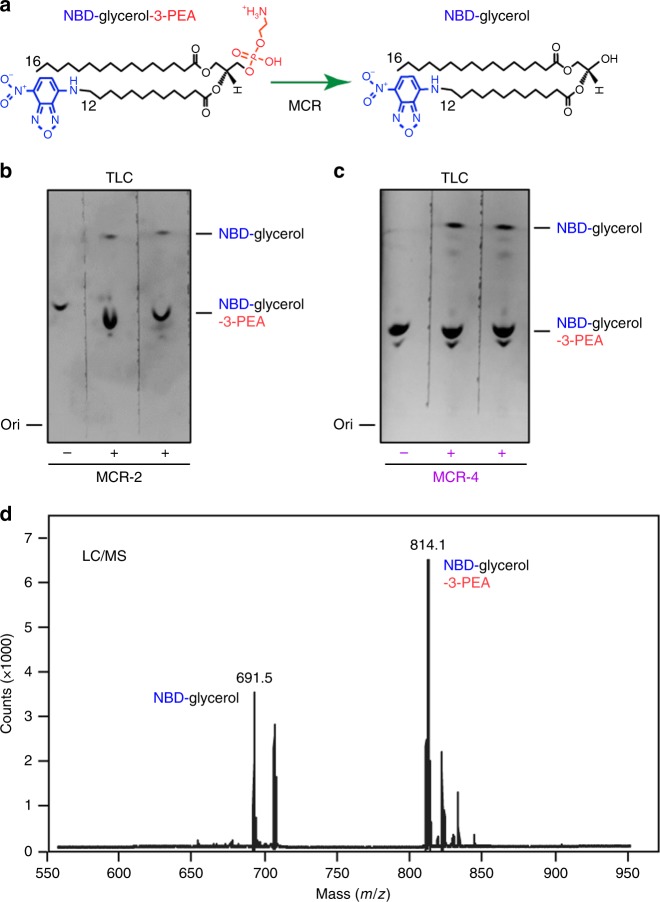
Scheme for enzymatic action of MCR-4. a A working model for the chemical reaction catalyzed by MCR family enzymes. This was adapted from our recent proposal, with minor changes. In this model, MCR enzymes including MCR-4 removes the phosphoethanolamine (PEA) moiety from its alternative substrate NBD-glycerol-3-PEA, giving a putative intermediate of MCR-4-bound PEA and a final product of NBD-glycerol. NBD is indicated in blue, whereas PEA is highlighted in red. Thin layer chromatography (TLC)-based detection of enzymatic activities of MCR-2 (b) and MCR-4 (c) protein in the conversion of NBD-glycerol-PEA lipid substrate into NBD-glycerol For detection via TLC, the fluorescence signal of NBD-glycerol-3-PER (and/or NBD-glycerol) was captured under Epi blue light (455–485 nm) and a corresponding filter by the ChemiDoc MP imaging system (BioRad, CA, USA). d LC/MS analyses of MCR-4-mediated reaction products of NBD-glycerol-3-PEA. The spectrum of the substrate for MCR-4, NBD-glycerol-3-PEA appears at m/z of 814.1, whereas NBD-glycerol, the product of NBD-glycerol-3-PEA removing PEA (m/z, 123), is present at m/z 691.5
Fig. 4
Fig. 4
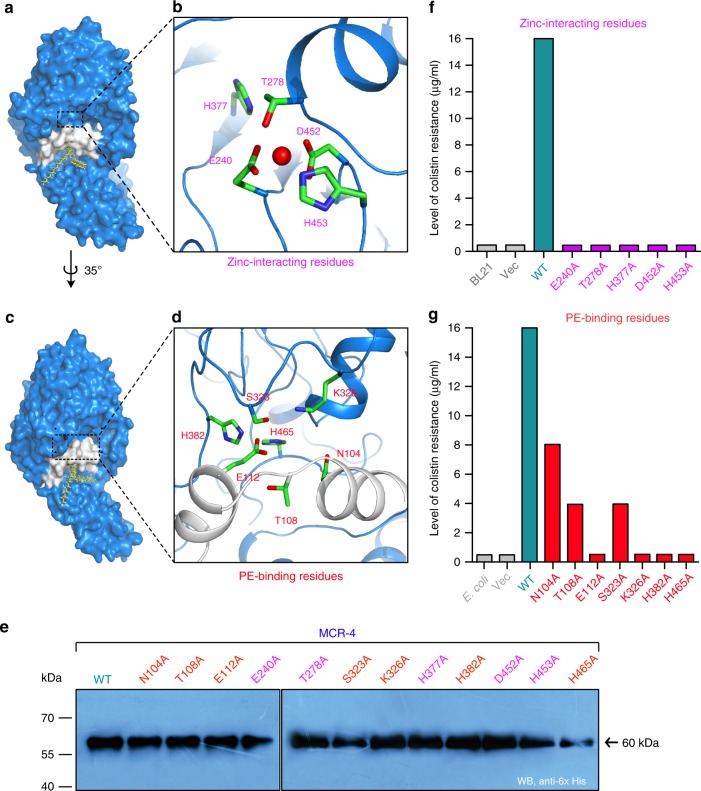
Structure and function studies of MCR-4 colistin resistance. a Surface structure of MCR-4 with the PE lipid substrate-interactive cavity. b An enlarged illustration for a five residue-containing, Zn2+-binding motif. The five residues in Zn2+-binding motif of MCR-4 refer to E240, T278, H377, D452, and H453, respectively. c Surface illustration of MCR-4 rotated counter-clockwise (35°). d An enlarged view of the seven residue-containing domain involved in binding of MCR-4 the PE lipid substrate. The seven residues denote N104, T108, E112, S323, K326, H382, and H465, respectively. e Use of western blotting to assay the expression of MCR-4 and its 12 point-mutants in E. coli. The original blot is seen in Supplementary Figure 15b. f Site-directed mutagenesis analyses for the Zn2+-binding motif of MCR-4 in the context of colistin resistance using the colistin susceptibility tests. g Colistin susceptibility-based dissection of the PE-interactive residues of MCR-4 It is a representative result from three independent experiments
Fig. 5
Fig. 5
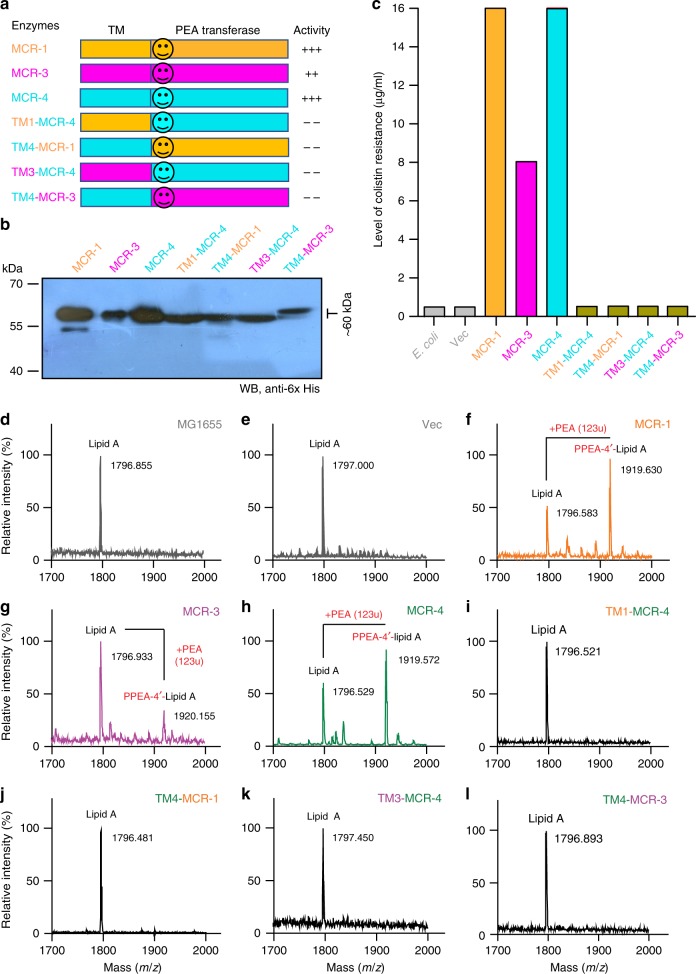
Domain-swapping analyses of three MCR-like proteins (MCR-1, MCR-3 and MCR-4). a Scheme for domain-swapped constructs between MCR-4 and MCR-1/3 The smiley-face refers to a linker between the transmembrane region and the catalytic domain of PEA transferase. b Western blot assays for the expression of mcr-4 and its mosaic versions in E. coli The original blot is provided in Supplementary Figure 15c. c Comparison of bacterial viability of E. coli expressing mcr-4 and its hybrid derivatives on the LBA plates with varied level of colistin It is a representative result from three individual assays of colistin resistance. d, e MALDI-TOF MS spectrum of the LPS-lipid A species isolated from the colistin-susceptible strain E. coli MG1655 with or without the empty vector pBAD24 MALDI-TOF MS profile of the LPS-lipid A species from the two positive control strains, E. coli MG1655 with MCR-1 (f) and/or MCR-3 (g). h MS evidence that MCR-4 transfer PEA to lipid A (m/z, 1796.583), producing the PPEA-4’-lipid A (m/z, 1919.630) The four domain-swapped versions of MCR-4 and MCR-1/3 that fail to render the recipient E. coli strain MG1655 resistant to colistin included TM1-MCR-4 (i), TM4-MCR-1 (j), TM3-MCR-4 (k), TM4-MCR-3 (l), respectively
Fig. 6
Fig. 6
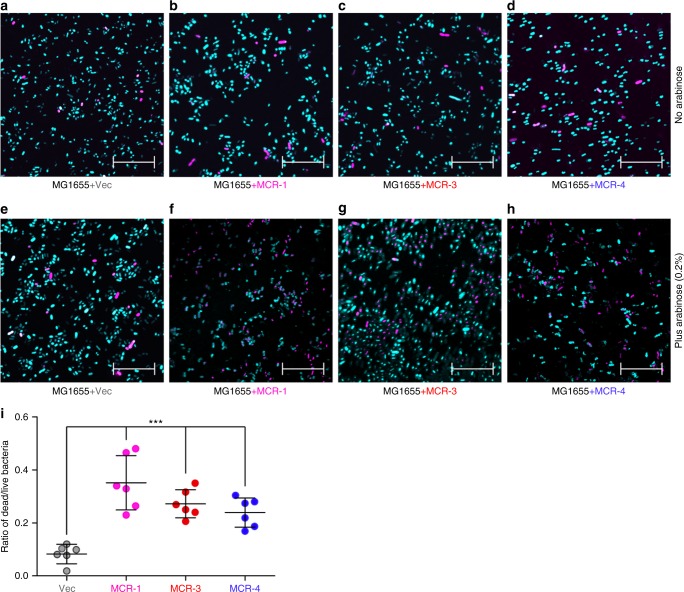
Effect on bacterial viability exerted by the expression of mcr-1/3/4 genes. Bacterial viability measured without the addition of arabinose to E. coli MG1655 having the empty vector pBAD24 (a), MCR-1 (b), MCR-3 (c) or MCR-4 (d). Bacterial viability measured with the addition of 0.2% arabinose to the derivatives of E. coli MG1655 having the empty vector pBAD24 (e), MCR-1 (f), MCR-3 (g) or MCR-4 (h). The scale of bar is 20 μm. i The relative quantitation of LIVE/DEAD E. coli strains expressing MCR-1/3/4 0.2% (w/v) L-arabinose was supplemented to activate the expression of mcr-1/3/4. Bacterial cells were stained with LIVE/DEAD kit, giving the images with confocal laser scanning microscopy. Turquoise and magenta refers to live and dead cell. One-way analysis of variance (ANOVA) was applied, which is followed by Tukey–Kramer multiple comparisons post hoc test. Statistical significance was fixed at p < 0.001
Fig. 7
Fig. 7
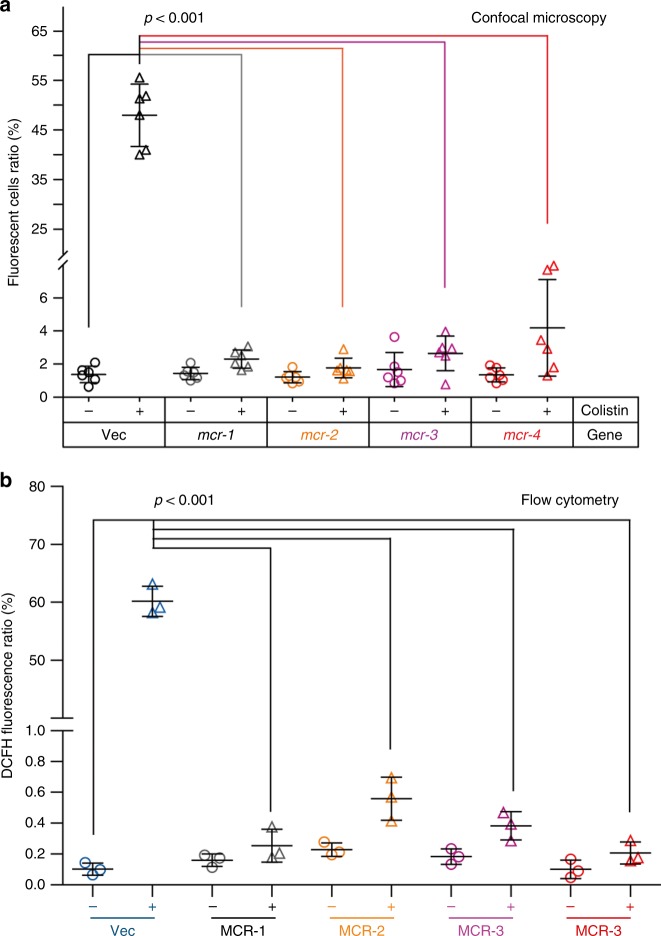
Relative quantification assays for colistin-induced ROS levels in E. coli expressing mcr-like genetic determinant. a Confocal microscopy-based quantification of ROS levels in E. coli carrying different versions of MCR family. b Use of flow cytometry to determine the ROS fluctuation in E. coli having mcr variants. The ratio of fluorescent cells (a) was calculated by counting the number of cells with/without fluorescence (seen in Supplementary Figure 10). Over 500 cells from 6 individual photographs were counted for each group. The data was given after one-way analysis of variance (ANOVA) along with Tukey–Kramer multiple comparisons post hoc test. Statistical significance was set at p < 0.001. The flow cytometry data (b) was recorded with a BD FACSVerse flow cytometer counting 10,000 cells at a flow rate of 35 ml/min or 14 ml/min. DCFH florescence was excited with a 488 nm argon laser and emission was detected with the FL1 emission filter at 525 nm using FL1 photomultiplier tube

References

    1. Lim LM, et al. Resurgence of colistin: a review of resistance, toxicity, pharmacodynamics, and dosing. Pharmacotherapy. 2010;30:1279–1291. doi: 10.1592/phco.30.12.1279. - DOI - PMC - PubMed
    1. Spapen H, Jacobs R, Van Gorp V, Troubleyn J, Honore PM. Renal and neurological side effects of colistin in critically ill patients. Ann. Intensive Care. 2011;1:14. doi: 10.1186/2110-5820-1-14. - DOI - PMC - PubMed
    1. Alos JI. [Antibiotic resistance: A global crisis] Enferm. Infecc. Microbiol. Clin. 2015;33:692–699. doi: 10.1016/j.eimc.2014.10.004. - DOI - PubMed
    1. Laxminarayan R, et al. Antibiotic resistance-the need for global solutions. Lancet Infect. Dis. 2013;13:1057–1098. doi: 10.1016/S1473-3099(13)70318-9. - DOI - PubMed
    1. Ponce de Leon-Rosales S, Arredondo-Hernandez R, Lopez-Vidal Y. [Resistance to antibiotic: A serious global problem] Gac. Med. Mex. 2015;151:681–689. - PubMed

Publication types

MeSH terms

Substances