Review
. 2019 Jul 29;58(31):10460-10476.
doi: 10.1002/anie.201814471. Epub 2019 Apr 29.

Selective Arene Hydrogenation for Direct Access to Saturated Carbo- and Heterocycles

Affiliations
Review

Selective Arene Hydrogenation for Direct Access to Saturated Carbo- and Heterocycles

Mario P Wiesenfeldt et al. Angew Chem Int Ed Engl. .

Abstract

Arene hydrogenation provides direct access to saturated carbo- and heterocycles and thus its strategic application may be used to shorten synthetic routes. This powerful transformation is widely applied in industry and is expected to facilitate major breakthroughs in the applied sciences. The ability to overcome aromaticity while controlling diastereo-, enantio-, and chemoselectivity is central to the use of hydrogenation in the preparation of complex molecules. In general, the hydrogenation of multisubstituted arenes yields predominantly the cis isomer. Enantiocontrol is imparted by chiral auxiliaries, Brønsted acids, or transition-metal catalysts. Recent studies have demonstrated that highly chemoselective transformations are possible. Such methods and the underlying strategies are reviewed herein, with an emphasis on synthetically useful examples that employ readily available catalysts.

Keywords: arene hydrogenation; chemoselectivity; cycloalkanes; heterocycles; stereoselectivity.


Conflict of interest statement

M.P.W., Z.N., and F.G. are inventors on German patent applications 10 2017 106 467.2 and 10 2018 104 201.9, held and submitted by Westfälische Wilhelms‐Universität Münster. These patent applications cover methods for the synthesis of fluorinated cyclic aliphatic and heterocyclic compounds. See Figures 16 and 17.

Figures
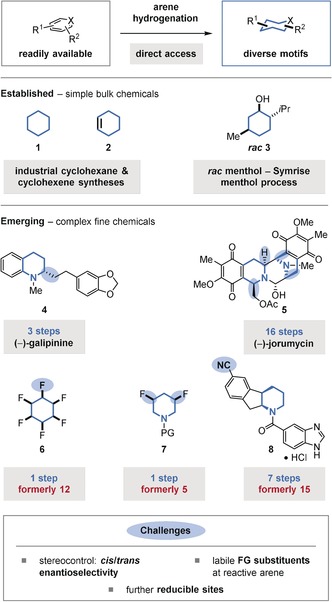
Figure 1
Figure 1
Arene hydrogenation provides direct access to diverse carbo‐ and heterocycle motifs.
Figure 2
Figure 2
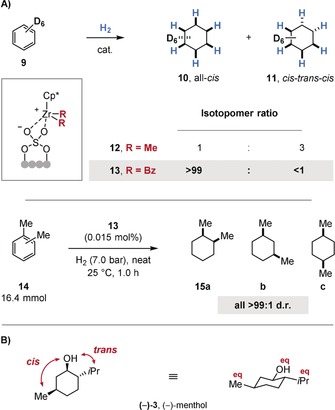
A) Highly cis‐selective arene hydrogenation using a supported, single‐site organozirconium precatalyst (13). B) Relative stereochemistry of (−)‐menthol ((−)‐3) and its most stable conformation. Eq: equatorial orientation.
Figure 3
Figure 3
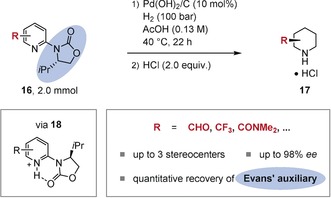
Enantioselective synthesis of piperidines by the diastereoselective hydrogenation of pyridines using the Evans auxiliary.
Figure 4
Figure 4
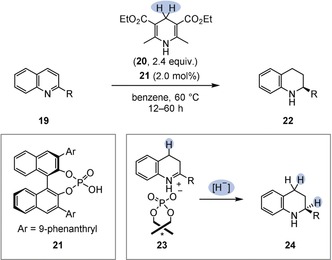
Enantioselective transfer hydrogenation of 2‐substituted quinolines (19) using a chiral Brønsted acid catalyst (21).
Figure 5
Figure 5
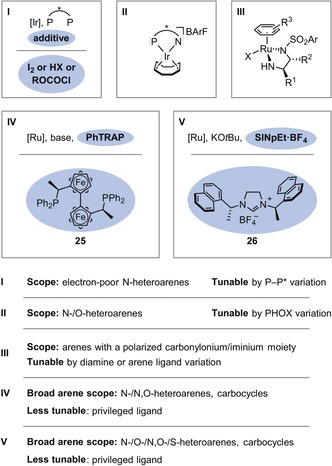
Established transition‐metal‐based catalyst systems for the enantioselective hydrogenation of (hetero‐)arenes and some relevant characteristics.
Figure 6
Figure 6
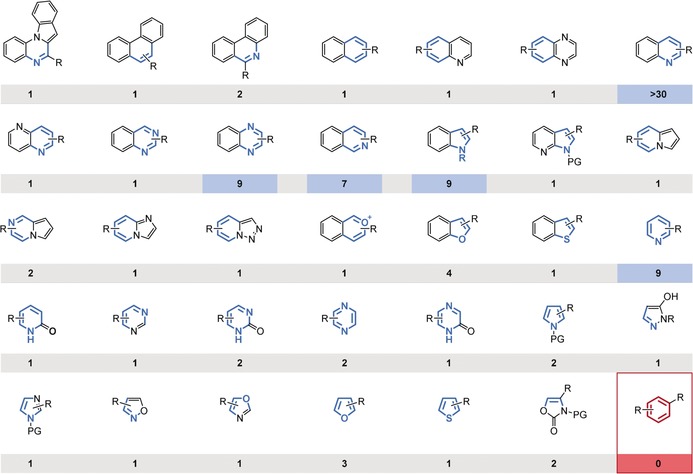
Overview of the substrate scope of (highly) enantioselective arene hydrogenations catalyzed by chiral transition‐metal catalysts and the respective number of published synthetic methods (≥90 % ee, minimum two substrates).
Figure 7
Figure 7
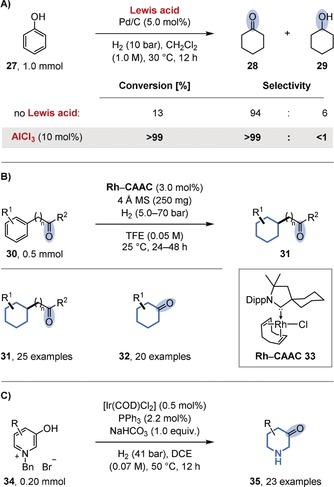
Chemoselective hydrogenation of arenes in the presence of ketones. A) Effect of a Lewis acid on the partial hydrogenation of phenol (27). B) Chemoselective hydrogenation of aromatic ketones (30) using rhodium‐CAAC complexes (e.g. 33). C) Chemoselective partial hydrogenation of 3‐hydroxypyridinium salts (34). COD=1,5‐cyclooctadiene, DCE=1,2‐dichloroethane, TFE=2,2,2‐trifluoroethanol.
Figure 8
Figure 8
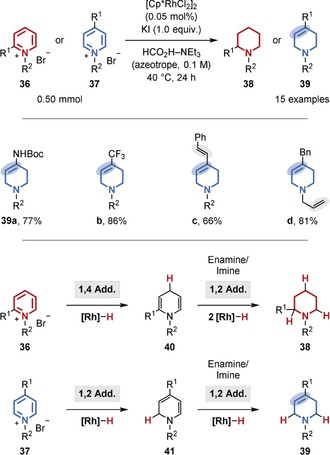
Chemoselective transfer hydrogenation of pyridinium salts.
Figure 9
Figure 9
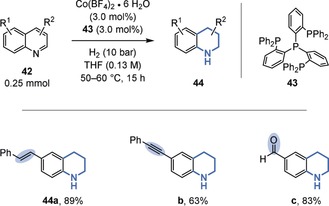
Chemoselective hydrogenation of quinolines in the presence of an alkene, an alkyne, and an aldehyde.
Figure 10
Figure 10
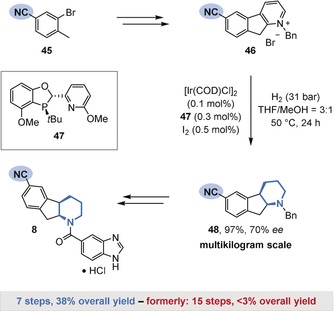
Boehringer Ingelheim's synthesis of a potent therapeutic agent (8) against Type 2 diabetes by the chemoselective hydrogenation of pyridinium salt 46.
Figure 11
Figure 11
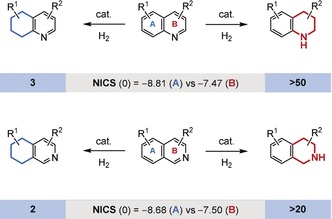
Regioselective hydrogenation of quinolines and isoquinolines and the respective number of published synthetic methods (≥50 % yield, at least two substrates). The NICS(0) value refers to the center of the ring.
Figure 12
Figure 12
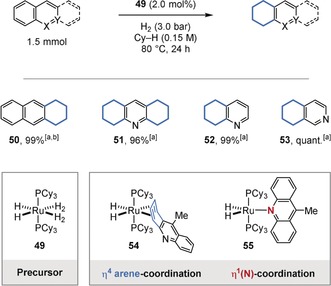
Regioselective hydrogenation of polycyclic aromatic compounds using Chaudret's complex (49). It was suggested that a preferential Ru‐η4‐arene coordination determines the regioselectivity. [a] GC yields. [b] 1 h reaction time. Cy=cyclohexyl.
Figure 13
Figure 13
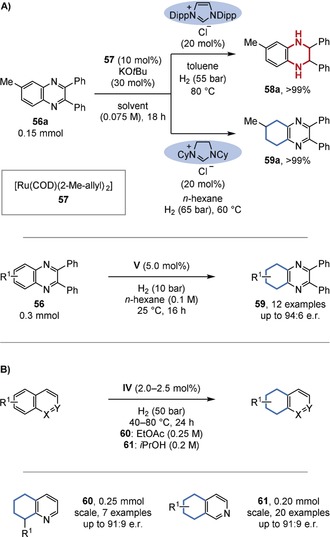
A) Regio‐ and enantioselective hydrogenation of quinoxalines. B) Regio‐ and enantioselective hydrogenation of quinolines and isoquinolines. Dipp=2,6‐diisopropylphenyl.
Figure 14
Figure 14
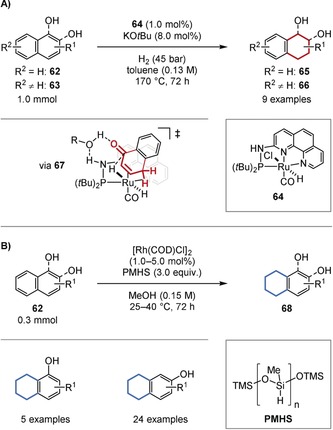
A) Regioselective hydrogenation of naphthols (62, 63) to the 1,2,3,4‐tetrahydronaphthols (65, 66). B) Regioselective hydrogenation of naphthols to 5,6,7,8‐tetrahydronaphthols (68). TMS=trimethylsilyl.
Figure 15
Figure 15
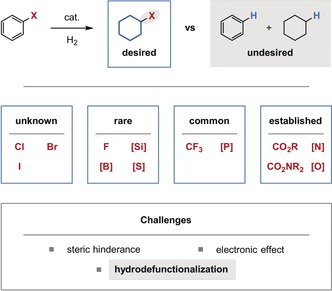
Tolerance of functional groups directly attached to the reactive arene. The stated frequencies of tolerance are based on our knowledge of the available literature for the hydrogenation of benzene derivatives.62 [Si]: silyl group; [B]: boryl group; [S]: sulfur‐containing functional group including an S‐phenyl substituent; [P], [N], [O] are defined analogously.
Figure 16
Figure 16
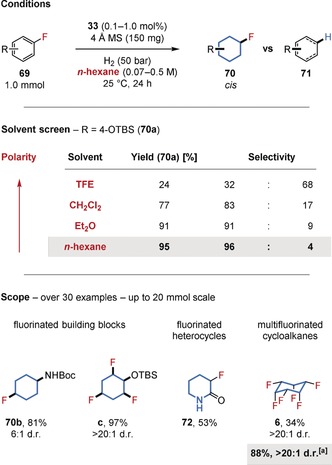
Chemoselective hydrogenation of fluorinated arenes. [a] New conditions using 450 mg SiO2 instead of 4 Å MS.
Figure 17
Figure 17
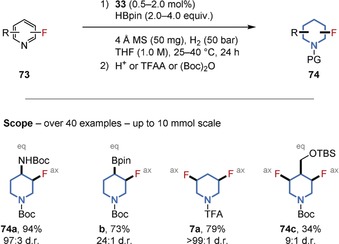
Chemoselective hydrogenation of fluorinated pyridines. Defined orientations of the substituents were determined. PG=protecting group (H, TFA, or Boc), TFAA=trifluoroacetic anhydride.
Figure 18
Figure 18
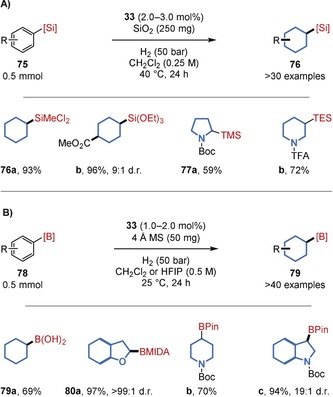
Chemoselective procedures for the hydrogenation of A) silylated and B) borylated arenes. HFIP=Hexafluoroisopropanol, MIDA=N‐Methyliminodiacetate.

References

    1. Weissermel K., Arpe H.-J., Industrial organic chemistry, Wiley-VCH, Weinheim, 2008, pp. 337–385.
    1. None
    1. Nagahara H., Ono M., Konishi M., Fukuoka Y., Appl. Surf. Sci. 1997, 121–122, 448;
    1. Foppa L., Dupont J., Chem. Soc. Rev. 2015, 44, 1886. - PubMed
    1. Review:

Publication types

LinkOut - more resources