Review
. 2019 Jan;27(1):1-10.
doi: 10.4250/jcvi.2019.27.e9.

Contemporary Imaging Diagnosis of Cardiac Amyloidosis

Affiliations
Review

Contemporary Imaging Diagnosis of Cardiac Amyloidosis

Seung Pyo Lee et al. J Cardiovasc Imaging. 2019 Jan.

Abstract

Cardiac amyloidosis is a rare disease that frequently presents as ventricular hypertrophy. However, diagnosis is not always easy or straightforward as there are several myocardial disorders that phenocopy cardiac amyloidosis. Here, we present a narrative review of the current modalities that are actively used or being developed for diagnosis and follow-up of cardiac amyloidosis. Although not all of the findings may be present in those with cardiac amyloidosis, there are some clues in each diagnostic step that help lead to confirmatory diagnosis of cardiac amyloidosis; we believe that cardiologists should be familiar with these clues.

Keywords: Amyloidosis; Diagnosis; Echocardiography; Magnetic resonance imaging; Multimodal imaging.


Conflict of interest statement

The authors have no financial conflicts of interest.

Figures
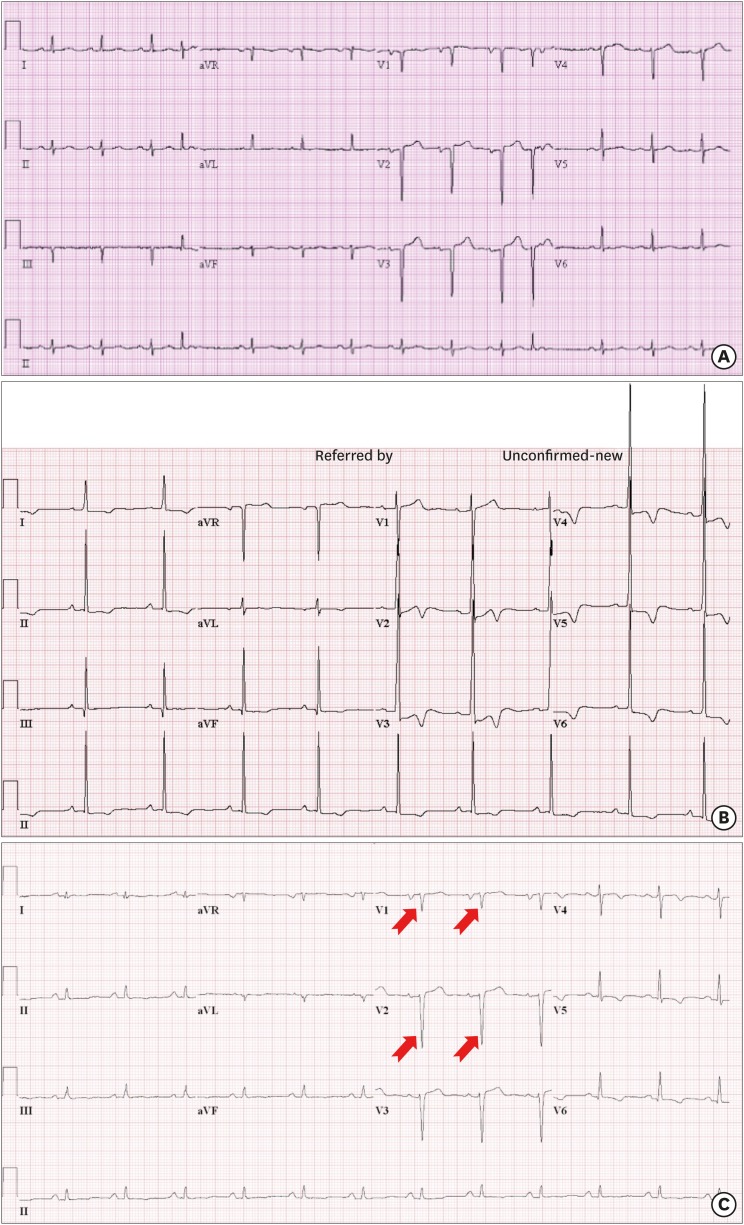
Figure 1
Figure 1. Examples of 12-lead electrocardiograms of cardiac amyloidosis patients. (A, B) Two patients with a similar degree of LV wall thickness, 15 mm. A is a case of cardiac amyloidosis, and B is a case of the concentric form of hypertrophic cardiomyopathy. (A) Despite increased ventricular wall thickness, there is no evidence of ventricular hypertrophy on electrocardiograms. The QRS voltage, especially in the limb leads and the lateral precordial leads, is rather low considering the presence of thickened left ventricular wall. (B) This is in contrast to a significant increase of QRS voltage in patients with hypertrophic cardiomyopathy. (C) A pseudoinfarction pattern in a patient with cardiac amyloidosis. A typical QS wave (red arrows) can be seen in the septal precordial leads and can be misdiagnosed as myocardial infarction.
Figure 2
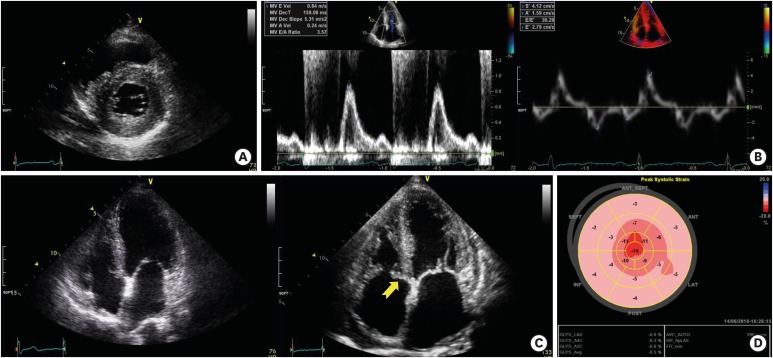
Figure 2. Typical echocardiography features in cardiac amyloidosis patients. (A) Thickened LV wall that measures up to 14 mm on parasternal view. (B) Doppler interrogation demonstrates a restrictive filling pattern in the mitral inflow study and very low e′ velocity at the mitral septal annulus. Calculation of E/e′ is estimated to be 30, which indicates high LV filling pressure. (C) An angina patient who developed cardiac amyloidosis after 5 years of percutaneous coronary intervention. The LV wall thickness at the time of coronary intervention was normal, as were the sizes of both atria (left panel). The patient visited the hospital for progressive dyspnea and significant thickening of the ventricular wall, and biatrial enlargement was noted (right panel). Note thickening of the tricuspid valve at the time of diagnosis of cardiac amyloidosis (yellow arrows) that was not evident on initial echocardiography. (D) A representative bull's eye plot of longitudinal strain. Note that the longitudinal strain of the apex is preserved in contrast to those of the other midventricular or basal segments.
Figure 3
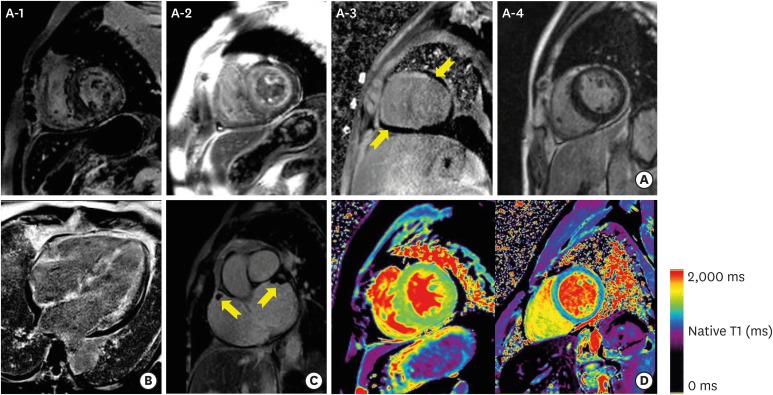
Figure 3. Cardiovascular magnetic resonance (CMR) images of cardiac amyloidosis patients. (A) The pattern of late gadolinium enhancement (LGE) can be diverse in cardiac amyloidosis patients. Although multifocal patchy LGE (A-1) and global subendocardial ring enhancement patterns (A-2) are most common, suboptimal nulling is not unusual (A-3) and even no LGE (A-4) in spite of cardiac amyloidosis on myocardial biopsy. Pericardial effusion is also noted (A-3, yellow arrows). (B) Along with subendocardial LGE in the ventricle, LGE may also be seen in the interatrial septum. (C) Analysis for the presence of intracardiac thrombi in patients with cardiac amyloidosis is important, as in this case in which thrombi were noted at both atria (yellow arrows). (D) Parametric CMR is easy to quantify and gives information on diffuse myocardial change. A typical case of cardiac amyloidosis with an elevated septal native T1 up to 1,550 msec (left panel). A CMR scan of a normal volunteer with a native T1 of 1,150 msec (right panel).
Figure 4
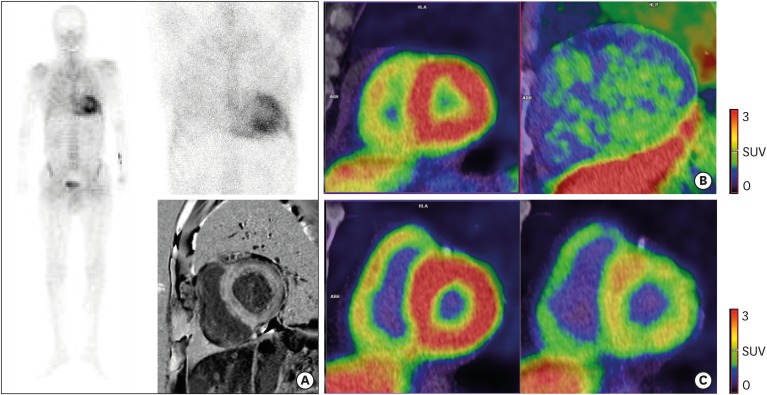
Figure 4. Nuclear imaging in diagnosis of cardiac amyloidosis and follow-up. (A) A representative image of 99mTc-DPD SPECT in an ATTR cardiac amyloidosis patient. Evident uptake of 99mTc-DPD in the myocardium is noted and is supported by suboptimal nulling on CMR. (B) Uptake of 11C-Pittsburgh B (PiB) compound in a patient with biopsy-proven cardiac amyloidosis (left panel). This compound is specific for amyloid deposits as no 11C-PiB is noted in healthy volunteers (right panel). (C) A significant decrease of 11C-PiB uptake in a patient with cardiac amyloidosis 12 months after chemotherapy and autologous stem cell transplantation (left panel; before chemotherapy, right panel).

References

    1. Merlini G, Bellotti V. Molecular mechanisms of amyloidosis. N Engl J Med. 2003;349:583–596. - PubMed
    1. Kyle RA, Linos A, Beard CM, et al. Incidence and natural history of primary systemic amyloidosis in Olmsted County, Minnesota, 1950 through 1989. Blood. 1992;79:1817–1822. - PubMed
    1. Pinney JH, Smith CJ, Taube JB, et al. Systemic amyloidosis in England: an epidemiological study. Br J Haematol. 2013;161:525–532. - PMC - PubMed
    1. Mohammed SF, Mirzoyev SA, Edwards WD, et al. Left ventricular amyloid deposition in patients with heart failure and preserved ejection fraction. JACC Heart Fail. 2014;2:113–122. - PMC - PubMed
    1. Cornwell GG, 3rd, Murdoch WL, Kyle RA, Westermark P, Pitkänen P. Frequency and distribution of senile cardiovascular amyloid. A clinicopathologic correlation. Am J Med. 1983;75:618–623. - PubMed