


Treatment Patterns and Outcomes in Botulinum Therapy for Patients With Facial Synkinesis
- PMID: 30703206
- PMCID: PMC6537828
- DOI: 10.1001/jamafacial.2018.1962
Treatment Patterns and Outcomes in Botulinum Therapy for Patients With Facial Synkinesis
Abstract
Importance: In the last decade, there has been a significant increase in the number of practitioners administering botulinum toxin for facial synkinesis. However, there are few resources available to guide treatment patterns, and little is known about how these patterns are associated with functional outcomes and quality of life.
Objective: To evaluate botulinum treatment patterns, including the dosing and frequency of muscle targeting, for treatment of facial synkinesis and to quantify patient outcomes.
Design, setting, and participants: This prospective cohort study of 99 patients treated for facial synkinesis was conducted from January 2016 through December 2018 at the Vanderbilt Bill Wilkerson Center in Nashville, Tennessee, a tertiary referral center.
Intervention: Onabotulinum toxin A treatment of facial synkinesis.
Main outcomes and measures: Patient-reported outcomes on the Synkinesis Assessment Questionnaire and botulinum treatment patterns, including the dosages and frequency of injection for each facial muscle, were compared at the initiation of treatment and at the end of recorded treatment.
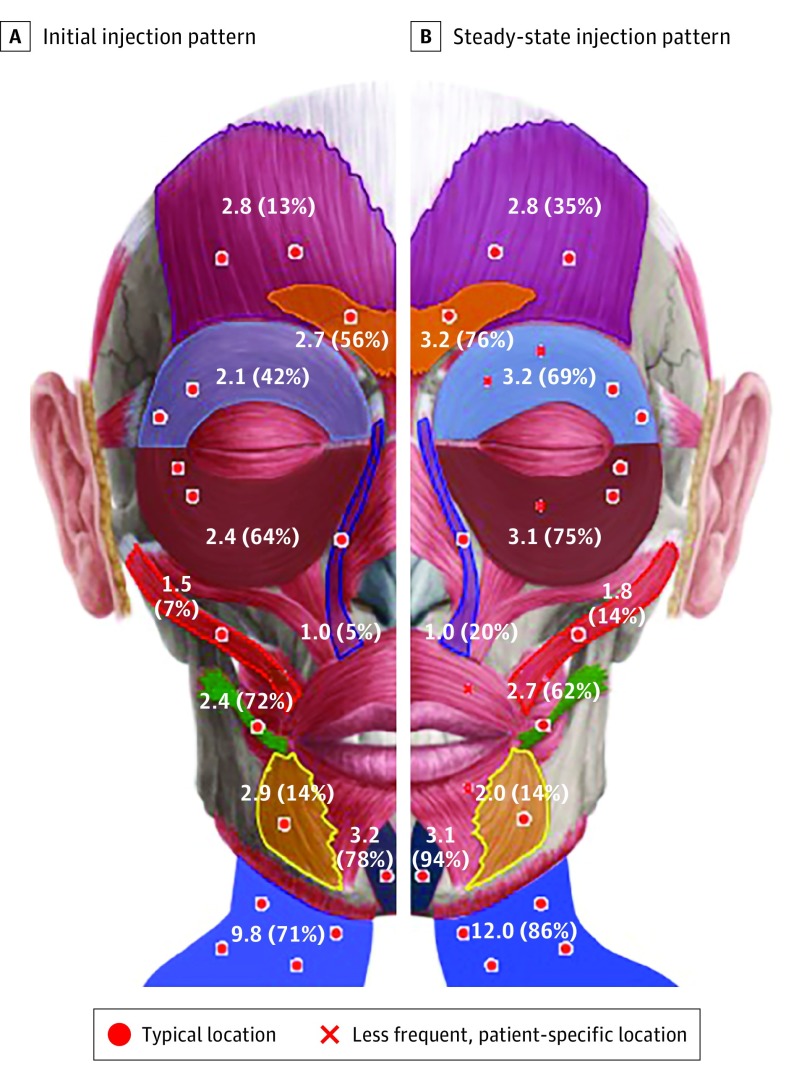
Results: In total, 99 patients (80 female patients [81%]) underwent botulinum injections for treatment of facial synkinesis. The median (interquartile range) age was 54.0 (43.5-61.5) years, and the median (interquartile range) follow-up was 27.1 (8.9-59.7) months. Most patients underwent injections after receiving a diagnosis of Bell palsy (41 patients, 41%) or after resection of vestibular schwannoma (36 patients [36%]). The patients received a total of 441 treatment injections, and 369 pretreatment and posttreatment Synkinesis Assessment Questionnaire scores were analyzed. The mean botulinum dose was 2 to 3 U for each facial muscle and 9 to 10 U for the platysma muscle. The dose increased over time for the majority of all muscles, with steady state achieved after a median of 3 treatments (interquartile range, 2-3). Linear regression analysis for cluster data of the mean total questionnaire score difference was -14.2 (95% CI, -17.0 to -11.5; P < .001). There was a significant association of postinjection questionnaire score with younger patients, female sex, total dose, and synkinesis severity. Oculo-oral synkinesis may respond more to treatment compared with oro-ocular synkinesis.
Conclusion and relevance: Patients with facial synkinesis responded significantly to botulinum treatment. Treatment began with 6 core facial muscles that were injected during most treatment sessions, and dosages increased after the first injection until steady state was achieved. Those with a greater degree of morbidity, younger patients, and females showed significant improvement, and the larger the dose administered, the greater the response. Oculo-oral synkinesis may be more responsive than oro-ocular synkinesis.
Level of evidence: 3.
Conflict of interest statement
Figures
References
-
- Salles AG, da Costa EF, Ferreira MC, Remigio AF, Moraes LB, Gemperli R. Epidemiologic overview of synkinesis in 353 patients with longstanding facial paralysis under treatment with botulinum toxin for 11 years. Plast Reconstr Surg. 2015;136(6):1289-1298. doi: 10.1097/PRS.0000000000001802 - DOI - PubMed
MeSH terms
Substances
LinkOut - more resources
Full Text Sources
Medical