. 2019 Jan 30;9(2):49.
doi: 10.3390/biom9020049.

The Search for Natural Inhibitors of Biofilm Formation and the Activity of the Autoinductor C6-AHL in Klebsiella pneumoniae ATCC 13884

Affiliations

The Search for Natural Inhibitors of Biofilm Formation and the Activity of the Autoinductor C6-AHL in Klebsiella pneumoniae ATCC 13884

Elizabeth Cadavid et al. Biomolecules. .

Abstract

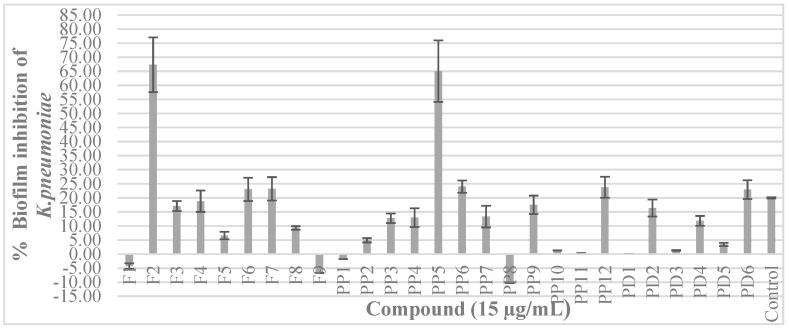
Human nosocomial infections are common around the world. One of the main causes is the bacteria Klebsiella pneumoniae, which shows high rates of resistance to antibiotics. Thus, drugs with novel mechanisms of action are needed. In this work, we report the effects of various natural substances on the formation of biofilm in Klebsiella pneumoniae, as well as its stability. The effect of the molecules on the growth of K. pneumoniae was initially determined by measuring the optical density. The modification of the biofilm, the changes relating to its resistance, the effects on the bacterial adhesion to the urethral catheter and its antagonist role the hexanoyl-homoserinelactone were assessed by crystal violet, as well as by microscopy. The best effects were obtained with 3-methyl-2(5H)-furanone and 2´-hydroxycinnamic acid, which inhibited the formation of biofilm by 67.38% and 65.06%, respectively. Additionally, the remaining biofilm formed was more susceptible to gentamicin. Through microscopy examination, there were evident changes in the biofilm and adherence on the polyvinyl chloride (PVC) urethral catheter. Besides, 3-methyl-2(5H)-furanone inhibited the biofilm-forming effect of the autoinducer hexanoyl-homoserinelactone. Thus, these molecules could be developed as supplemental of antibiotics.

Keywords: Klebsiella pneumoniae; adherence; biofilm; furan; inhibition; phenyl-acyl compounds; pyran; quorum sensing; resistance.


Conflict of interest statement

The authors declare no conflict of interest.

Figures
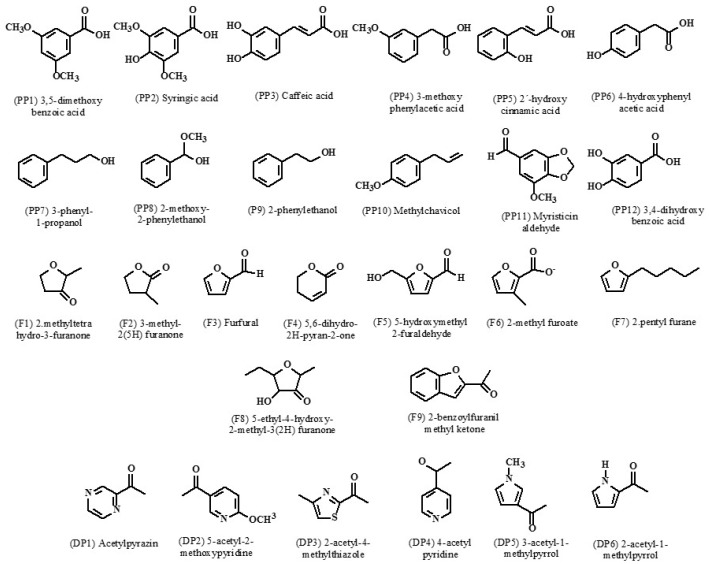
Figure 1
Figure 1
The chemical structures of compounds assayed for biofilm inhibitors.
Figure 2
Figure 2
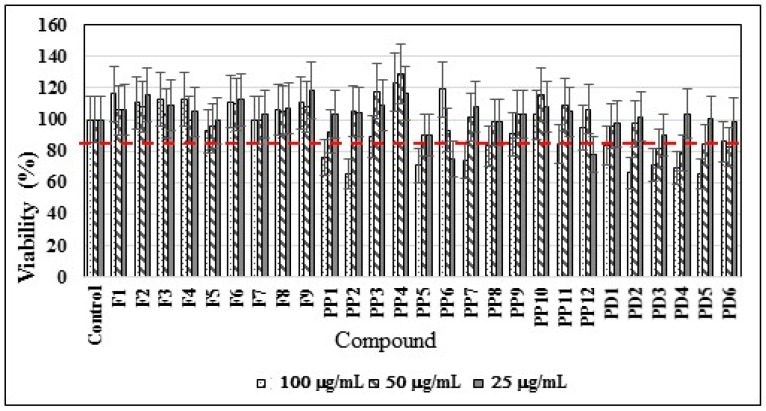
The effects of the compounds evaluated on the viability of K. pneumoniae. Minimum viability 85% growth was established respect to the found in the control medium without substances. See structure code in Figure 1.
Figure 3
Figure 3
Effects of the compounds on the formation of the K. pneumoniae biofilm. The biofilm was obtained from an inoculum of K. pneumoniae in microplates of polystyrene and quantified by absorbance with violet crystal. In LB medium all substances were evaluated at 15 µg/mL (non-biocidal concentration). Negative values indicate a biofilm-inducing effect. See structure code in Figure 1.
Figure 4
Figure 4
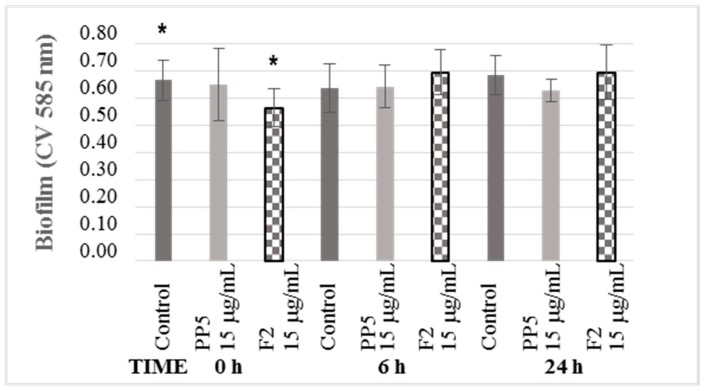
The kinetics of biofilm inhibition of the compounds. At 0, 6 and 24 h of incubation the compound was added, and the amount of biofilm formed was quantified by staining with violet crystal at 30 h. The asterisk (*) represents values lower than the average of the control of each compound concentration with statistically significant difference (* p < 0.05) (n = 5).
Figure 5
Figure 5
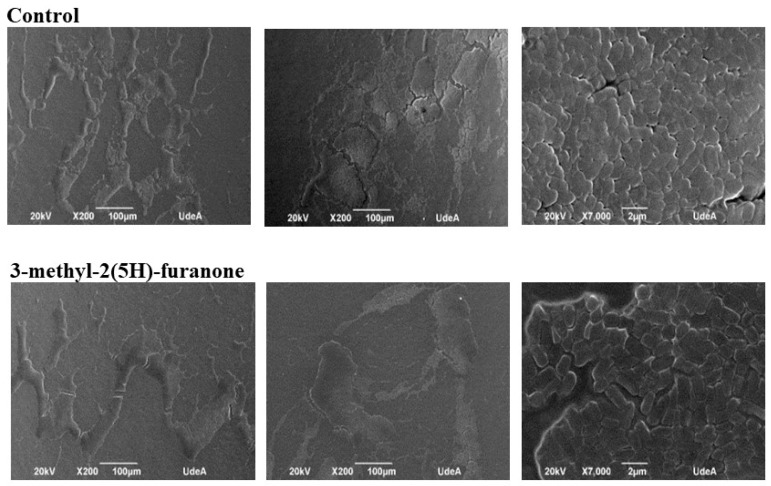
The appearance of the biofilm of K. pneumoniae observed with Scanning Electron Microscope (SEM) at 200X and 7000X. Upper: Culture without treatment. Bottom: Biofilm formed under the effects of 3-methyl-2(5H)-furanone. The compound reduces the colonization area and increases the interbacterial spaces.
Figure 6
Figure 6
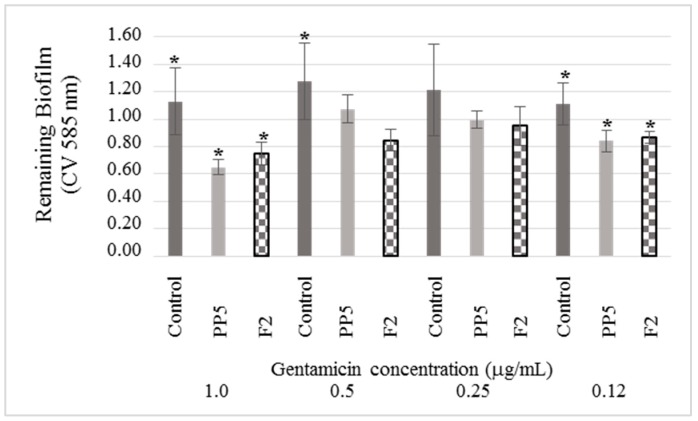
The effect of gentamicin on the elimination of mature biofilm formed under the effect of 2´-hydroxycinnamic acid and 3-methyl-2(5H)-furanone inhibitors (30 h incubation). These compounds increased the sensitivity of the biofilm of K. pneumoniae to gentamicin. For both substances the relative reduction of biofilm concerning the control and to each concentration of gentamicin it is appreciated. Results along with the standard deviation are presented as average values. The asterisk (*) represents values lower than the average of the control of each antibiotic concentration with statistically significant difference (* p < 0.05) (n = 5).
Figure 7
Figure 7
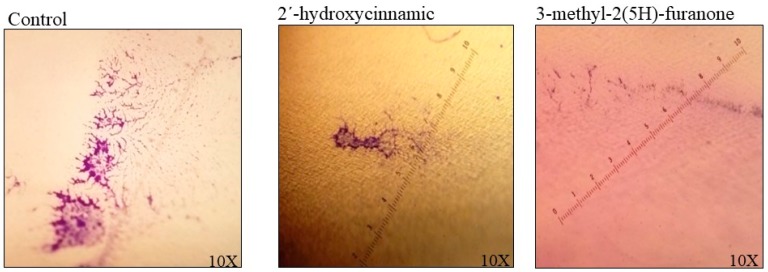
The appearance of the biofilm of K. pneumoniae in a polyvinyl chloride (PVC) urethral catheter. Biofilm formed at 30 h of incubation at 37 °C was stained with violet crystal at 0.05%. The size of microcolonies was determined in three fields to quantify the colonization level; each image is a catheter field with greater biofilm formation. A 60.15% reduction in colonization was observed in the presence of 2´-hydroxycinnamic acid, and a 67.62% reduction with 3-methyl-2(5H)-furanone at 15 µg/mL was observed.
Figure 8
Figure 8
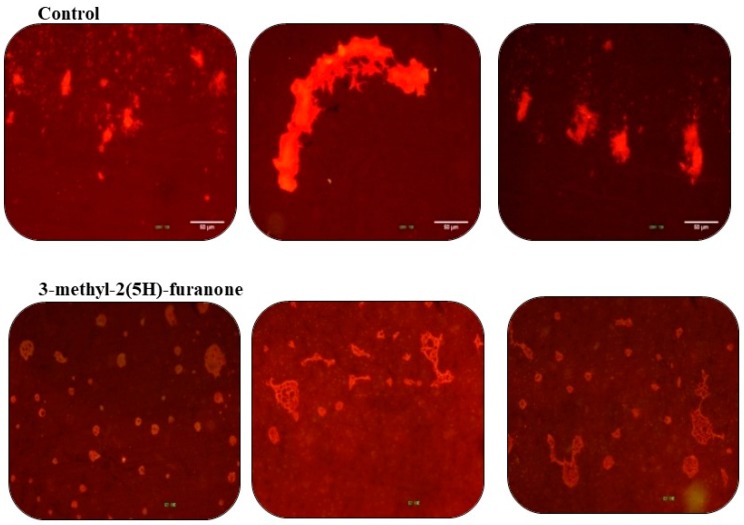
The biofilm of K. pneumoniae on coverslips. Upper: Biofilm formed for 30 h without treatment. Bottom: Biofilm formed under the effect of 3-methyl-2(5H)-furanone at 15 µg/mL. All biofilms were stained with acridine orange at 0.1% and observed with a fluorescence microscope with a blue filter.
Figure 9
Figure 9
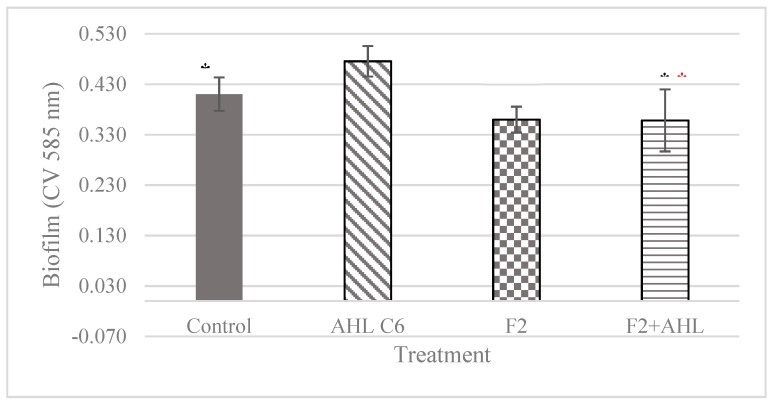
The neutralizing effect of C6-AHL autoinducer with 3-methyl-2(5H)-furanone (G2). The biofilm was formed for 30 h at 37 °C with the addition of the compounds from the beginning of the assay. The biofilm was quantified by staining with violet crystal. The black asterisks indicate statistically significant difference to the control, whereas the red asterisks indicate statistically significant difference as compared to C6-AHL.

References

    1. WHO . Global Antimicrobial Resistance Surveillance System (GLASS) Report: Early Implementation 2016–2017. World Health Organization; Geneva, Switzerland: 2017.
    1. WHO . Antimicrobial Resistance. Global Report on Surveillance. WHO Library Cataloguing-in-Publication Data; Geneva, Switzerland: 2014.
    1. Maharjan G., Khadka P., Shilpakar G.S., Chapagain G., Dhungana G.R. Catheter-associated urinary tract infection and obstinate biofilm producers. Can. J. Infect. Dis. Med. Microbiol. 2018;2018:7. doi: 10.1155/2018/7624857. - DOI - PMC - PubMed
    1. Blázquez J., Rodríguez-Beltrán J., Matic I. Antibiotic-induced genetic variation: how it arises and how it can be prevented. Ann Rev Microbiol. 2018;72:209–230. doi: 10.1146/annurev-micro-090817-062139. - DOI - PubMed
    1. Cadavid E., Robledo S., Quiñones W., Echeverri F. Induction of biofilm formation in Klebsiella pneumoniae ATCC 13884 by several drugs: the possible role of quorum sensing modulation. Antibiotics. 2018;7:103. doi: 10.3390/antibiotics7040103. - DOI - PMC - PubMed

Publication types

MeSH terms

LinkOut - more resources