


Eicosapentaenoic acid/arachidonic acid ratio and weight loss during hospitalization for glycemic control among overweight Japanese patients with type 2 diabetes: a retrospective observational study
- PMID: 30704490
- PMCID: PMC6357375
- DOI: 10.1186/s12944-019-0983-x
Eicosapentaenoic acid/arachidonic acid ratio and weight loss during hospitalization for glycemic control among overweight Japanese patients with type 2 diabetes: a retrospective observational study
Abstract
Background: The study aimed to examine the relationship between levels of serum eicosapentaenoic acid (EPA), arachidonic acid (AA), as well as EPA/AA ratio and weight loss during hospitalization in participants considered to be overweight, with type 2 diabetes.
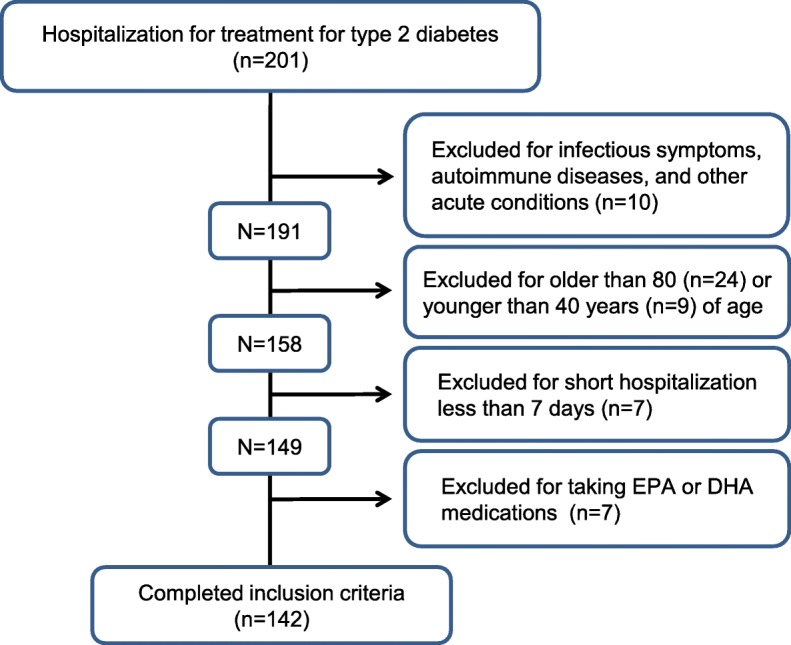
Methods: The study participants included 142 patients who were hospitalized for treatment of type 2 diabetes. We divided the participants into two groups depending on the achievenemt in reduction of bodyweight 3% or more during hospitalization and examined the relationship between serum levels of EPA and AA, as well as ratio of EPA/AA on admission and effectiveness of weight loss under strict dietary therapy during hospitalization, using Cox proportional hazard models.
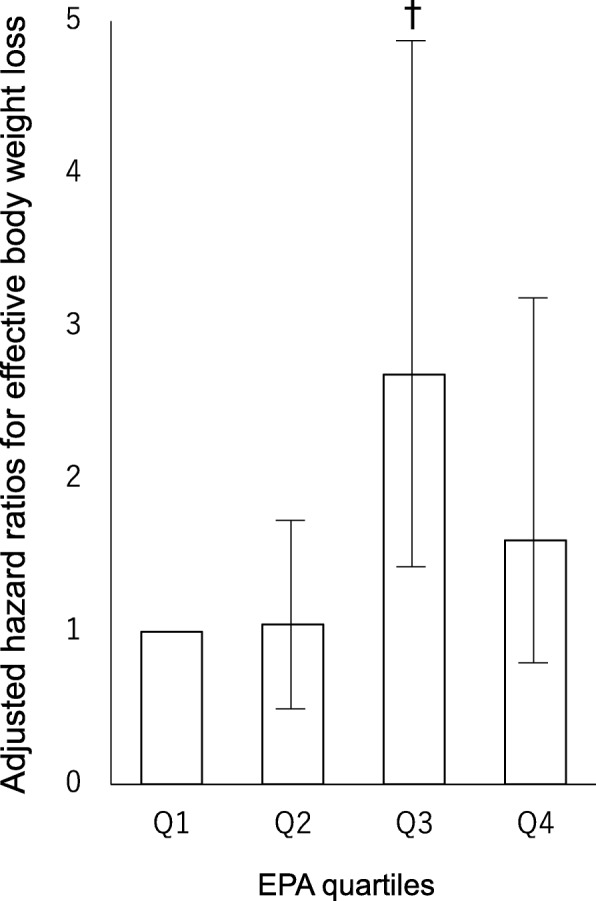
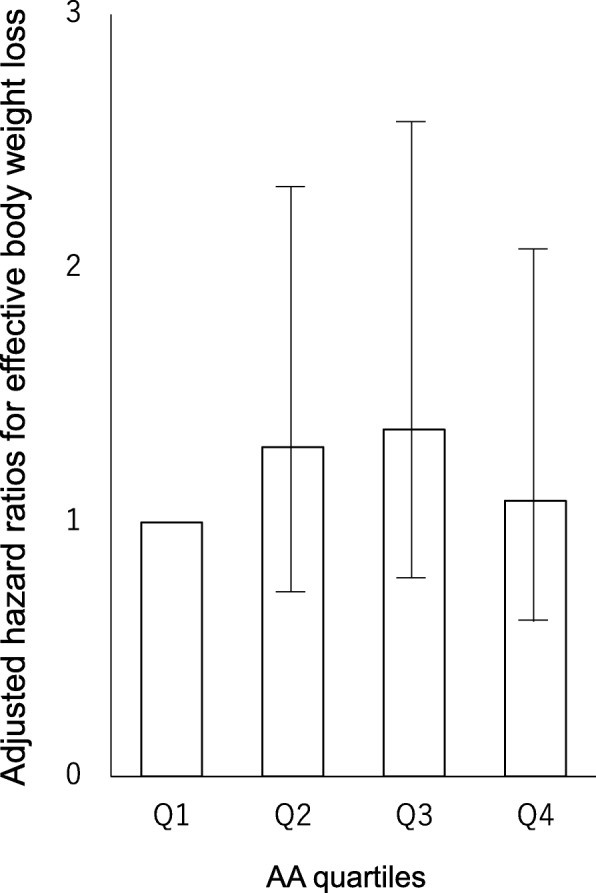
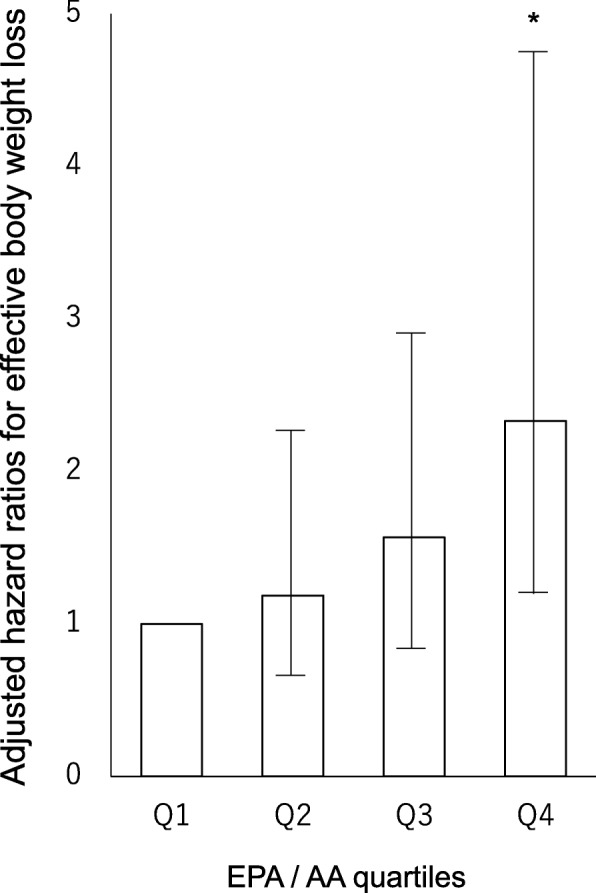
Results: After adjustment was made for several confounders, the hazard ratio of effective weight loss for logarithmical serum EPA was 1.59 (95% CI 1.02-2.49, P = 0.04) and for logarithmical EPA/AA ratio 1.64 (1.03-2.61, P = 0.04), whereas the hazard ratio for effective weight loss for logarithmical serum AA was 1.11 (0.45-2.78, P = 0.82). In addition, after dividing EPA/AA ratio and serum EPA into quartiles based on participant number, the hazard ratio for the highest quartile of EPA/AA ratio was 2.33 (1.14-4.77, P = 0.02), and for the highest quartile of serum EPA 1.60 (0.80-3.19, P = 0.18) compared with the lowest quartile.
Conclusion: These results suggest the possibility that EPA is involved in bodyweight change under a caloric-restriction regimen. In addition, EPA/AA ratio was found to be a better predictor of medical intervention for weight loss among overweight patients with type 2 diabetes, compared with serum EPA level.
Keywords: Arachidonic acid; Body weight loss; Eicosapentaenoic acid; Type 2 diabetes.
Conflict of interest statement
Competing interest
Hideaki Kaneto has received honoraria for lectures and received scholarship grants from Sanofi, Novo Nordisk, Eli Lilly, Boehringer Ingelheim, Taisho Toyama Pharma, MSD, Takeda, Ono Pharma, Daiichi Sankyo, Sumitomo Dainippon Pharma, Mitsubishi Tanabe Pharma, Kissei Pharma, Astellas, Novartis, Kowa, Chugai, the Japan Foundation for Applied Enzymology, and A2 Healthcare. Kohei Kaku has been an advisor to, received honoraria for lectures from, and received scholarship grants from Novo Nordisk Pharma, Sanwa Kagaku Kenkyusho, Takeda, Taisho Pharmaceutical Co., MSD, Taisho Toyama Pharma., Astellas, Kissei Pharma., Mitsubishi Tanabe Pharma. Co., Ono Pharma. Co., Sumitomo Dainippon Pharma, Novartis, Mitsubishi Tanabe Pharma, AstraZeneca, Nippon Boehringer Ingelheim Co., Fujifilm Pharma Co., and Sanofi. M.S. and S.N. have received honoraria for lectures from AstraZeneca and Sanofi, respectively.
Ethics approval and consent to participate
The hospital ethics committee approved the study protocol, and information on the study was provided to the public via the Internet, in place of obtaining informed consent from each patient (No. 3115).
Consent for publication
Not applicable.
Publisher’s Note
Springer Nature remains neutral with regard to jurisdictional claims in published maps and institutional affiliations.
Figures
References
-
- Lean ME, Leslie WS, Barnes AC, Brosnahan N, Thom G, McCombie L, Peters C, Zhyzhneuskaya S, Al-Mrabeh A, Hollingsworth KG, Rodrigues AM, Rehackova L, Adamson AJ, Sniehotta FF, Mathers JC, Ross HM, McIlvenna Y, Stefanetti R, Trenell M, Welsh P, Kean S, Ford I, McConnachie A, Sattar N, Taylor R. Primary care-led weight management for remission of type 2 diabetes (DIRECT): an open-label, cluster-randomised trial. Lancet. 2018;391(10):541–551. doi: 10.1016/S0140-6736(17)33102-1. - DOI - PubMed
-
- American College of Cardiology/American Heart Association Task Force on Practice Guidelines Obesity Society. 2013 AHA/ACC/TOS guideline for the management of overweight and obesity in adults: a report of the American College of Cardiology/American Heart Association task force on practice guidelines and the Obesity Society. Circulation. 2014;129(Suppl 2):S102–S138. - PMC - PubMed
-
- Muramoto A, Matsushita M, Kato A, Yamamoto N, Koike G, Nakamura M, Numata T, Tamakoshi A, Tsushita K. Three percent weight reduction is the minimum requirement to improve health hazards in obese and overweight people in Japan. Obes Res Clin Pract. 2014;8(5):e466–e475. doi: 10.1016/j.orcp.2013.10.003. - DOI - PubMed
Publication types
MeSH terms
Substances
LinkOut - more resources
Full Text Sources
Medical
Research Materials
