


Phylogeography of HIV-1 suggests that Ugandan fishing communities are a sink for, not a source of, virus from general populations
- PMID: 30705307
- PMCID: PMC6355892
- DOI: 10.1038/s41598-018-37458-x
Phylogeography of HIV-1 suggests that Ugandan fishing communities are a sink for, not a source of, virus from general populations
Abstract
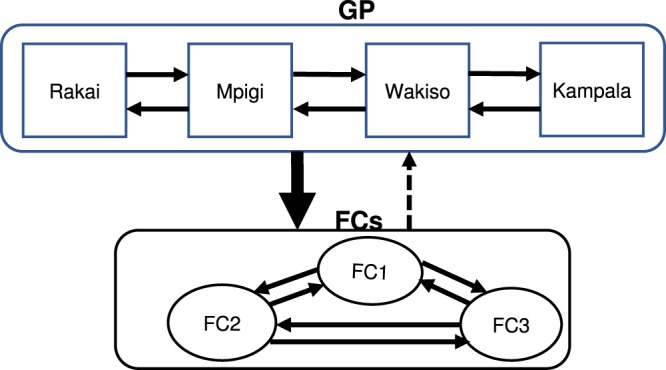
Although fishing communities (FCs) in Uganda are disproportionately affected by HIV-1 relative to the general population (GP), the transmission dynamics are not completely understood. We earlier found most HIV-1 transmissions to occur within FCs of Lake Victoria. Here, we test the hypothesis that HIV-1 transmission in FCs is isolated from networks in the GP. We used phylogeography to reconstruct the geospatial viral migration patterns in 8 FCs and 2 GP cohorts and a Bayesian phylogenetic inference in BEAST v1.8.4 to analyse the temporal dynamics of HIV-1 transmission. Subtype A1 (pol region) was most prevalent in the FCs (115, 45.1%) and GP (177, 50.4%). More recent HIV transmission pairs from FCs were found at a genetic distance (GD) <1.5% than in the GP (Fisher's exact test, p = 0.001). The mean time depth for pairs was shorter in FCs (5 months) than in the GP (4 years). Phylogeographic analysis showed strong support for viral migration from the GP to FCs without evidence of substantial viral dissemination to the GP. This suggests that FCs are a sink for, not a source of, virus strains from the GP. Targeted interventions in FCs should be extended to include the neighbouring GP for effective epidemic control.
Conflict of interest statement
The authors declare no competing interests.
Figures
References
-
- Uganda AIDS Commission and Ministry of Health. Multi-sectoral HIV programming for MARPS in Uganda: review of profiles, sizes and programme coverage: study review report (2014).
-
- Gopalappa, C. Model-based Estimation of Sources of New Infections in Uganda. HIV Modes of Transmission Synthesis. Uganda AIDS Commission (2014).
Publication types
MeSH terms
Grants and funding
LinkOut - more resources
Full Text Sources
Medical
Molecular Biology Databases
