


The pleasantness of sensory dissonance is mediated by musical style and expertise
- PMID: 30705379
- PMCID: PMC6355932
- DOI: 10.1038/s41598-018-35873-8
The pleasantness of sensory dissonance is mediated by musical style and expertise
Erratum in
-
Author Correction: The pleasantness of sensory dissonance is mediated by musical style and expertise.Sci Rep. 2019 Jun 18;9(1):9045. doi: 10.1038/s41598-019-44427-5. Sci Rep. 2019. PMID: 31209231 Free PMC article.
Abstract
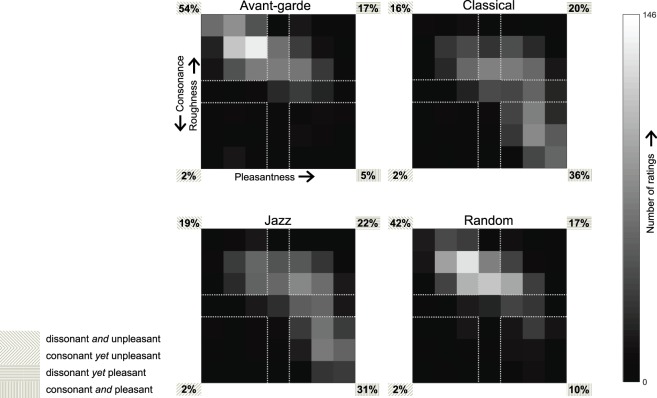
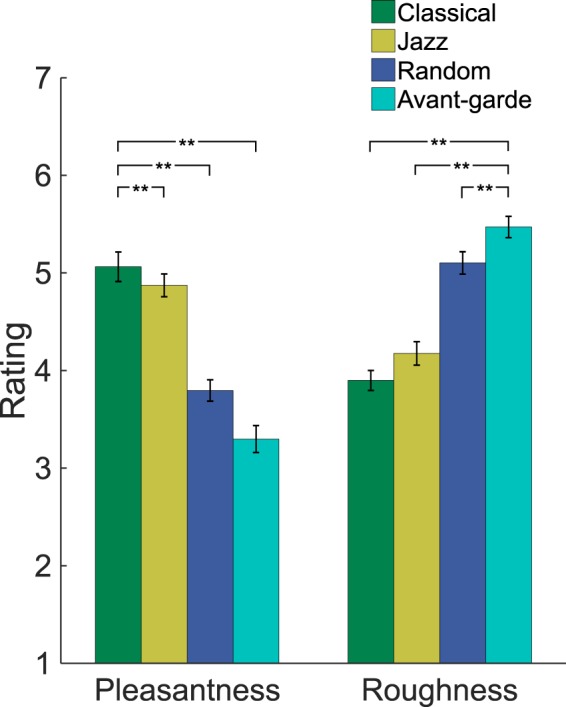
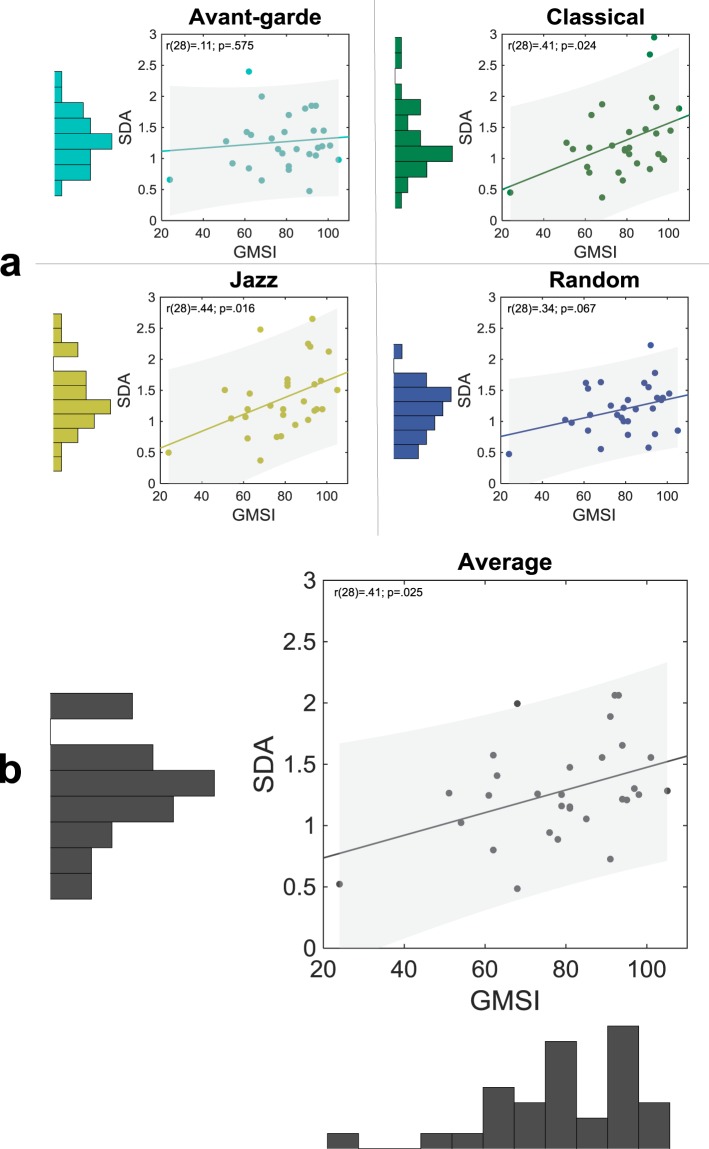
Western musical styles use a large variety of chords and vertical sonorities. Based on objective acoustical properties, chords can be situated on a dissonant-consonant continuum. While this might to some extent converge with the unpleasant-pleasant continuum, subjective liking might diverge for various chord forms from music across different styles. Our study aimed to investigate how well appraisals of the roughness and pleasantness dimensions of isolated chords taken from real-world music are predicted by Parncutt's established model of sensory dissonance. Furthermore, we related these subjective ratings to style of origin and acoustical features of the chords as well as musical sophistication of the raters. Ratings were obtained for chords deemed representative of the harmonic language of three different musical styles (classical, jazz and avant-garde music), plus randomly generated chords. Results indicate that pleasantness and roughness ratings were, on average, mirror opposites; however, their relative distribution differed greatly across styles, reflecting different underlying aesthetic ideals. Parncutt's model only weakly predicted ratings for all but Classical chords, suggesting that listeners' appraisal of the dissonance and pleasantness of chords bears not only on stimulus-side but also on listener-side factors. Indeed, we found that levels of musical sophistication negatively predicted listeners' tendency to rate the consonance and pleasantness of any one chord as coupled measures, suggesting that musical education and expertise may serve to individuate how these musical dimensions are apprehended.
Conflict of interest statement
The authors declare no competing interests.
Figures
References
-
- Aldwell, E., Schachter, C. & Cadwallader, A. Harmony and Voice Leading. (Cengage Learning, 2010).
-
- Gauldin, R. Harmonic Practice in Tonal Music. (W. W. Norton, Incorporated, 2000).
-
- Green, B. & Butler, D. From acoustics to Tonpsychologie. In The Cambridge History of Western Music Theory. (ed. Christensen, T.) 246–271, 10.1017/CHOL9780521623711.011 (Cambridge University Press, 2002).
-
- Nolan, C. Music theory and mathematics. In The Cambridge History of Western Music Theory. (ed. Christensen, T.)272–304, 10.1017/CHOL9780521623711.012 (Cambridge University Press, 2002).
-
- Macy, L. W. Grove Music Online. (Oxford Music Online 2003).
Publication types
MeSH terms
LinkOut - more resources
Full Text Sources
