Review
. 2019 Jan 18:8:F1000 Faculty Rev-72.
doi: 10.12688/f1000research.16793.1. eCollection 2019.

Recent advances in understanding intestinal stem cell regulation

Affiliations
Review

Recent advances in understanding intestinal stem cell regulation

Deqing Hu et al. F1000Res. .

Abstract

Intestinal homeostasis and regeneration are driven by intestinal stem cells (ISCs) lying in the crypt. In addition to the actively cycling ISCs that maintain daily homeostasis, accumulating evidence supports the existence of other pools of stem/progenitor cells with the capacity to repair damaged tissue and facilitate rapid restoration of intestinal integrity after injuries. Appropriate control of ISCs and other populations of intestinal epithelial cells with stem cell activity is essential for intestinal homeostasis and regeneration while their deregulation is implicated in colorectal tumorigenesis. In this review, we will summarize the recent findings about ISC identity and cellular plasticity in intestine, discuss regulatory mechanisms that control ISCs for intestinal homeostasis and regeneration, and put a particular emphasis on extrinsic niche-derived signaling and intrinsic epigenetic regulation. Moreover, we highlight several fundamental questions about the precise mechanisms conferring robust capacity for intestine to maintain physiological homeostasis and repair injuries.

Keywords: Epigenetics; Homeostasis; Intestinal stem cell; Nich; Plasticity; Regeneration.


Conflict of interest statement

No competing interests were disclosed.No competing interests were disclosed.No competing interests were disclosed.No competing interests were disclosed.

Figures
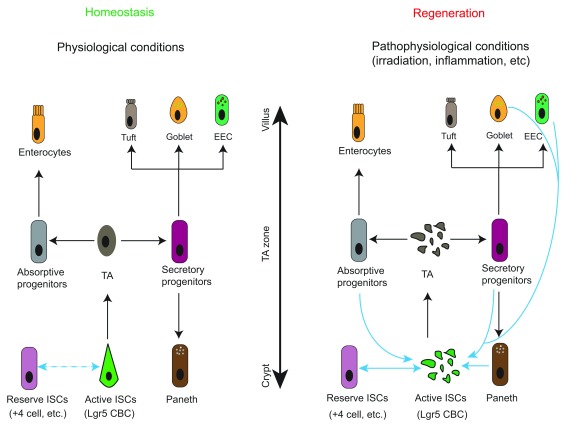
Figure 1.
Figure 1.. Hierarchy and plasticity of intestinal stem cells (ISCs).
Under homeostatic conditions, active ISCs such as Lgr5 crypt base columnar cells (CBCs) migrate upwards to become transit-amplifying (TA) cells in the TA zone. TA cells divide rapidly and specify into either absorptive or secretory progenitors. Absorptive progenitors further differentiate into large quantities of enterocytes, while secretory progenitors commit to the Paneth, goblet, enteroendocrine (EEC), or goblet cells. Interconversion between reserve ISCs and active ISCs occurs occasionally in this setting (demonstrated by double-headed dash line). In response to radio- or chemo-therapies, the highly proliferative Lgr5 CBCs and TA cells are ablated. Reserve ISCs enter the cell cycle to replenish CBCs for subsequent regenerative process. Plasticity of differentiated progenies, including secretory and absorptive progenitors as well as terminally differentiated EEC and Paneth cells, has been observed when CBCs are damaged. These cells can revert to active ISCs and give rise to all intestinal cell types. However, whether they can bypass CBCs to transdifferentiate directly into other intestinal lineages and their functional importance to intestinal regeneration upon injuries remain to be determined.
Figure 2.
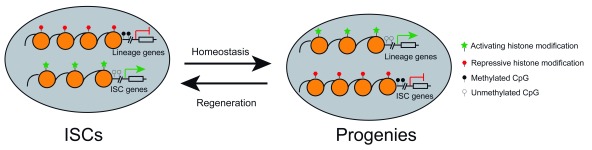
Figure 2.. Epigenetic reprogramming for intestinal homeostasis and regeneration.
During homeostasis, intestinal stem cells (ISCs) adopt a unique epigenetic signature and chromatin accessibility that collaboratively lead to expression of ISC-related genes and shutdown of lineage-specific factors. Lineage specification of ISCs is accompanied by epigenetic remodeling and chromatin accessibility changes that turn off ISCs genes while activating lineage-restricted genes. During the regenerative process, epigenetic landscape and chromatin accessibility are reconfigured to resemble ISCs during dedifferentiation of ISC progenies.

References

    1. Beumer J, Clevers H: Regulation and plasticity of intestinal stem cells during homeostasis and regeneration. Development. 2016;143(20):3639–49. 10.1242/dev.133132 - DOI - PubMed
    2. F1000 Recommendation

    1. Clevers H: The intestinal crypt, a prototype stem cell compartment. Cell. 2013;154(2):274–84. 10.1016/j.cell.2013.07.004 - DOI - PubMed
    1. Li L, Clevers H: Coexistence of quiescent and active adult stem cells in mammals. Science. 2010;327(5965):542–5. 10.1126/science.1180794 - DOI - PMC - PubMed
    1. Barker N, van de Wetering M, Clevers H: The intestinal stem cell. Genes Dev. 2008;22(14):1856–64. 10.1101/gad.1674008 - DOI - PMC - PubMed
    1. Yousefi M, Li L, Lengner CJ: Hierarchy and Plasticity in the Intestinal Stem Cell Compartment. Trends Cell Biol. 2017;27(10):753–64. 10.1016/j.tcb.2017.06.006 - DOI - PMC - PubMed

Publication types