. 2019 Feb 1;15(2):e1007375.
doi: 10.1371/journal.ppat.1007375. eCollection 2019 Feb.

An anti-Gn glycoprotein antibody from a convalescent patient potently inhibits the infection of severe fever with thrombocytopenia syndrome virus

Affiliations

An anti-Gn glycoprotein antibody from a convalescent patient potently inhibits the infection of severe fever with thrombocytopenia syndrome virus

Ki Hyun Kim et al. PLoS Pathog. .

Abstract

Severe fever with thrombocytopenia syndrome (SFTS) is an emerging infectious disease localized to China, Japan, and Korea that is characterized by severe hemorrhage and a high fatality rate. Currently, no specific vaccine or treatment has been approved for this disease. To develop a therapeutic agent for SFTS, we isolated antibodies from a phage-displayed antibody library that was constructed from a patient who recovered from SFTS virus (SFTSV) infection. One antibody, designated as Ab10, was reactive to the Gn envelope glycoprotein of SFTSV and protected host cells and A129 mice from infection in both in vitro and in vivo experiments. Notably, Ab10 protected 80% of mice, even when injected 5 days after inoculation with a lethal dose of SFTSV. Using cross-linker assisted mass spectrometry and alanine scanning, we located the non-linear epitope of Ab10 on the Gn glycoprotein domain II and an unstructured stem region, suggesting that Ab10 may inhibit a conformational alteration that is critical for cell membrane fusion between the virus and host cell. Ab10 reacted to recombinant Gn glycoprotein in Gangwon/Korea/2012, HB28, and SD4 strains. Additionally, based on its epitope, we predict that Ab10 binds the Gn glycoprotein in 247 of 272 SFTSV isolates previously reported. Together, these data suggest that Ab10 has potential to be developed into a therapeutic agent that could protect against more than 90% of reported SFTSV isolates.


Conflict of interest statement

K. H. Kim, H. Kim, S. Kim, J. Kim, J. Chung, W. B. Park and M.D. Oh hold a patent based on these findings (PCT/KR2017/003156).

Figures
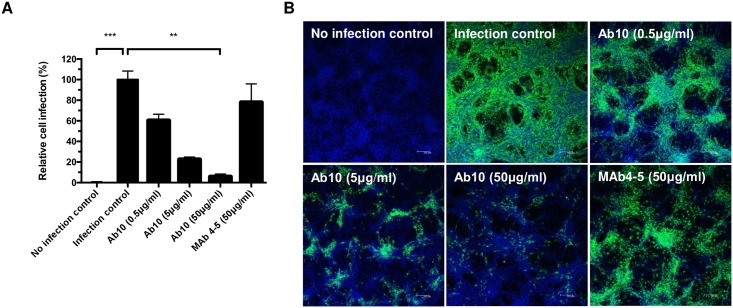
Fig 1
Fig 1. Ab10 has in vitro neutralizing activity against severe fever with thrombocytopenia syndrome virus (SFTSV).
To measure neutralizing efficacy, Ab10 scFv-Fc fusion protein was mixed with 100 TCID50 of SFTSV (strain: Gangwon/Korea/2012) and added to Vero cells. After incubation for 1 h, the cells were washed and cultured for 2 days. Then, the Gn glycoprotein produced in infected Vero cells was detected in an immunofluorescence assay using anti-SFTSV Gn glycoprotein antibody, which did not compete with Ab10 in its binding, with at least five technical replicates. The fluorescence signal intensity of stained SFTSV Gn glycoprotein was used as a quantitative indicator for viral infection. (A) The proportion of infected cells compared to non-treated cells was defined as relative cell infection (%) and was plotted. Mab4-5 scFv-Fc fusion protein was also treated in a parallel experiment. Error bars represent standard deviations (s.d.), asterisks indicate a statistically significant difference as determined by a nonparametric Friedman test with a post hoc Dunn’s multiple comparison test (* P ≤ 0.05, ** P ≤ 0.01, *** P ≤ 0.001, **** P ≤ 0.0001). (B) Representative images of each treatment group are shown (scale bar, 100 μm). SFTSV Gn glycoprotein and nuclei were stained with FITC (green) and DAPI (blue), respectively.
Fig 2
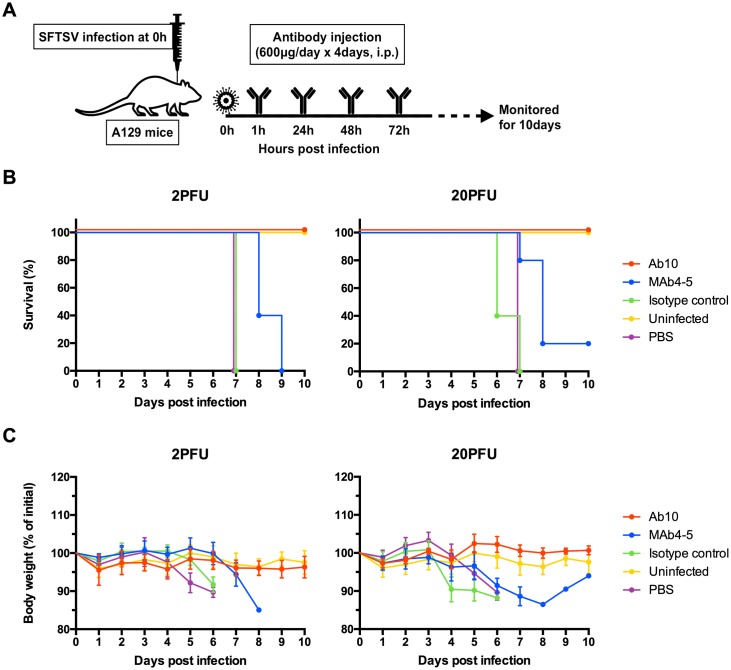
Fig 2. Ab10 protected mice from SFTSV infection.
The overall scheme for the administration of virus and antibody is described in (A). Eight-week-old A129 mice (n = 5 per group) were inoculated with 2 or 20 PFU of SFTSV through a subcutaneous route. At 1, 24, 48, and 72 h post-infection, infected mice were intraperitoneally administered with 600 μg of Ab10, MAb4-5, IgG1 isotype control antibody, or PBS vehicle control. Percentages of survival (B) and body weight relative to the day of virus inoculation (C) were monitored daily until 10 days post-infection. Survival was determined by the Kaplan-Meier method. Relative body weight values in (C) are presented as the means with standard deviations of surviving mice in each group.
Fig 3
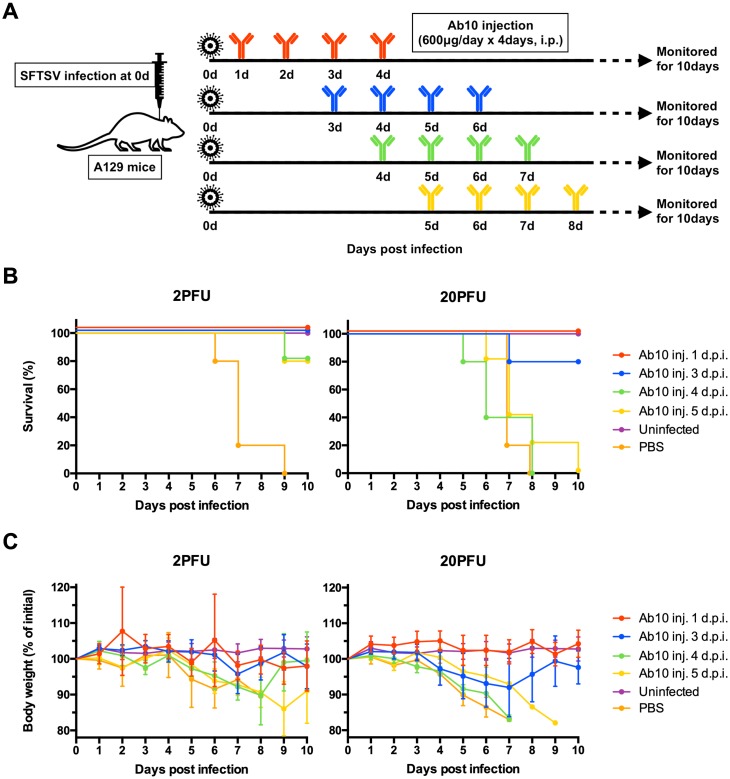
Fig 3. Delayed administration of Ab10 also protected mice from SFTSV infection up to 3 days after inoculation of the virus.
The overall scheme for the virus challenge and delayed antibody administration is described in (A). Eight-week-old A129 mice (n = 5 per group) were inoculated with 2 or 20 PFU of SFTSV through a subcutaneous route. From 1, 3, 4, or 5 days post-infection, infected mice were intraperitoneally administered with 600 μg of Ab10 per day for 4 consecutive days. Percentages of survival (B) and weight relative to the day of virus inoculation (C) were monitored daily until 10 days post-infection. Survival was determined by the Kaplan-Meier method. The values in (C) are presented as the means with standard deviations of surviving mice in each group.
Fig 4
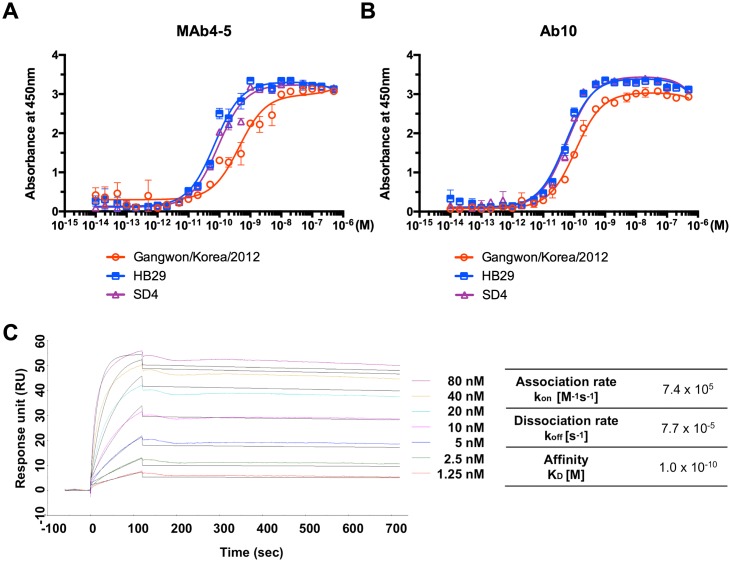
Fig 4. Ab10 also bound to Gn glycoprotein of HB29 and SD4 strains with comparable affinity to that of Gangwon/Korea 2012.
Binding properties of human IgG1 monoclonal antibody Ab10 (A) and MAb4-5 (B) to the recombinant Gn glycoprotein ectodomain of Gangwon/Korea 2012, HB29, and SD4 strains were measured by enzyme-linked immunosorbent assay (ELISA). Non-linear regression curves were fitted to a one site specific saturation binding model and the mean absorbance at 450 nm with standard deviation (s.d.) error bars are shown at each antibody concentration. (C) Surface plasmon analysis of Ab10 antibody was performed on the CM5 chip with an immobilized anti-histidine antibody binding to a poly-histidine tagged SFTSV Gn ectodomain. The experimental data at concentrations of 80, 40, 20, 10, 5, 2.5, and 1.25 nM Ab10 antibody are shown in color, and the fitted curves are shown in black. Calculated rate constants are shown in the table.
Fig 5
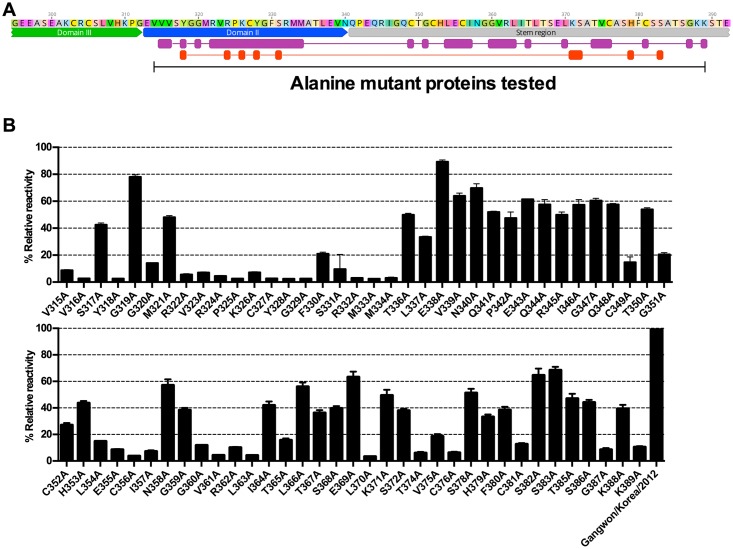
Fig 5. The epitope of Ab10 was determined by alanine mutant analysis.
The conformational epitope of Ab10 antibody on the Gn glycoprotein ectodomain was determined by measuring antibody binding activity to recombinant mutant proteins with amino acid residues that were substituted with alanine at residues corresponding to 315–389. (A) Epitopes predicted by cross-linker assisted mass spectrometry are shown in red, and alanine substituted residues that affected Ab10 antibody binding are shown in purple. The overlapping domain II (blue annotation) and region upstream of the stem region (gray annotation) are also indicated. (B) The reactivity of Ab10 to each alanine mutant is represented as relative reactivity, which was calculated using absorbance values (Abs) as follows: % Relative reactivity = [100 × {(Abs of mutant captured by Ab10) / (Abs of mutant captured by HA antibody)} / {(Abs of wildtype captured by Ab10) / (Abs of wildtype captured by HA antibody)}]. Bars indicate the mean and standard deviation (s.d.).

References

    1. Yu X-J, Liang M-F, Zhang S-Y, Liu Y, Li J-D, Sun Y-L, et al. Fever with Thrombocytopenia Associated with a Novel Bunyavirus in China. N Engl J Med. 2011;364: 1523–1532. 10.1056/NEJMoa1010095 - DOI - PMC - PubMed
    1. Sun J, Lu L, Wu H, Yang J, Ren J, Liu Q. The changing epidemiological characteristics of severe fever with thrombocytopenia syndrome in China, 2011–2016. Sci Rep. 2017;7: 9236 10.1038/s41598-017-08042-6 - DOI - PMC - PubMed
    1. Kim K-H, Yi J, Kim G, Choi SJ, Jun KI, Kim N-H, et al. Severe fever with thrombocytopenia syndrome, South Korea, 2012. Emerging Infect Dis. 2013;19: 1892–1894. 10.3201/eid1911.130792 - DOI - PMC - PubMed
    1. Takahashi T, Maeda K, Suzuki T, Ishido A, Shigeoka T, Tominaga T, et al. The first identification and retrospective study of Severe Fever with Thrombocytopenia Syndrome in Japan. J Infect Dis. Oxford University Press; 2014;209: 816–827. 10.1093/infdis/jit603 - DOI - PMC - PubMed
    1. Korea Centers for Disease Control and Prevention. Disease information (Severe Fever with Thrombocytopenia Syndrome, SFTS). In: cdc.go.kr [Internet]. 9 Feb 2018 [cited 22 Jun 2018]. http://www.cdc.go.kr/CDC/health/CdcKrHealth0101.jsp?menuIds=HOME001-MNU1...

Publication types

MeSH terms

Supplementary concepts