


Polymer nanodiscs: Advantages and limitations
- PMID: 30707909
- PMCID: PMC6497063
- DOI: 10.1016/j.chemphyslip.2019.01.010
Polymer nanodiscs: Advantages and limitations
Abstract
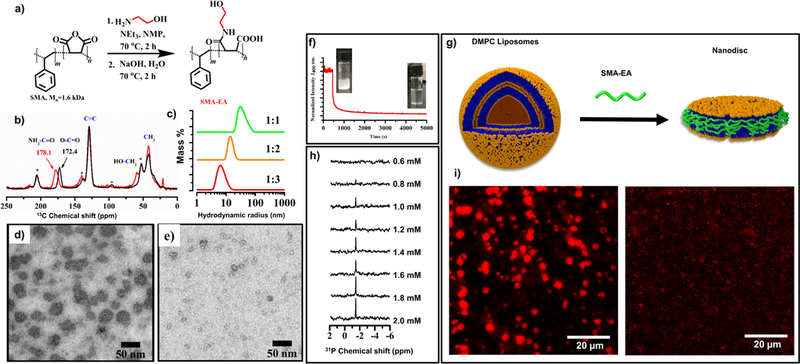
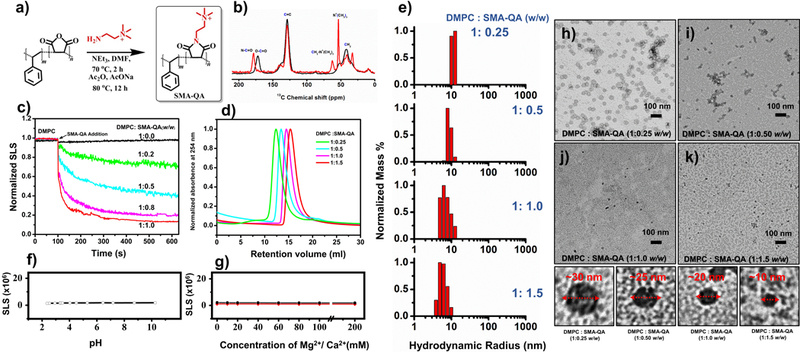
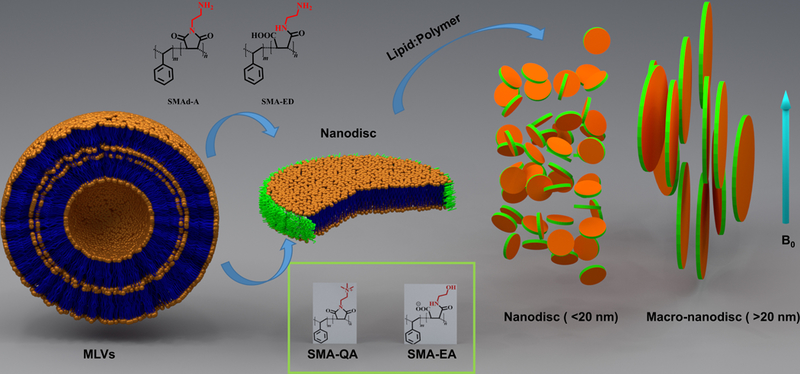
There is considerable interest in the development of membrane mimetics to study the structure, dynamics and function of membrane proteins. Polymer nanodiscs have been useful as a membrane mimetic by not only providing a native-like membrane environment, but also have the ability to extract the desired membrane protein directly from the cell membrane. In spite of such great potential, polymer nanodiscs have their disadvantages including lack of size control and instability at low pH and with divalent metals. In this review, we discuss how these limitations have been overcome by simple modifications of synthetic polymers commonly used to form nanodiscs. Recently, size control has been achieved using an ethanolamine functionalization of a low molecular weight polymer. This size control enabled the use of polymer-based lipid-nanodiscs in solution NMR and macro-nanodiscs in solid-state NMR applications. The introduction of quaternary ammonium functional groups has been shown to improve the stability in the presence of low pH and divalent metal ions, forming highly monodispersed nanodiscs. The polymer charge has been shown to play a significant role on the reconstitution of membrane proteins due to the high charge density on the nanodisc's belt. These recent developments have expanded the applications of polymer nanodiscs to study the membrane proteins using wide variety of techniques including NMR, Cryo-EM and other biophysical techniques.
Keywords: Membrane proteins; Polymer charge; Polymer nanodiscs; Size control; Solid-state NMR; pH resistant.
Copyright © 2019 Elsevier B.V. All rights reserved.
Figures
References
-
- Barniol-Xicota M, Verhelst SHL, 2018. Stable and Functional Rhomboid Proteases in Lipid Nanodiscs by Using Diisobutylene/Maleic Acid Copolymers. J Am Chem Soc 140, 14557–14561. - PubMed
-
- Bordier C, 1981. Phase separation of integral membrane proteins in Triton X-114 solution. J Biol Chem 256, 1604–1607. - PubMed
-
- Craig AF, Clark EE, Sahu ID, Zhang R, Frantz ND, Al-Abdul-Wahid MS, Dabney-Smith C, Konkolewicz D, Lorigan GA, 2016. Tuning the size of styrene-maleic acid copolymer-lipid nanoparticles (SMALPs) using RAFT polymerization for biophysical studies. Biochim Biophys Acta 1858,2931–2939. - PubMed
Publication types
MeSH terms
Substances
Grants and funding
LinkOut - more resources
Full Text Sources
