


Differential reporting of fruit and vegetable intake among youth in a randomized controlled trial of a behavioral nutrition intervention
- PMID: 30709403
- PMCID: PMC6359852
- DOI: 10.1186/s12966-019-0774-9
Differential reporting of fruit and vegetable intake among youth in a randomized controlled trial of a behavioral nutrition intervention
Abstract
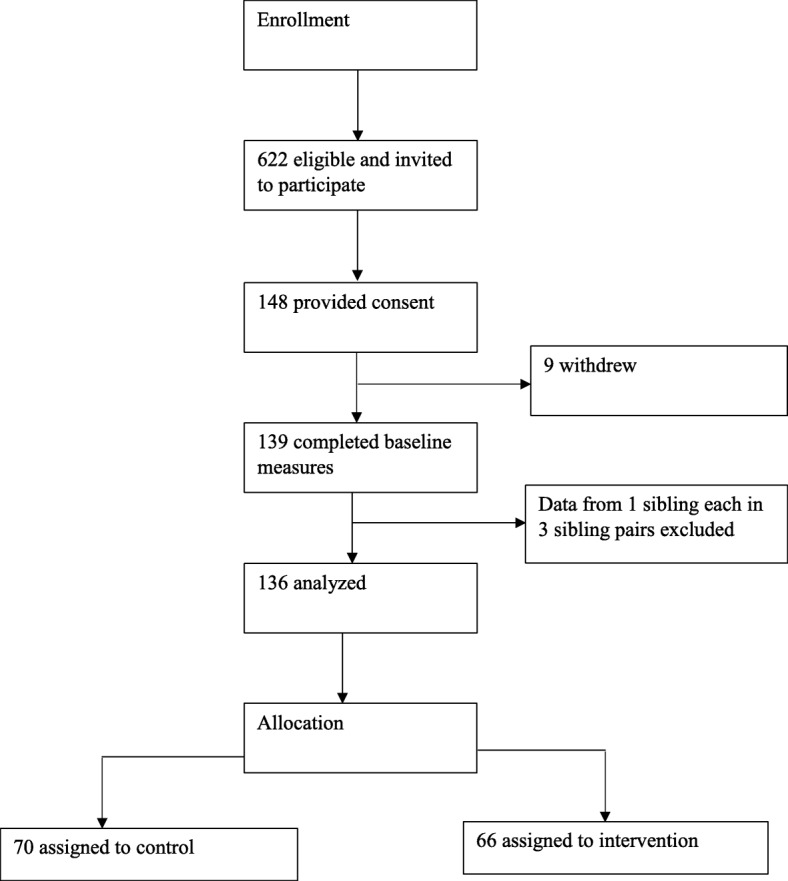
Background: Nutrition interventions typically rely on self-reported intake that may be susceptible to differential reporting bias due to exposure to the intervention. Such differences may result from increased social desirability, increased attention to eating or improved recall accuracy, and may bias estimates of the intervention effect. This study investigated differential reporting bias of fruit and vegetable intake in youth with type 1 diabetes participating in a randomized controlled trial targeting increased whole plant food intake.
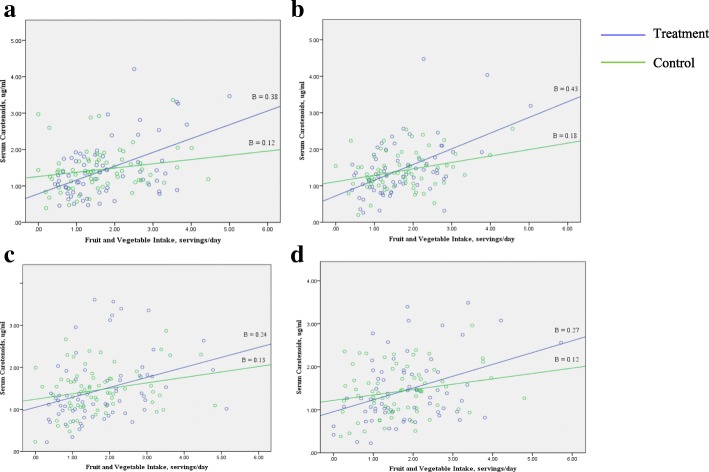
Methods: Participants (treatment n = 66, control n = 70) completed 3-day food records at baseline, 6-,12-, and 18-months, from which fruit and vegetable intake (servings/day) was calculated. Serum carotenoids were assessed at these visits using a high-performance liquid chromatography-based assay. Linear regression estimated associations of fruit and vegetable intake with serum carotenoids by treatment assignment. Multiplicative interaction terms tested the interaction of treatment assignment with fruit and vegetable intake on serum carotenoids for each visit and within each group over time.
Results: The association of fruit and vegetable intake with serum carotenoids was significantly lower in the control versus intervention group at baseline (β = 0.22 Vs 0.46) and 6-month visits (β = 0.37 Vs 0.54), as evidenced by significant interaction effects. However, the association of fruit and vegetable intake with serum carotenoids did not significantly differ over time for either group.
Conclusions: While the stronger association of fruit and vegetable with carotenoids in the treatment arm suggests greater reporting accuracy, this difference was evident at baseline, and did not change significantly over time in either group. Thus, results indicate greater subject-specific bias in the control arm compared to the treatment, and lack of evidence for reactivity to the intervention by treatment assignment.
Clinical trial registry number and website: NCT00999375.
Keywords: Carotenoids; Differential reporting bias; Fruit and vegetable intake; Randomized controlled trial; Type 1 diabetes.
Conflict of interest statement
Authors’ information
Namrata Sanjeevi is a Postdoctoral Fellow, Tonja Nansel and Aiyi Liu are Senior Investigators and Leah Lipsky is a Staff Scientist at
Ethics approval and consent to participate
Children and adolescents provided assent, while written informed consent was obtained from parents during enrollment. Youth turning 18 years of age during the study also provided written informed consent. The procedures were approved by the institutional review boards of the institutions participating in the study.
Consent for publication
Not applicable
Competing interests
The authors declare that they have no competing interests.
Publisher’s Note
Springer Nature remains neutral with regard to jurisdictional claims in published maps and institutional affiliations.
Figures
References
-
- Klesges LM, Baranowski T, Beech B, Cullen K, Murray DM, Rochon J, Pratt C. Social desirability bias in self-reported dietary, physical activity and weight concerns measures in 8- to 10-year-old African-American girls: results from the girls health enrichment multisite studies (GEMS) Prev Med. 2004;38(Suppl):S78–S87. doi: 10.1016/j.ypmed.2003.07.003. - DOI - PubMed
Publication types
MeSH terms
Substances
Associated data
Grants and funding
LinkOut - more resources
Full Text Sources
Medical
