. 2019 Jan;145(1):562.
doi: 10.1121/1.5087692.

How canaries listen to their song: Species-specific shape of auditory perception

Affiliations

How canaries listen to their song: Species-specific shape of auditory perception

Adam R Fishbein et al. J Acoust Soc Am. 2019 Jan.

Abstract

The melodic, rolling songs of canaries have entertained humans for centuries and have been studied for decades by researchers interested in vocal learning, but relatively little is known about how the birds listen to their songs. Here, it is investigated how discriminable the general acoustic features of conspecific songs are to canaries, and their discrimination abilities are compared with a small parrot species, the budgerigar. Past experiments have shown that female canaries are more sexually responsive to a particular song element-the "special" syllables-and consistent with those observations, it was found that special syllables are perceptually distinctive for canaries. It is also shown that canaries discriminate the subtle differences among syllables and phrases using spectral, envelope, and temporal fine structure cues. Yet, while canaries can hear these fine details of the acoustic structure of their song, the evidence overall suggests that they listen at a more global, phrase by phrase level, rather than an analytic, syllable by syllable level, except when attending to some features of special syllables. These results depict the species-specific shape of auditory perception in canaries and lay the groundwork for future studies examining how song perception changes seasonally and according to hormonal state.


Figures
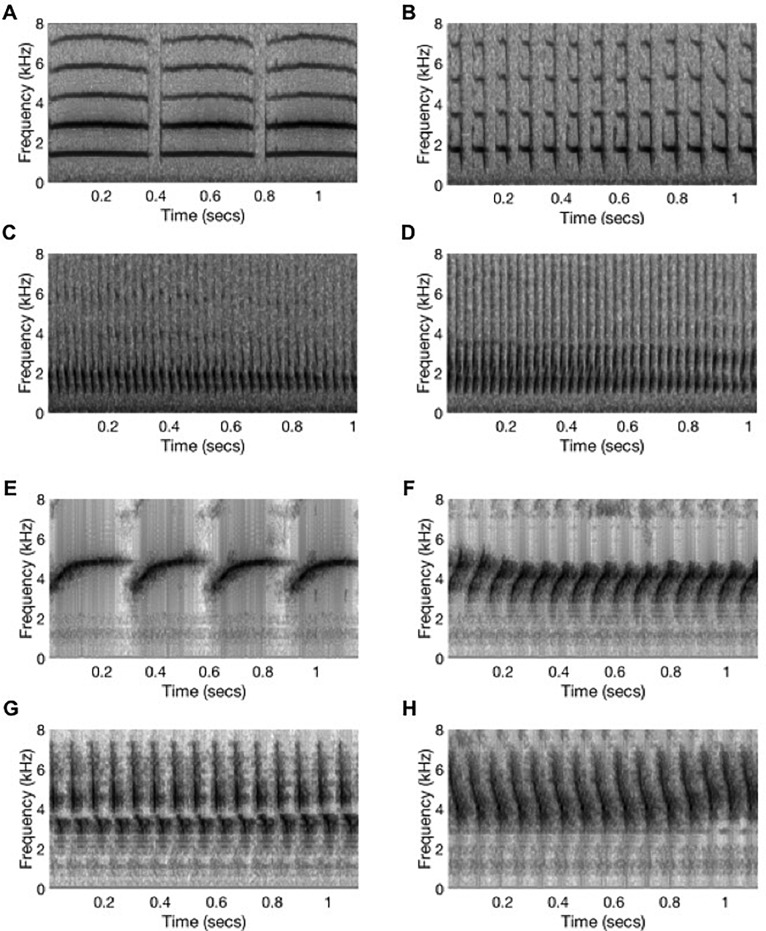
FIG. 1.
FIG. 1.
(a) Four song phrases from one male canary. Phrases C and D display characteristics of special syllables, while phrases A and B do not and are thus classified as non-special. Phrases A–D here are A1–A4 in MDS plots in Figs. 3 and 4. A syllable is a collection of notes (a note is a continuous trace on a spectrogram) and a phrase is a repetition of the same syllable type. (b) Four song phrases from another male canary. Phrases G and H display characteristics of special syllables, while phrases E and F do not and are thus classified as non-special. Phrases E–H here are B1–B4 in MDS plots in Figs. 3 and 4.
FIG. 2.
FIG. 2.
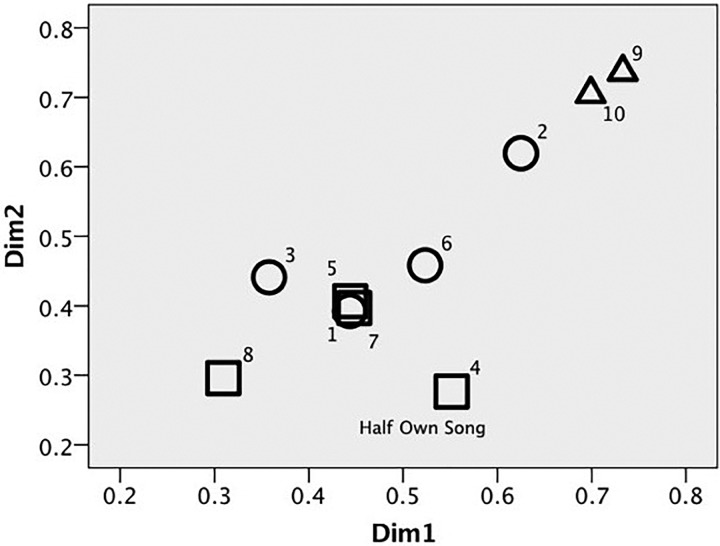
Subject weight plot for 2-D MDS solution for all birds. Triangles = Budgerigars, Circles = Female Canaries, Squares = Male Canaries. Half of the stimuli were from the song of bird 4 who was also a subject in the experiment.
FIG. 3.
FIG. 3.
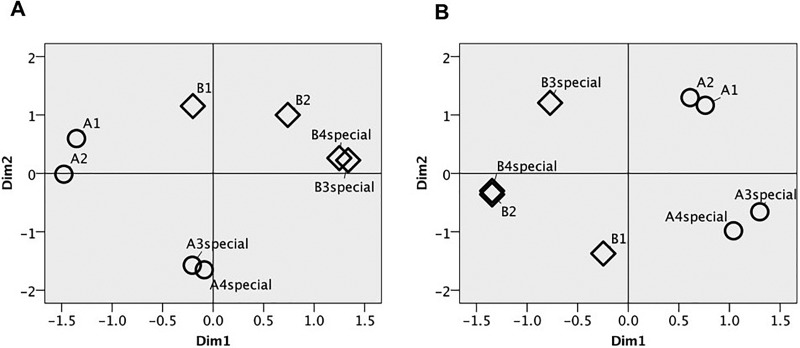
(a) Canary 2-D MDS solution. (b) Budgerigar 2-D MDS solution. Circles indicate phrases taken from recordings of bird A. Diamonds indicate phrases taken from recordings of bird B.
FIG. 4.
FIG. 4.
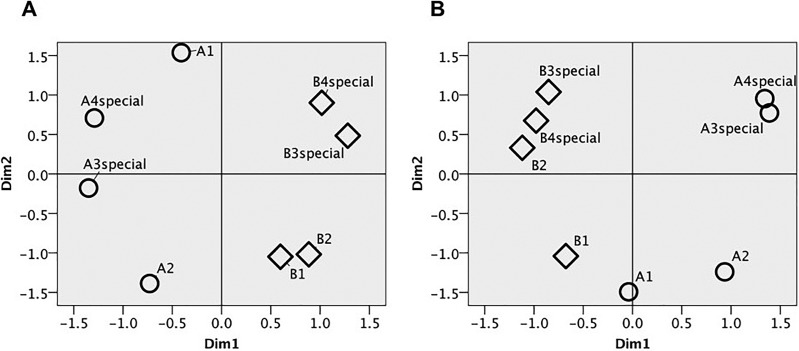
(a) Female canaries 2-D MDS solution. (b) Male canaries 2-D MDS solution. Circles indicate phrases taken from recordings of bird A. Diamonds indicate phrases taken from recordings of bird B.
FIG. 5.
FIG. 5.
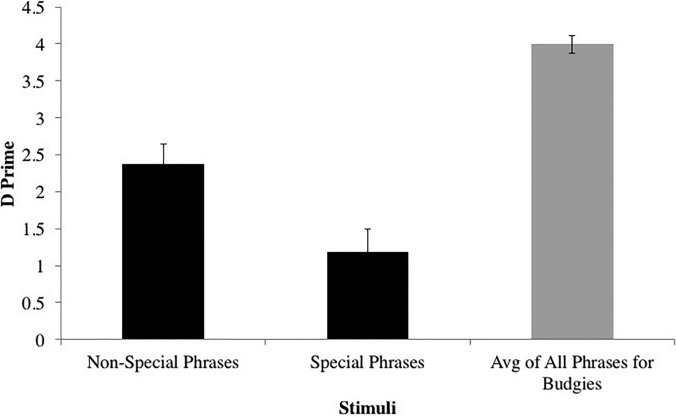
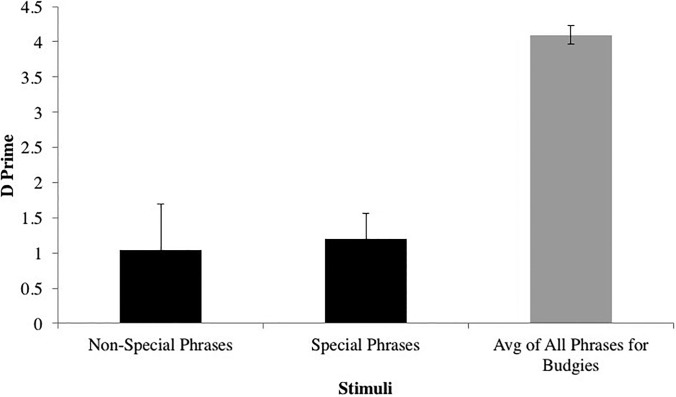
Canary perception of single syllables reversed at various locations in phrases. Black = Canaries, Gray = Budgerigars.
FIG. 6.
FIG. 6.
Canary perception of spectral-temporal syllable variation (synthetic target). Black = Canaries, Gray = Budgerigars.
FIG. 7.
FIG. 7.
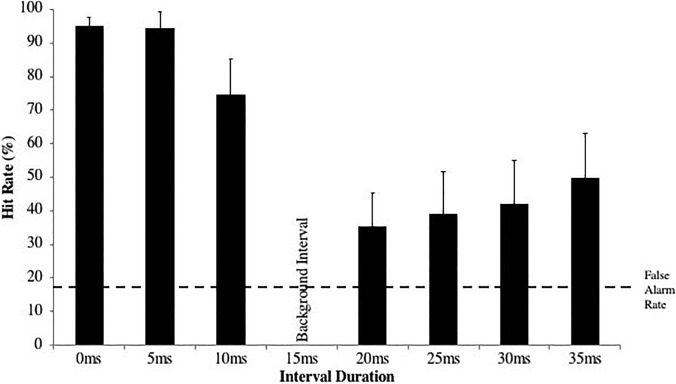
Canary discrimination of phrases based on the temporal delivery of special song syllables. Birds performed significantly better on targets faster than the background than on slower targets.
FIG. 8.
FIG. 8.
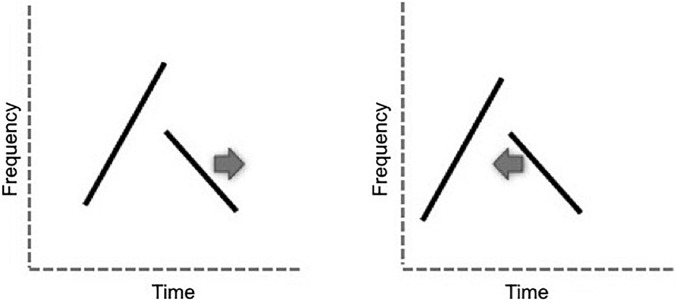
Schematic of the synthetic special syllables produced for experiment 5a (left) in which the gap between notes was manipulated and for experiment 5b (right) in which the degree of overlap of notes was manipulated.

References

    1. Alward, B. A. , Balthazart, J. , and Ball, G. F. (2013). “Differential effects of global versus local testosterone on singing behavior and its underlying neural substrate,” Proc. Natl. Acad. Sci. U.S.A. 110, 19573–19578.10.1073/pnas.1311371110 - DOI - PMC - PubMed
    1. Ball, G. F. , and Hulse, S. H. (1998). “Birdsong,” Am. Psychol. 53(1), 37–58.10.1037/0003-066X.53.1.37 - DOI - PubMed
    1. Beecher, M. D. , and Brenowitz, E. A. (2005). “Functional aspects of song learning in birds,” Trends Ecol. Evol. 20(3), 143–149. - PubMed
    1. Borg, I. , and Groenen, P. J. F. (2005). Modern Multidimensional Scaling: Theory and Applications, 2nd ed. ( Springer Science and Business Media, Inc., New York).
    1. Brenowitz, E. A. , and Remage-Healey, L. (2016). “It takes a seasoned bird to be a good listener: Communication between the sexes,” Curr. Opin. Neurobiol. 38, 12–17.10.1016/j.conb.2016.01.005 - DOI - PMC - PubMed

Publication types