


Risk of Stroke in Patients With Ocular Arterial Occlusive Disorders: A Retrospective Canadian Study
- PMID: 30712440
- PMCID: PMC6405587
- DOI: 10.1161/JAHA.118.010509
Risk of Stroke in Patients With Ocular Arterial Occlusive Disorders: A Retrospective Canadian Study
Abstract
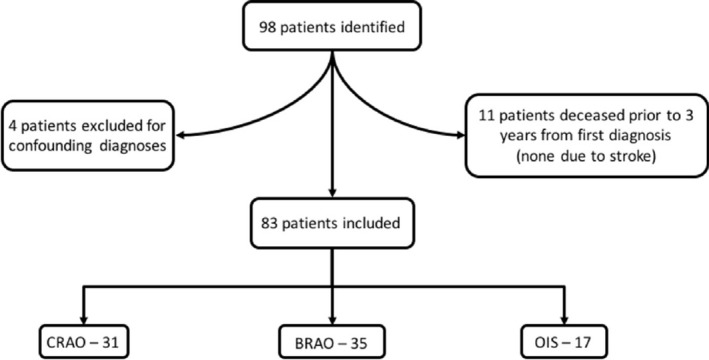
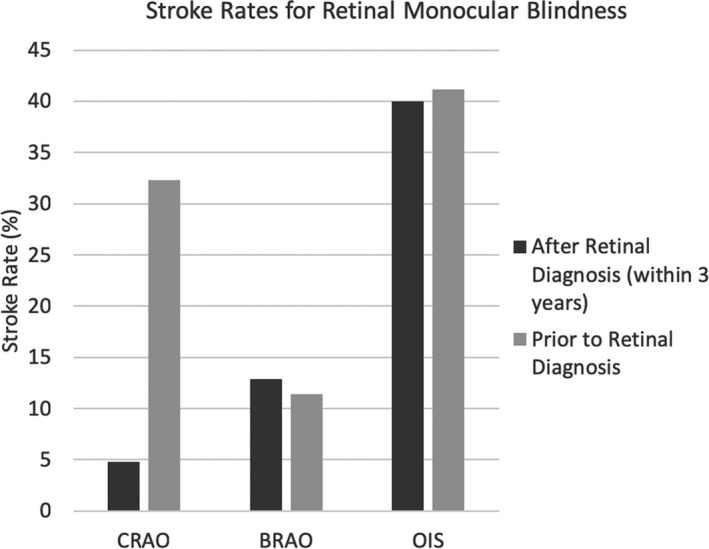
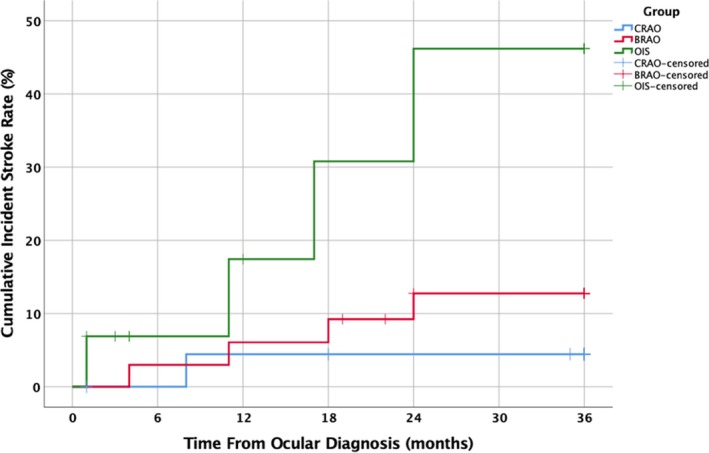
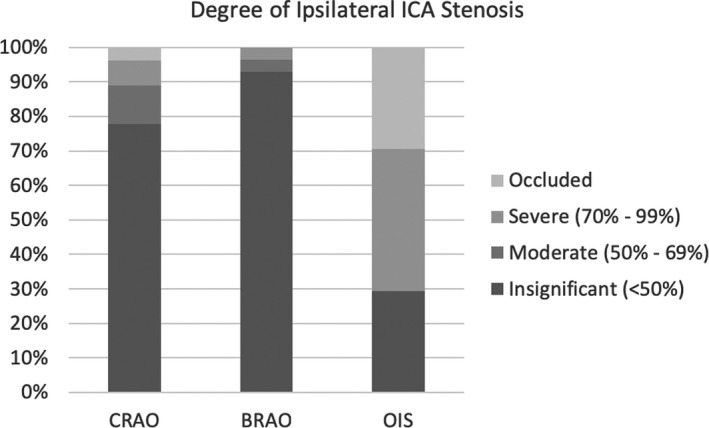
Background Monocular vision loss, attributed to either central retinal artery occlusion ( CRAO ), branch retinal artery occlusion ( BRAO ), or ocular ischemic syndrome ( OIS ), is thought to be associated with an increased prevalence of cerebral infarcts. However, there is a paucity of data substantiating this. We aimed to investigate this relationship in a Canadian center and further understand the importance of associated internal carotid artery stenosis in potential clinical decision making. Methods and Results We performed a retrospective cohort study at a comprehensive stroke center of patients presenting initially with CRAO , BRAO , or OIS to a centralized ophthalmology center over a 5-year period. Patients were followed for 3 years for the occurrence of a hemispheric stroke. We identified 83 affected eyes, with 31 CRAO , 35 BRAO , and 17 OIS patients. Before ocular diagnosis, 32.3%, 11.4%, and 41.2% of CRAO , BRAO , and OIS patients, respectively, experienced a symptomatic stroke. Of the remaining patients, 4.8%, 12.9%, and 40%, respectively, suffered a hemispheric stroke within 3 years of ocular diagnosis. Logistic regressions suggested that for CRAO and BRAO patients together, the degree of ipsilateral internal carotid artery stenosis is unable to predict the occurrence of a stroke ( P=0.18), whereas our model correctly predicted a stroke in 82.4% of OIS patients ( P=0.005). Conclusions CRAO , BRAO , and OIS are associated with significantly increased symptomatic stroke rates. Degree of ipsilateral internal carotid artery stenosis may not be useful in risk stratification for these patients, suggesting that they should be triaged appropriately for stroke risk-factor management, independent of internal carotid artery stenosis.
Keywords: Branch retinal artery occlusion; Central retinal artery occlusion; Ocular ischemic syndrome; cerebral infarct; retinal ischemia; stenosis; stroke.
Figures
References
-
- Mozaffarian D, Benjamin EJ, Go AS, Arnett DK, Blaha MJ, Cushman M, de Ferranti S, Despres JP, Fullerton HJ, Howard VJ, Huffman MD, Judd SE, Kissela BM, Lackland DT, Lichtman JH, Lisabeth LD, Liu S, Mackey RH, Matchar DB, McGuire DK, Mohler ER III, Moy CS, Muntner P, Mussolino ME, Nasir K, Neumar RW, Nichol G, Palaniappan L, Pandey DK, Reeves MJ, Rodriguez CJ, Sorlie PD, Stein J, Towfighi A, Turan TN, Virani SS, Willey JZ, Woo D, Yeh RW, Turner MB. Heart disease and stroke statistics—2015 update. A report from the American Heart Association. Circulation. 2015;131:e29–e322. - PubMed
-
- Benavente O, Eliasziw M, Streifler JY, Fox AJ, Barnett HJM, Meldrum H. Prognosis after transient monocular blindness associated with carotid‐artery stenosis. N Engl J Med. 2001;345:1084–1090. - PubMed
-
- Allan BD, Gregory SK, Vikram SK. The fate of patients with retinal artery occlusion and Hollenhorst plaque. J Vasc Surg. 2007;46:1125–1129. - PubMed
Publication types
MeSH terms
LinkOut - more resources
Full Text Sources
