


Shift Work Disrupts Circadian Regulation of the Transcriptome in Hospital Nurses
- PMID: 30712475
- PMCID: PMC6542471
- DOI: 10.1177/0748730419826694
Shift Work Disrupts Circadian Regulation of the Transcriptome in Hospital Nurses
Abstract
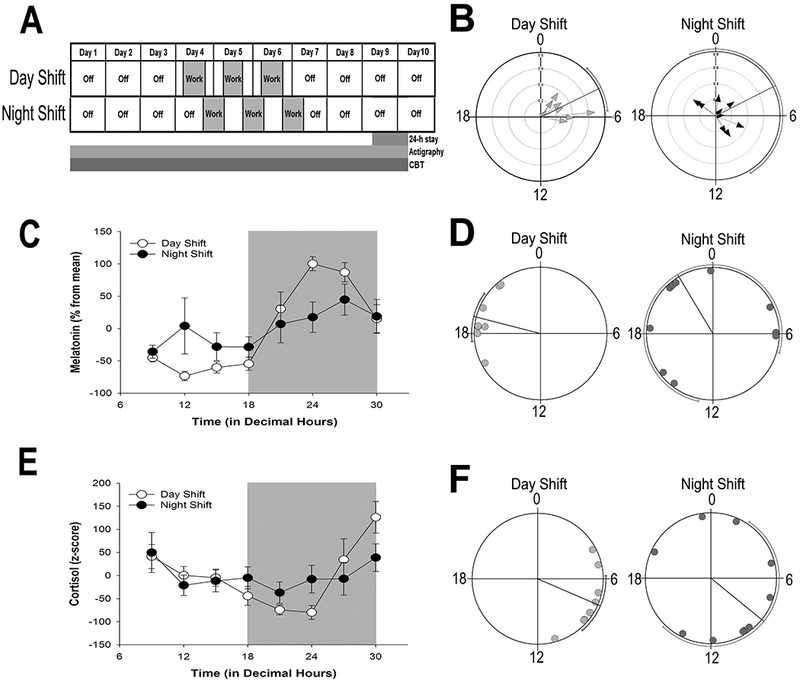
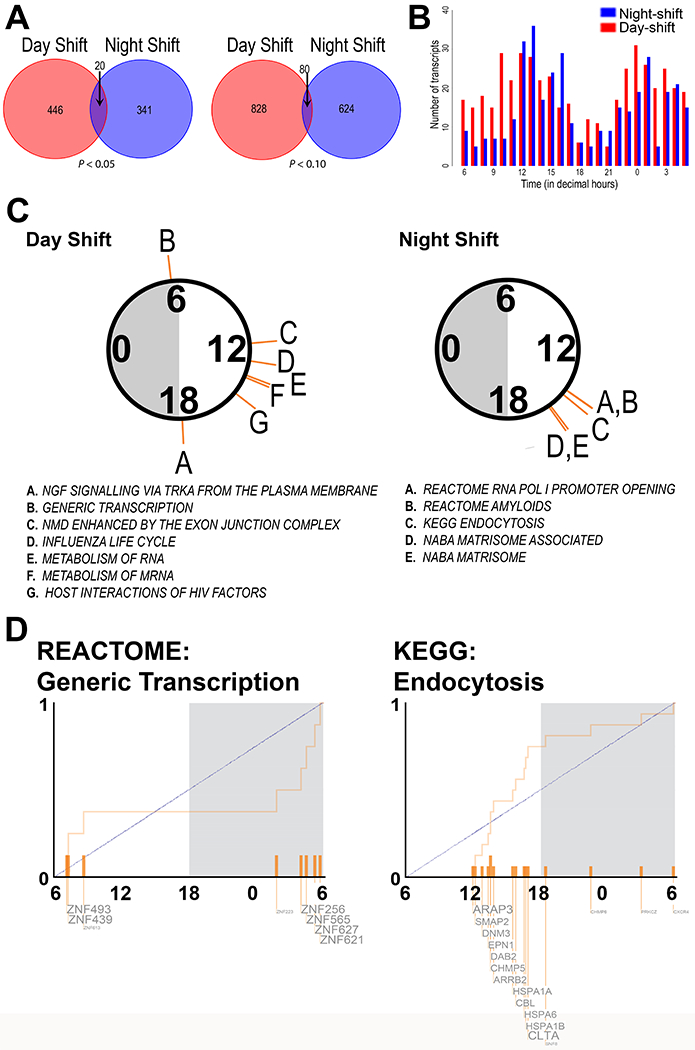
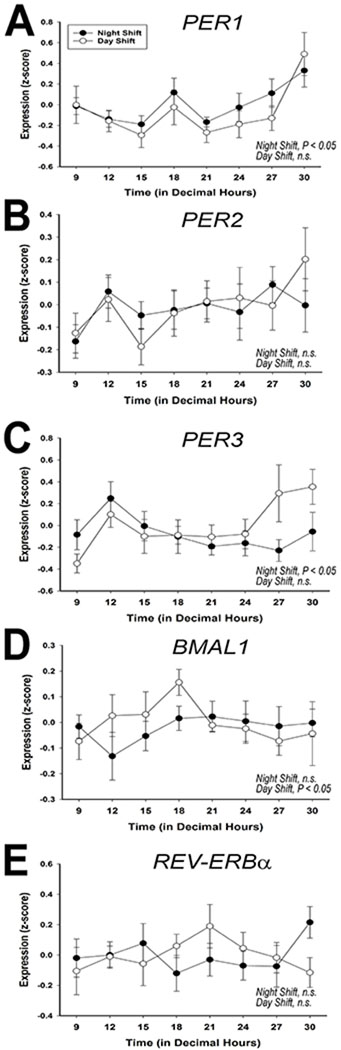
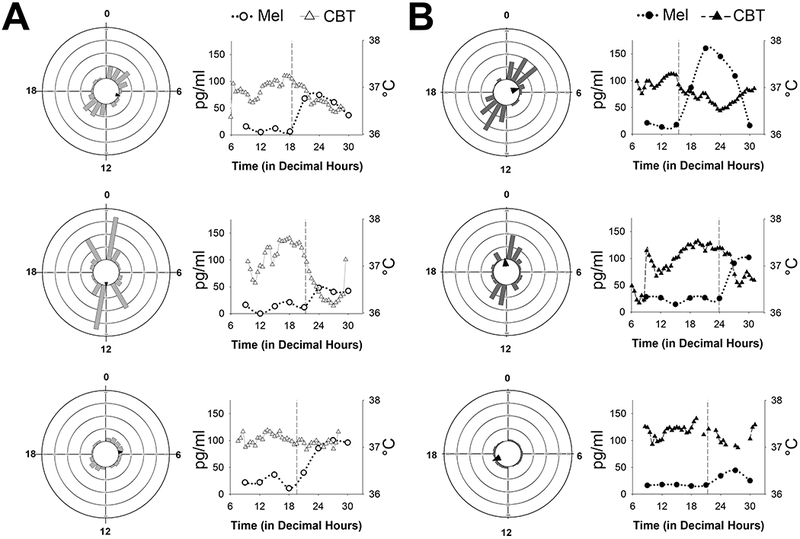
Circadian misalignment between sleep and behavioral/feeding rhythms is thought to lead to various health impairments in shift workers. Therefore, we investigated how shift work leads to genome-wide circadian dysregulation in hospital nurses. Female nurses from the University of Alabama at Birmingham (UAB) Hospital working night shift ( n = 9; 29.6 ± 11.4 y) and day shift ( n = 8; 34.9 ± 9.4 y) participated in a 9-day study measuring locomotor activity and core body temperature (CBT) continuously. Additionally, cortisol and melatonin were assayed and peripheral blood mononuclear cells (PBMCs) were harvested for RNA extraction every 3 h on a day off from work. We saw phase desynchrony of core body temperature, peak cortisol, and dim light melatonin onset in individual night-shift subjects compared with day-shift subjects. This variability was evident even though day- and night-shift nurses had similar sleep timing and scheduled meal times on days off. Surprisingly, the phase and rhythmicity of the expression of the clock gene, PER1, in PBMCs were similar for day-shift and night-shift subjects. Genome-wide microarray analysis of PBMCs from a subset of nurses revealed distinct gene expression patterns between night-shift and day-shift subjects. Enrichment analysis showed that day-shift subjects expressed pathways involved in generic transcription and regulation of signal transduction, whereas night-shift subjects expressed pathways such as RNA polymerase I promoter opening, the matrisome, and endocytosis. In addition, there was large variability in the number of rhythmic transcripts among subjects, regardless of shift type. Interestingly, the amplitude of the CBT rhythm appeared to be more consistent with the number of cycling transcripts for each of the 6 subjects than was melatonin rhythm. In summary, we show that shift-work patterns affect circadian alignment and gene expression in PBMCs.
Keywords: chronobiology; circadian disruption; clock genes; endocrinology; microarray; sleep.
Conflict of interest statement
CONFLICT OF INTERESTSM
None
Figures
References
-
- Archer SN, Laing EE, Moller-Levet CS, van der Veen DR, Bucca G, Lazar AS, Santhi N, Slak A, Kabiljo R, von Schantz M, Smith CP and Dijk DJ (2014) From the Cover: Mistimed sleep disrupts circadian regulation of the human transcriptome. Proceedings of the National Academy of Sciences of the United States of America 111:E682–691. - PMC - PubMed
-
- Boivin DB and Boudreau P (2014) Impacts of shift work on sleep and circadian rhythms. Pathologie-biologie 62:292–301. - PubMed
-
- Czeisler CA, Moore-Ede MC and Coleman RH (1982) Rotating shift work schedules that disrupt sleep are improved by applying circadian principles. Science 217:460–463. - PubMed
Publication types
MeSH terms
Substances
Grants and funding
LinkOut - more resources
Full Text Sources
Molecular Biology Databases
