. 2018 Sep-Dec;6(3-4):79-100.
doi: 10.1142/S2339547818300020. Epub 2019 Jan 11.

The growing role of precision and personalized medicine for cancer treatment

Affiliations

The growing role of precision and personalized medicine for cancer treatment

Paulina Krzyszczyk et al. Technology (Singap World Sci). 2018 Sep-Dec.

Abstract

Cancer is a devastating disease that takes the lives of hundreds of thousands of people every year. Due to disease heterogeneity, standard treatments, such as chemotherapy or radiation, are effective in only a subset of the patient population. Tumors can have different underlying genetic causes and may express different proteins in one patient versus another. This inherent variability of cancer lends itself to the growing field of precision and personalized medicine (PPM). There are many ongoing efforts to acquire PPM data in order to characterize molecular differences between tumors. Some PPM products are already available to link these differences to an effective drug. It is clear that PPM cancer treatments can result in immense patient benefits, and companies and regulatory agencies have begun to recognize this. However, broader changes to the healthcare and insurance systems must be addressed if PPM is to become part of standard cancer care.

Keywords: Cancer; Cancer Treatment; Personalized Medicine; Precision Medicine.


Figures
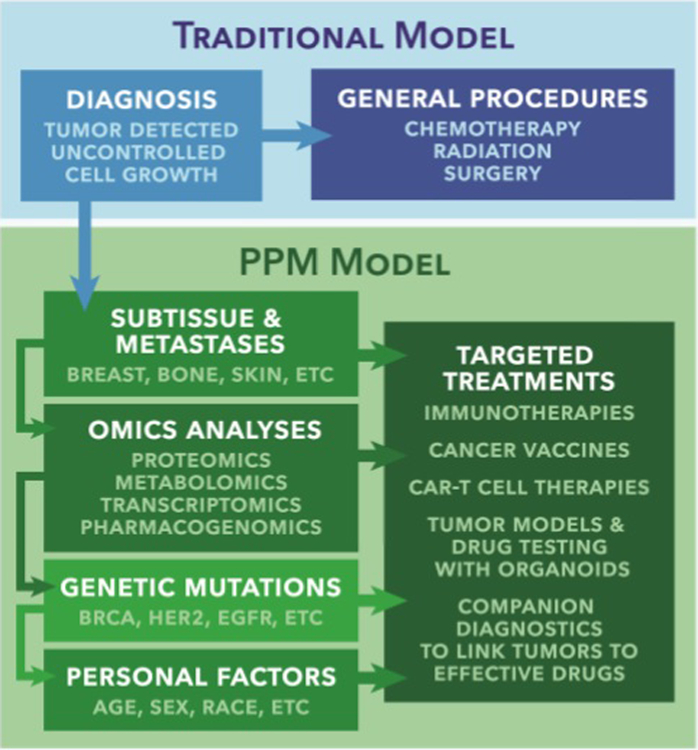
Figure 1
Figure 1
Traditional versus PPM model for cancer treatment. A comparison of the key differences in the traditional model of cancer treatment and the emerging precision and personalized medicine (PPM) model. Traditionally, cancer has been treated using general, “one size fits all” approaches such as chemotherapy, radiation, and surgical excision of tumors. These treatments vary widely in efficacy across individuals and also often cause harm to healthy, noncancerous organs and tissues. The PPM approach is characterized by individualized treatments tailored to specific tissues, gene mutations, and personal factors relevant to each unique case of cancer. Companion diagnostics (CDx) help identify which treatments will be most effective for a specific patient’s tumor, and novel cell therapies are used to target the cancer with minimal damage to healthy tissues, making the PPM model more effective and safer.
Figure 2
Figure 2
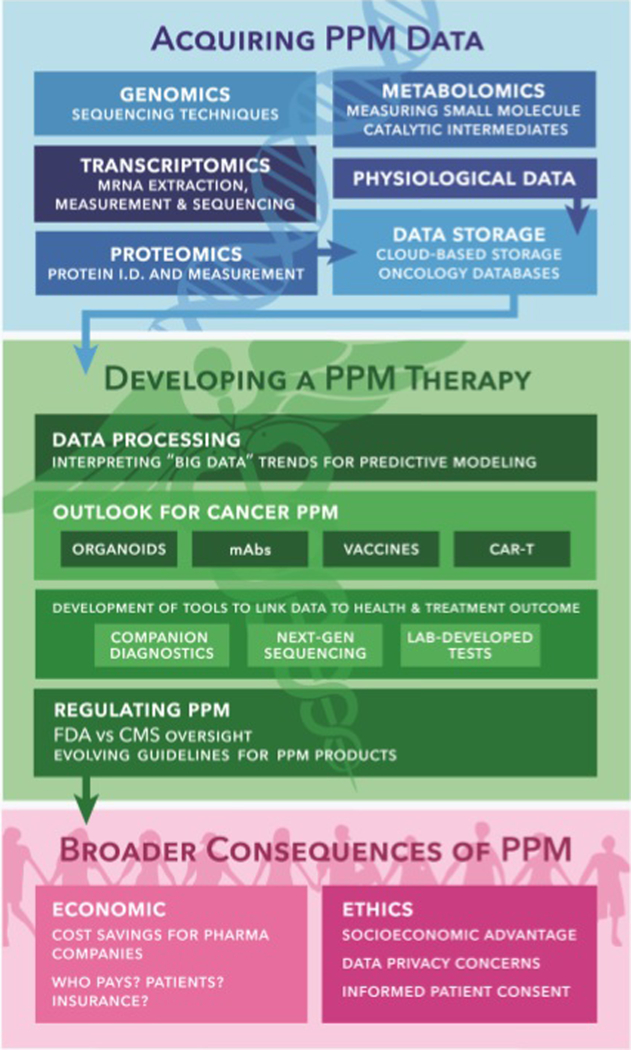
The PPM process: From data acquisition to integration in healthcare. A flowchart of the general process of PPM treatment, which serves as an outline for this article. First, a large volume of “omics” data is acquired from the patient and stored in one of several cloud-based databases. We discuss the various technologies that allow for omics data acquisition. Data processing algorithms identify the unique features of the patient’s cancer, and companion diagnostics (CDx) tools, which we discuss next, link these features to specific treatments that will likely be the most effective at treating the cancer. We outline the development of several of these products, including targeted antibodies, cancer vaccines, and T-cell therapies. The regulation of new PPM treatments and products by the Food and Drug Administration (FDA) and Center for Medicare and Medicaid Services (CMS) is continually evolving; we discuss the landmark regulatory changes that have enabled approval of new technologies and consider the future of the regulatory landscape. Finally, we look at the economics and ethics of PPM, including how to reduce cost, who to hold responsible for payments, and concerns about accessibility and data security.
Figure 3
Figure 3
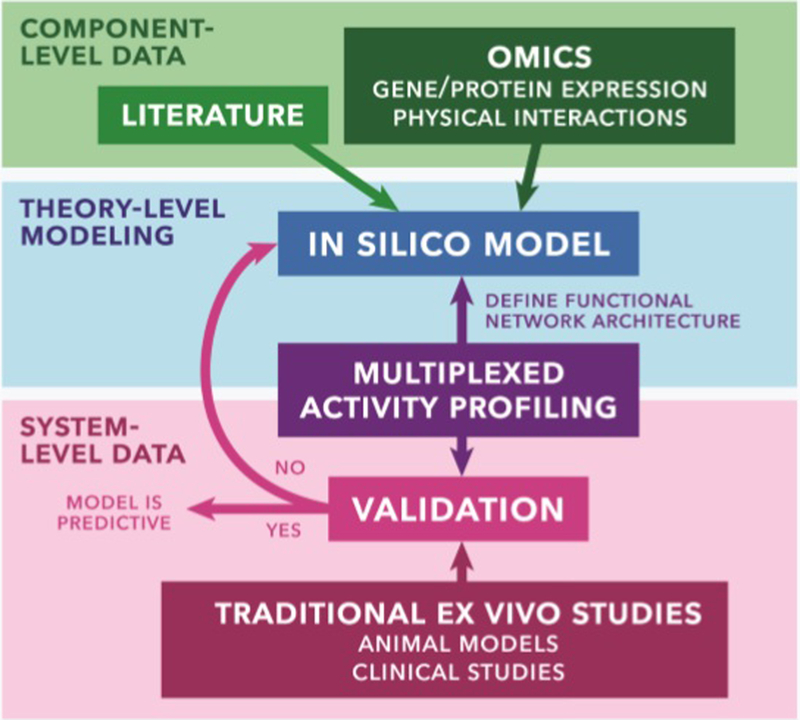
Predictive model development from large-scale omics data. An overview of the process for development of predictive models. Turning gigabytes of patient data into relevant clinical information requires a Big Data approach — specifically, predictive algorithms that are refined and validated with results from data-driven investigations, including traditional animal model studies and clinical trials. Adapted by permission from [RightsLink Permissions Springer]: [Springer Nature] [NATURE BIOTECHNOLOGY] Butcher et al., [COPYRIGHT] (2004).
Figure 4
Figure 4
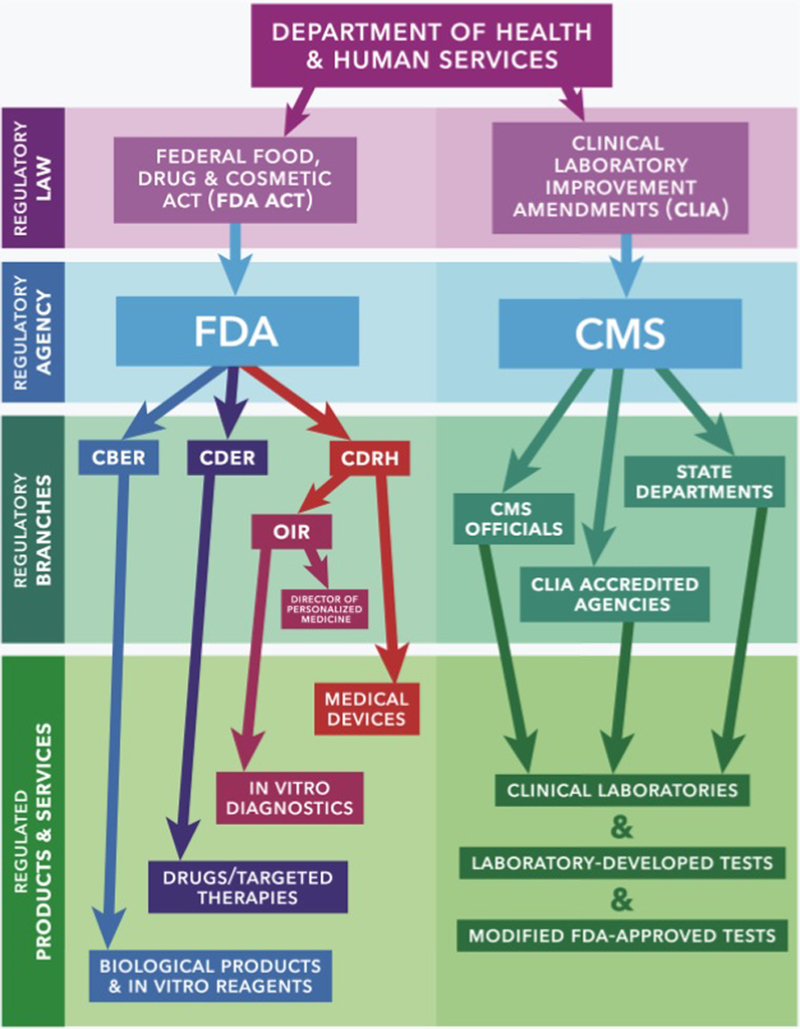
Regulatory landscape for PPM products and services. A look at the structure of the agencies responsible for regulating PPM products. The FDA is responsible for evaluating the safety and efficacy of all medical devices, pharmaceutical products, and biological products sold in the United States. Most CDx tests and treatment products fall under FDA jurisdiction. The CMS oversees all clinical laboratories in the United States, certifying that they meet quality and proficiency standards for collecting and interpreting clinical data. Generally, the CMS is responsible for approving laboratory-developed diagnostic tests.

References

    1. National Cancer Institute. Cancer statistics (2018), https://www.cancer.gov/about-cancer/understanding/statistics
    1. National Cancer Institute. Cancer types (2018), https://www.cancer.gov/types
    1. Alizadeh AA et al. Distinct types of diffuse large B-cell lymphoma identified by gene expression profiling. Nature 403, 503–511 (2000). - PubMed
    1. Guinney J et al. The consensus molecular subtypes of colorectal cancer. Nat. Med 21, 1350–1356 (2015). - PMC - PubMed
    1. Perou CM et al. Molecular portraits of human breast tumours. Nature 406, 747–752 (2000). - PubMed

LinkOut - more resources