


Plasma Epstein-Barr virus DNA as an archetypal circulating tumour DNA marker
- PMID: 30714167
- PMCID: PMC6594142
- DOI: 10.1002/path.5249
Plasma Epstein-Barr virus DNA as an archetypal circulating tumour DNA marker
Abstract
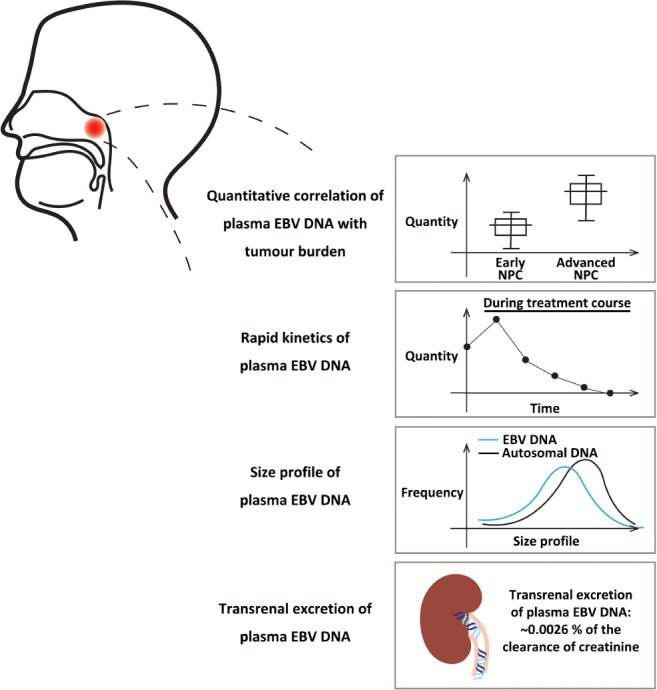
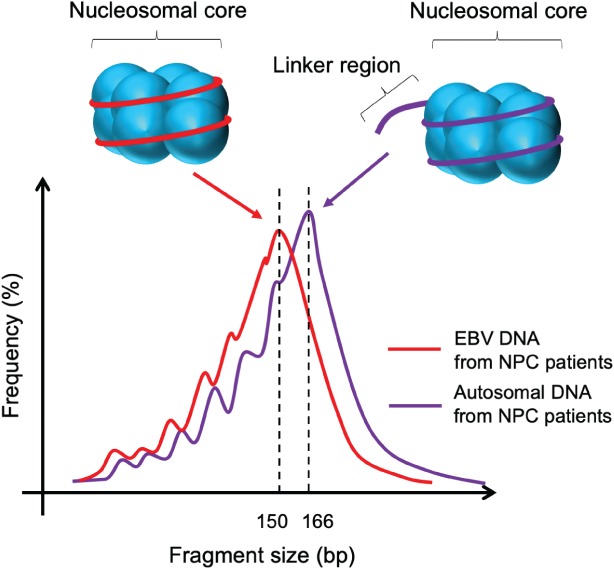
Analysis of circulating tumour DNA (ctDNA), as one type of 'liquid biopsy', has recently attracted great attention. Researchers are exploring many potential applications of liquid biopsy in many different types of cancer. In particular, it is of biological interest and clinical relevance to study the molecular characteristics of ctDNA. For such purposes, plasma Epstein-Barr virus (EBV) DNA from patients with nasopharyngeal carcinoma (NPC) would provide a good model to understand the biological properties and clinical applications of ctDNA in general. The strong association between EBV and NPC in endemic regions has made plasma EBV DNA a robust biomarker for this cancer. There are many clinical utilities of plasma EBV DNA analysis in NPC diagnostics. Its role in prognostication and surveillance of recurrence is well established. Plasma EBV DNA has also been validated for screening NPC in a recent large-scale prospective study. Indeed, plasma EBV DNA could be regarded as an archetypal ctDNA marker. In this review, we discuss the biological properties of plasma EBV DNA from NPC samples and also the clinical applications of plasma EBV DNA analysis in the management of NPC. Of note, the recently reported size analysis of plasma EBV DNA in patients with NPC has highlighted size as an important analytical parameter of ctDNA and demonstrated clinical value in improving the diagnostic performance of an EBV DNA-based NPC screening test. Such insights into ctDNA analysis (including size profiling) may help its full potential in cancer diagnostics for other types of cancer to be realised. © 2019 The Authors. The Journal of Pathology published by John Wiley & Sons Ltd on behalf of Pathological Society of Great Britain and Ireland.
Keywords: circulating tumour DNA (ctDNA); liquid biopsy; massively parallel sequencing; nasopharyngeal carcinoma; screening; size-based diagnostics.
© 2019 The Authors. The Journal of Pathology published by John Wiley & Sons Ltd on behalf of Pathological Society of Great Britain and Ireland.
Figures
References
-
- Forshew T, Murtaza M, Parkinson C, et al. Noninvasive identification and monitoring of cancer mutations by targeted deep sequencing of plasma DNA. Sci Transl Med 2012; 4: 136ra68. - PubMed
-
- Dawson SJ, Tsui DWY, Murtaza M, et al. Analysis of circulating tumor DNA to monitor metastatic breast cancer. N Engl J Med 2013; 368: 1199–1209. - PubMed
-
- Thierry AR, Mouliere F, El Messaoudi S, et al. Clinical validation of the detection of KRAS and BRAF mutations from circulating tumor DNA. Nat Med 2014; 20: 430–435. - PubMed
-
- Schwarzenbach H, Hoon DSB, Pantel K. Cell‐free nucleic acids as biomarkers in cancer patients. Nat Rev Cancer 2011; 11: 426–437. - PubMed
Publication types
MeSH terms
Substances
LinkOut - more resources
Full Text Sources
