


Persistent and aggressive interactions with the police: potential mental health implications
- PMID: 30714560
- PMCID: PMC8061162
- DOI: 10.1017/S2045796019000015
Persistent and aggressive interactions with the police: potential mental health implications
Abstract
Aims: Little is known about the potential health impact of police encounters despite a ubiquitous police presence in many disadvantaged urban environments. In this paper, we assess whether persistent or aggressive interactions with the police are associated with poor mental health outcomes in a sample of primarily low-income communities of colour in Chicago.
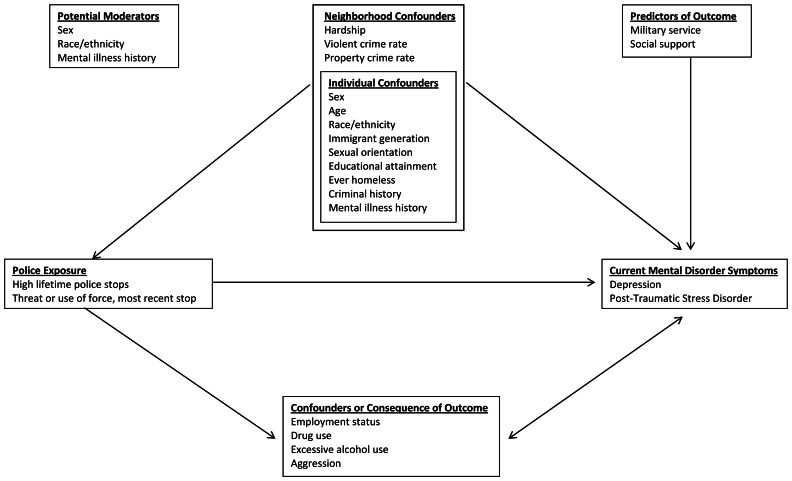
Methods: Between March 2015 and September 2016, we surveyed 1543 adults in ten diverse Chicago communities using a multistage probability design. The survey had over 350 questions on health and social factors, including police exposure and mental health status. We use sex-stratified logistic regression to examine associations between persistent police exposure (defined as a high number of lifetime police stops) or aggressive police exposure (defined as threat or use of police force during the respondent's most recent police stop) and the presence of post-traumatic stress disorder (PTSD) or depressive symptoms.
Results: Men reporting a high number of lifetime police stops have three times greater odds of current PTSD symptoms compared with men who did not report high lifetime police stops (OR 3.1, 95% CI 1.3-7.6), after adjusting for respondent age, race/ethnicity, education, history of homelessness, prior diagnosis of PTSD and neighbourhood violent crime rate. Women reporting a high number of lifetime police stops have two times greater odds of current PTSD symptoms, although the results are not statistically significant after adjustment (OR 2.0, 95% CI 0.9-4.2). Neither persistent nor aggressive police exposure is significantly associated with current depressive symptoms in our sample.
Conclusions: Our findings support existing preliminary evidence of an association between high lifetime police stops and PTSD symptoms. If future research can confirm as causal, these results have considerable public health implications given the frequent interaction between police and residents in disadvantaged communities in large urban areas.
Keywords: Depression; discrimination; epidemiology; population survey; post-traumatic stress disorder.
Conflict of interest statement
None.
Figures
References
-
- American Association for Public Opinion Research (2016) Standard Definitions: Final Dispositions of Case Codes and Outcome Rates for Surveys.
-
- American Civil Liberties Union of Illinois (2015) Stop and frisk in Chicago. (https://www.aclu-il.org/en/publications/2015-stop-and-frisk-report). Accessed 14 August 2015.
-
- American Psychiatric Association (2000) Diagnostic and Statistical Manual for Mental Disorders. Washington, DC: American Psychiatric Association.
-
- Ayres I and Borowsky J (2008) A study of racially disparate outcomes in the Los Angeles police department. ACLU of Southern California.
-
- Blanchard EB, Jones-Alexander J, Buckley TC and Forneris CA (1996) Psychometric properties of the PTSD checklist (PCL). Behaviour Research and Therapy 34, 669–673. - PubMed
MeSH terms
LinkOut - more resources
Full Text Sources
Medical
