Review
. 2019 May 20;123(5):747-766.
doi: 10.1093/aob/mcy214.

Enset in Ethiopia: a poorly characterized but resilient starch staple

Affiliations
Review

Enset in Ethiopia: a poorly characterized but resilient starch staple

James S Borrell et al. Ann Bot. .

Abstract

Background: Enset (Ensete ventricosum, Musaceae) is an African crop that currently provides the staple food for approx. 20 million Ethiopians. Whilst wild enset grows over much of East and Southern Africa and the genus extends across Asia to China, it has only ever been domesticated in the Ethiopian Highlands. Here, smallholder farmers cultivate hundreds of landraces across diverse climatic and agroecological systems.

Scope: Enset has several important food security traits. It grows over a relatively wide range of conditions, is somewhat drought-tolerant, and can be harvested at any time of the year, over several years. It provides an important dietary starch source, as well as fibres, medicines, animal fodder, roofing and packaging. It stabilizes soils and microclimates and has significant cultural importance. In contrast to the other cultivated species in the family Musaceae (banana), enset has received relatively little research attention. Here, we review and critically evaluate existing research, outline available genomic and germplasm resources, aspects of pathology, and explore avenues for crop development.

Conclusion: Enset is an underexploited starch crop with significant potential in Ethiopia and beyond. Research is lacking in several key areas: empirical studies on the efficacy of current agronomic practices, the genetic diversity of landraces, approaches to systematic breeding, characterization of existing and emerging diseases, adaptability to new ranges and land-use change, the projected impact of climate change, conservation of crop wild relatives, by-products or co-products or non-starch uses, and the enset microbiome. We also highlight the limited availability of enset germplasm in living collections and seedbanks, and the lack of knowledge of reproductive and germination biology needed to underpin future breeding. By reviewing the current state of the art in enset research and identifying gaps and opportunities, we hope to catalyse the development and sustainable exploitation of this neglected starch crop.

Keywords: Ensete ventricosum; Biodiversity; biotic and abiotic resistance; climate adaptation; crop wild relatives (CWRs); domestication; false banana; food security; germplasm collections; pests and pathogens; sustainable agriculture; tropical crop ecology.


Figures

Fig. 1.
Fig. 1.
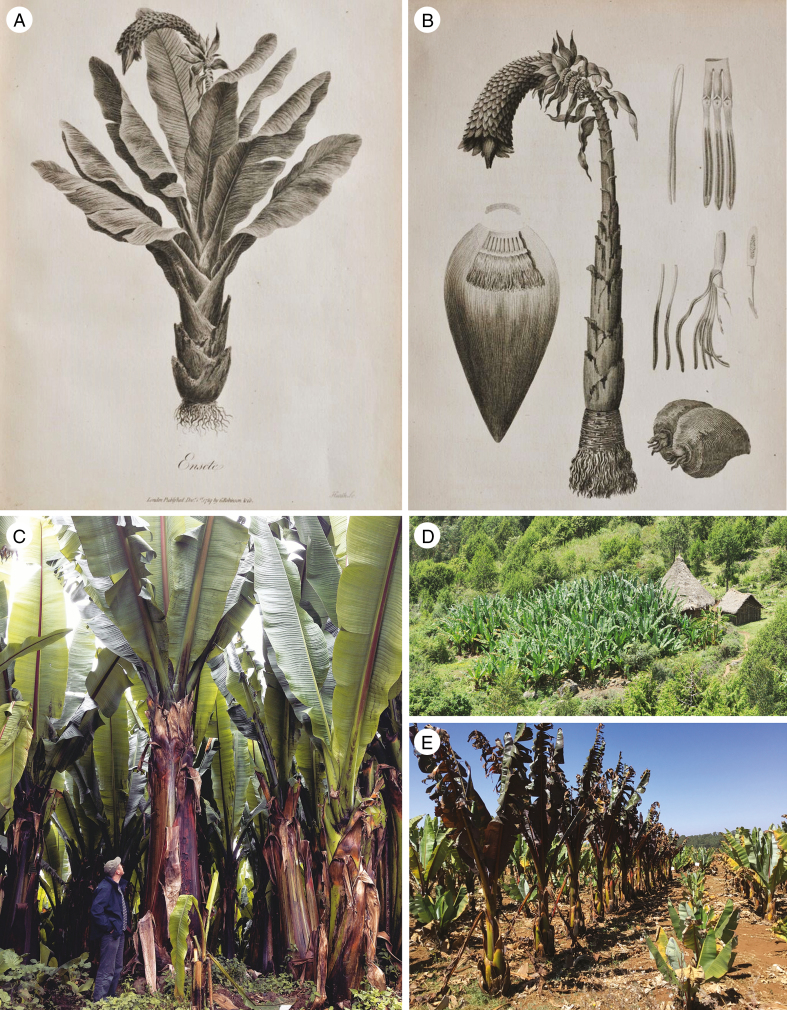
Domesticated Enset ventricosum in Ethiopia. (A, B) Original plates of ‘Ensete’ from Bruce (1790). (C) Large enset plants (landrace ‘Medasho’) grown by small scale farmers in Teticha (Sidama Zone, SNNPR region). (D) A typical enset home garden near Butajira (Gurage Zone, SNNPR region). (E) An enset germplasm collection at Yerefezy research station, University of Wolkite (Gurage Zone, SNNPR region). Clear differences in morphology can be observed, with substantial differences in growth rate under local environmental conditions.
Fig. 2.
Fig. 2.
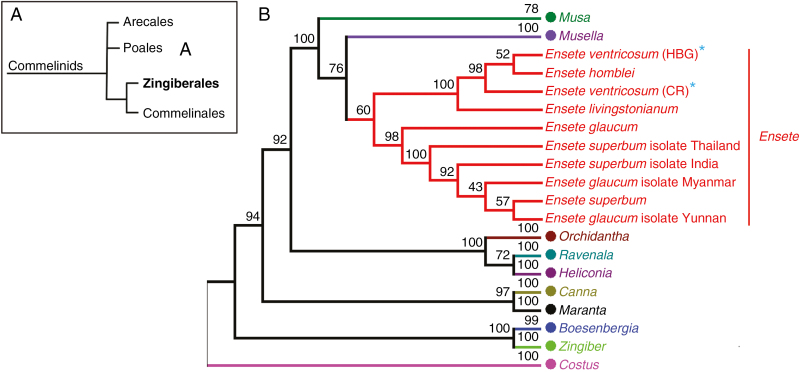
Evolutionary relationships of genus Ensete. (A) The genus Ensete is included in the Musaceae, one of eight families of the monocot order Zingiberales which together with the Commelinales is sister to the Poales that contain the cereal crops including wheat, maize and rice. (B) Evolutionary relationships of the genus Ensete within the Zingiberales based on ITS sequences, including collapsed sister genera within Musaceae and outgroups representing the eight families (see Supplementary Data Fig. S2 for an expanded tree and Supplementary Data Information for method details). Provenance of the two E. ventricosum accessions are Hamburg Botanic Garden (HBG) and Costa Rica (CR; Introduced).
Fig. 3.
Fig. 3.
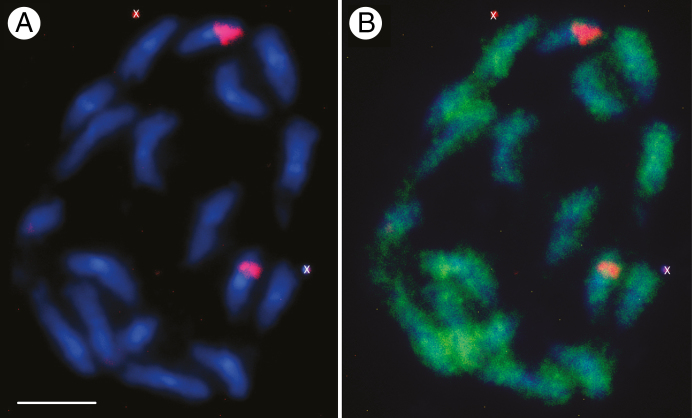
Metaphase chromosomes of Ensete ventricosum ‘Maurelli’ 2n = 18. Chromosomes appear blue with the DNA stain DAPI and show two distinct 5S rDNA loci (red) at the ends of a medium sized chromosome pair (A). The simple sequence repeat AAC (green) is distributed along all chromosome arms (B). Sequences were mapped by fluorescence in situ hybridization (FISH) using the method of Schwarzacher and Heslop-Harrison (2000, for details see Supplementary Data Information). Scale bar = 5 μm; ‘x’ denotes unspecified soil/contamination in image.
Fig. 4.
Fig. 4.
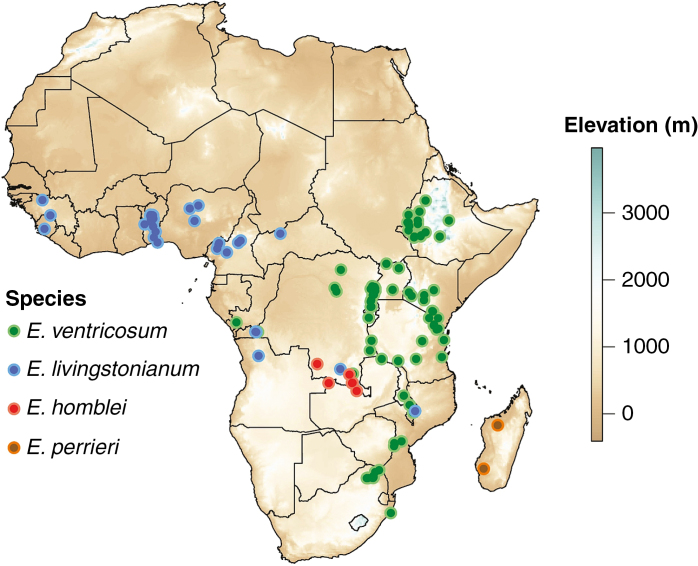
Three species of Ensete occur in mainland Africa, Ensete homblei, E. livingstonianum and E. ventricosum, with a fourth, E. perrieri, restricted to Madagascar. E. ventricosum is likely to be the most widespread species within the Musaceae, occurring over much of central, south-east and east Africa. Whilst the contemporary distribution reaches as far north as the Ethiopian Highlands, it has been suggested that enset was historically known to the Egyptians (Simoons, 1965). By comparison, distribution records for E. homblei, E. livingstonianum and their numerous synonyms are sparse. Ensete livingstonianum appears to be a species of drier habitats and is reported to die back in the dry season. It has a more westerly distribution than E. ventricosum, although they are likely to be sympatric over at least a portion of their range (Baker and Simmonds, 1953). Comparatively, E. homblei is recorded from only a handful of locations in the south-eastern Congo, and neighbouring northern Zambia. This could represent low sampling effort, rarity or both. Finally, E. perrieri is known from only three mature individuals, and is likely to be the most endangered crop wild relative of enset. Due to difficulty in distinguishing species with varying morphology, of different ages, and sometimes only from seed samples, it is possible that some geographically disjunct records represent misidentification, particularly for E. livingstonianum and E. ventricosum. Records presented here are collated from the literature (Cheesman, 1947; Baker and Simmonds, 1953), online databases (GBIF, 2018), herbaria (AAU, K) and personal observations.
Fig. 5.
Fig. 5.
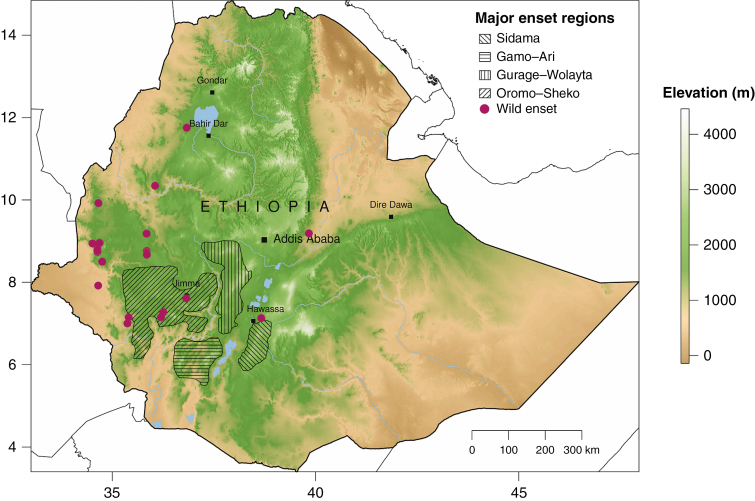
Distribution of major domesticated enset-growing regions (shaded polygons) and wild enset records (red points) in Ethiopia. Whilst domestic enset is occasionally encountered in the wider area, these four enset farming areas represent the major centres of cultivation, where enset is frequently the most important starch staple. The Sidama zone (SNNPR region) is predominantly high elevation, with enset sometimes grown together with crops such as coffee under sparse shade trees. At the highest elevations, enset is subject to frost damage. The Gurage-Wolayta cultivation area encompasses (from north to south) adjacent zones (Gurage, Hadiya, Kambata and Wolayta) in the SNNPR region. The northern part of Gurage is markedly drier than many other areas of enset cultivation. Here enset is predominantly grown in dense stands with few other crops and no shade trees. Gamo (Gamo zone) and Ari (South Omo zone) are relatively poorly known areas of enset cultivation, with high spatial variation in enset importance. Sheka and Dawro (SNNPR region) and adjacent areas in Oromia (Oromia region) are also relatively poorly researched. Here domestic enset occurs in close proximity to wild enset.
Fig. 6.
Fig. 6.
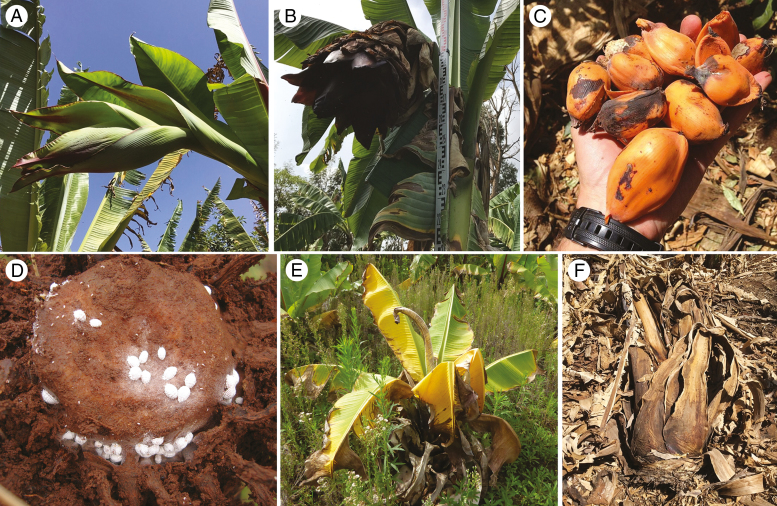
Floral morphology and diseases of enset. (A) A young inflorescence (landrace: ‘Dima’). (B) A mature inflorescence (landrace: Touzoma). (C) Ripe enset fruits (landrace: ‘Lemat’). (D) A mealybug-infested corm. (E) A young enset plant showing symptoms of bacterial wilt (Xanthomonas wilt of enset). (F) An enset plant recently killed by bacterial wilt.
Fig. 7.
Fig. 7.
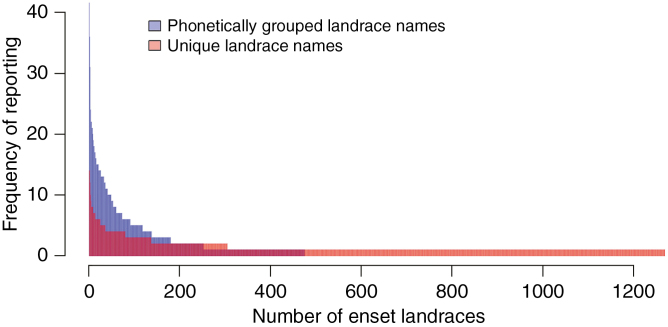
Frequency of enset landrace vernacular names in the literature. In comparison with the high number of domesticated enset vernacular names, only four names were reported for wild enset (E. ventricosum) in our survey.
Fig. 8.
Fig. 8.
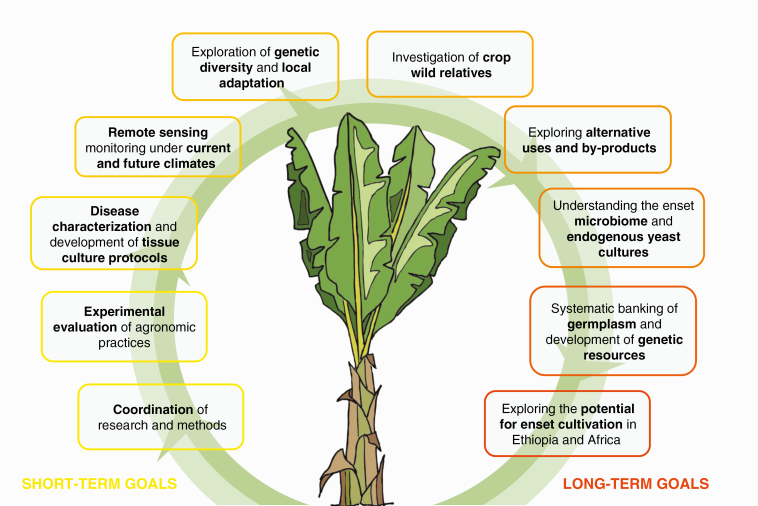
Roadmap for the sustainable development and exploitation of the Ethiopian starch crop enset for food security and to support livelihoods.
Fig. 9.
Fig. 9.
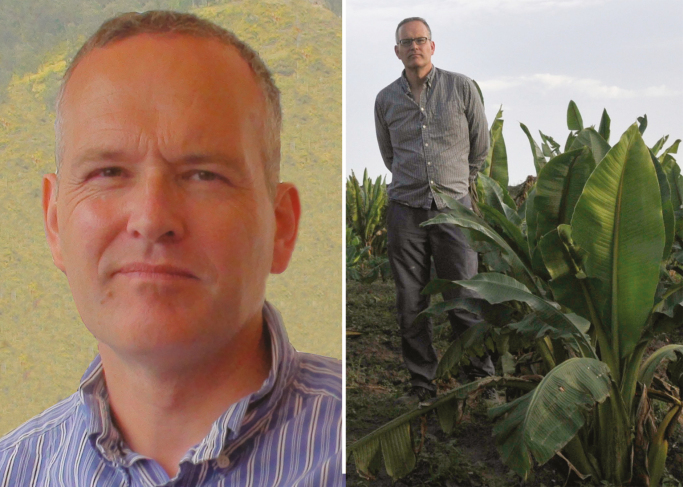
Mark Anthony John Goodwin: 9 August 1960 to 25 August 2018 (left) and in Hawassa, Ethiopia with enset in May 2012 (right). Images Pat Heslop-Harrison.

References

    1. Abate T, Hiebsch C, Brandt SA, Gebremariam S. 1996. Enset-based sustainable agriculture in Ethiopia. Addis Abeba, Ethiopia: Institute of Agricultural Research.
    1. Addis T, Blomme G, Turyagyenda L, Van den Berg E, De Waele D. 2006. Nematodes associated with enset and banana in the highlands of Ethiopia. International Journal of Nematology 16: 118–125.
    1. Addis T, Azerefegne F, Blomme G, Kanaujia K. 2008. Biology of the enset root mealybug Cataenococcus ensete and its geographical distribution in southern Ethiopia. Journal of Applied Biosciences 8: 251–260.
    1. Adhikari U, Nejadhashemi AP, Woznicki SA. 2015. Climate change and eastern Africa: a review of impact on major crops. Food and Energy Security 4: 110–132.
    1. Aerts R, Geeraert L, Berecha G, et al. 2016. Conserving wild Arabica coffee: emerging threats and opportunities. Agriculture, Ecosystems & Environment 237: 75–79.

Publication types