. 2019 Jun 1;28(11):1919-1929.
doi: 10.1093/hmg/ddz032.

Cardiomyopathy with lethal arrhythmias associated with inactivation of KLHL24

Affiliations

Cardiomyopathy with lethal arrhythmias associated with inactivation of KLHL24

Carola Hedberg-Oldfors et al. Hum Mol Genet. .

Abstract

Hypertrophic cardiomyopathy (HCM) is the most common inherited cardiovascular disorder, yet the genetic cause of up to 50% of cases remains unknown. Here, we show that mutations in KLHL24 cause HCM in humans. Using genome-wide linkage analysis and exome sequencing, we identified homozygous mutations in KLHL24 in two consanguineous families with HCM. Of the 11 young affected adults identified, 3 died suddenly and 1 had a cardiac transplant due to heart failure. KLHL24 is a member of the Kelch-like protein family, which acts as substrate-specific adaptors to Cullin E3 ubiquitin ligases. Endomyocardial and skeletal muscle biopsies from affected individuals of both families demonstrated characteristic alterations, including accumulation of desmin intermediate filaments. Knock-down of the zebrafish homologue klhl24a results in heart defects similar to that described for other HCM-linked genes providing additional support for KLHL24 as a HCM-associated gene. Our findings reveal a crucial role for KLHL24 in cardiac development and function.


Figures

Figure 1
Figure 1
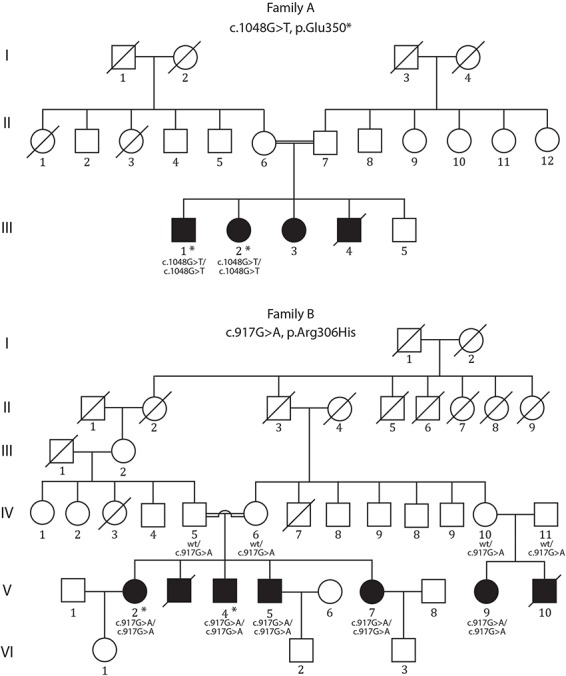
Pedigrees of two consanguineous families with segregation of KLHL24 mutations. Filled squares and circles indicate individuals with cardiomyopathy. Asterisks indicate the individuals whose DNA was analysed by exome sequencing. wt = wild type. Individual III:4 in family A died suddenly at the age of 20. In family B, individual V:3 died suddenly at 26 years of age, and V:10 died of sudden cardiac arrest at the age of 26.
Figure 2
Figure 2
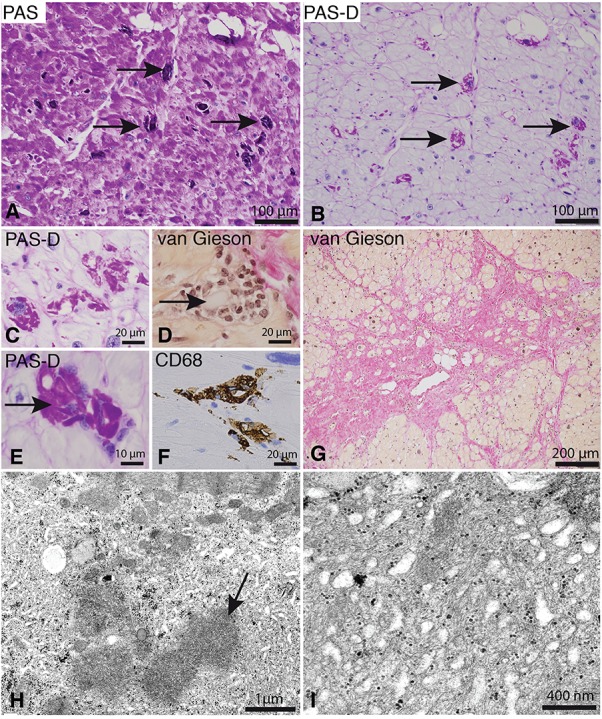
Histopathology of the heart in family A. (A–G) Cardiac explant from individual III:2 after fixation in paraformaldehyde and paraffin embedding. (A and B). There is accumulation of glycogen as revealed by PAS staining (A). Cardiomyocytes have often accumulated PAS-positive material that is alpha-amylase resistant (polyglucosan; arrows) (PAS-D: PAS-diastase). (C) Accumulation of polyglucosan in cardiomyocytes (PAS-Diastase). (D and E) Scattered cardiomyocytes, many of which include polyglucosan (arrows), are associated with inflammatory cells. (F) The inflammatory cells stain positively for CD68, a marker for macrophages. (G) There is patchy fibrosis in the heart that stains red on van Gieson staining, compared to brownish cardiomyocytes. (H and I) Electron microscopy of endomyocardial biopsy material from individual III:1 after glutaraldehyde fixation and embedding in resin. Polyglucosan (arrow in panel H) is associated with intermyofibrillar accumulation of glycogen, filaments and tubular structures, which are seen at higher magnification in panel I.
Figure 3
Figure 3
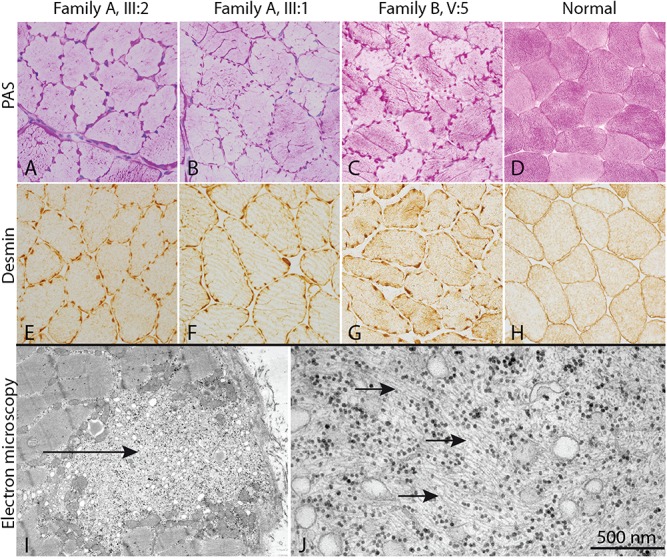
Skeletal muscle biopsy from three individuals from two families with cardiomyopathy and homozygous KLHL24 mutations and a normal control. (AH) In all three individuals with cardiomyopathy, a characteristic cogwheel appearance of the fibres are present due to jagged accumulation of glycogen (PAS staining) and intermediate filaments (desmin immunostaining). Electron microscopy (I, J) of individual III:2 shows focal subsarcolemmal accumulation of glycogen, tubular structures and intermediate filaments (arrows).
Figure 4
Figure 4
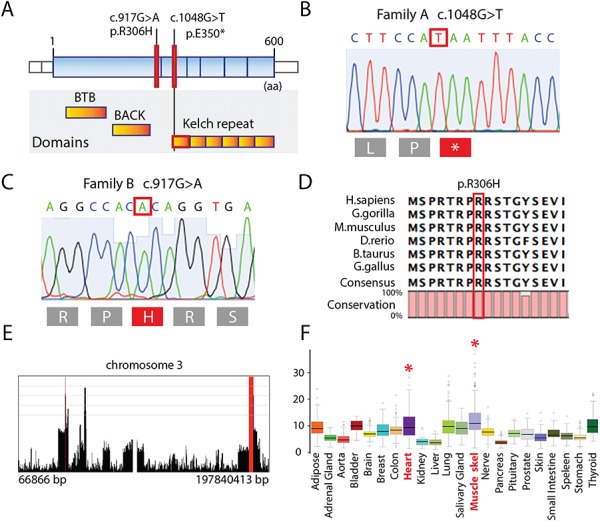
Molecular genetics analysis. (A) Illustration showing the different domains in the KLHL24 protein; mutations are indicated by red bars. (B) Chromatogram demonstrating the homozygous mutation c.1048G>T (p.Glu350*) in family A. (C) Chromatogram demonstrating the homozygous mutation c.917G>A (p.Arg306His) in family B. (D) Illustration showing the evolutionary conservation of the amino acids. The mutated residue (p.Arg306His) is indicated by the red bar. (E) Homozygosity mapping results from Family B showing homozygous regions in a view of chromosome 3 that reveals the longest run of homozygosity containing the candidate variant and spans the coordinates chr3:182,207,825-185,614,988 (rs9877496 to rs73175592) that is approximately 3.4 Mb in length. (F) Gene expression for KLHL24 in the GTEx Portal Database with the highest expression in skeletal muscle, followed by lung and the left ventricle of the heart; data source: GTEx Analysis Release V6p (dbGaP Accession phs000424.v6.p1).
Figure 5
Figure 5
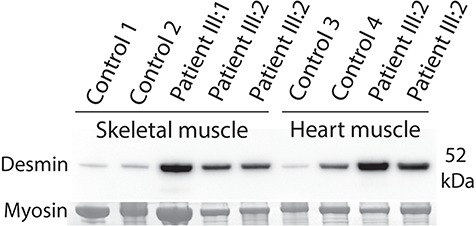
Western blot analysis of desmin in protein extracted from skeletal muscle biopsies and heart muscle specimens showed upregulation of desmin compared to control sample both in the skeletal muscle and the heart muscle. The band corresponding to myosin heavy chain was used as loading control. Each lane represents one unique specimen. Control 3 is a normal heart, whereas control 4 is a heart explant of a patient with cardiomyopathy with an expected moderate upregulation of desmin (27).
Figure 6
Figure 6
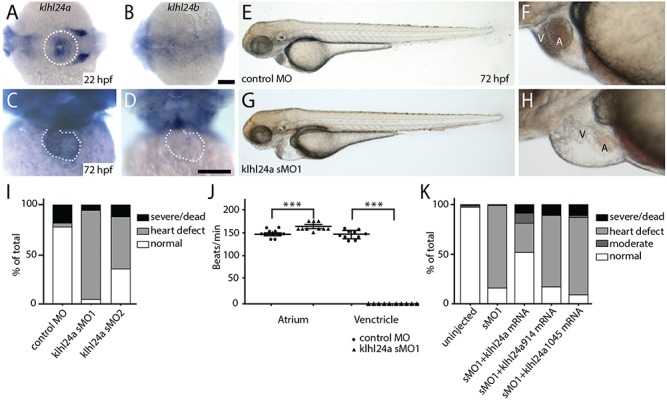
Expression and functional analysis of klhl24 in zebrafish. (A–D) Whole-mount in situ hybridization of klhl24a and klhl24b at 22 hpf (A,B; dorsal view, head left) and 72 hpf (C,D; front view, dorsal up). Expression of klhl24a mRNA in the cardiac cone at 22 hpf (A, dotted circle) and heart (C, dotted line) at 72 hpf. (EH) Morphology of embryos injected with control antisense morpholino (E,F) or klhl24a sMO1 (G, H) at 72 hpf with close-up on the heart region (F, H). Scale bar, 100 μm. V; ventricle, A; atrium. (I) Phenotypic distribution of embryos injected with control or klhl24a morpholinos. Embryos were categorized as normal (normal appearance), heart defect (otherwise normal), moderate (non-cardiac related abnormalities) or severe/dead (severely altered morphology or dead). (J) Contractions of atrium or ventricle as beats per minute analysed with the non-parametric Mann–Whitney t-test, with standard error of the mean (SEM). ***P < 0.001. (K) Phenotypic distribution in percentage of un-injected embryos or injected with sMO1, sMO1 + 12.5 pg klhl24a mRNA, sMO1 + 12.5 pg klhl24a 914 mRNA or sMO1 + 12.5 pg klhl24a1045.
Figure 7
Figure 7
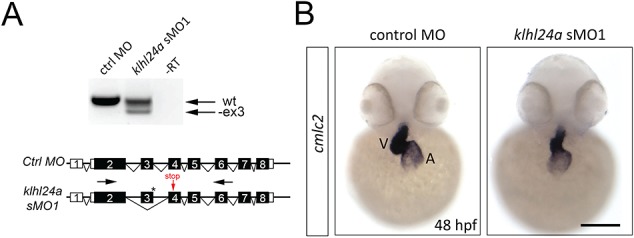
RT-PCR analysis of splicing of klhl24a mRNA using primers (black arrows) located in exon 2 and 6 surrounding the binding site of the sMO1 (asterisk). Control and klhl24a sMO1-injected embryos were analysed at 48 hpf. No reverse transcriptase (RT) served as negative control (−RT). One PCR fragment of sMO1-injected embryos is shorter than that of control-injected embryos. Sanger sequencing of the smaller PCR product showed that exon 3 is skipped in sMO1-injected embryos, resulting in a premature stop in exon 4 (red arrow). (B) Expression of cmlc2 in heart of control and klhl24a sMO1 morpholino-injected embryos at 48 hpf. Ventricle (V), Atrium (A). Scale bar, 100 μm.

References

    1. Sen-Chowdhry S., Jacoby D., Moon J.C. and McKenna W.J. (2016) Update on hypertrophic cardiomyopathy and a guide to the guidelines. Nat. Rev. Cardiol., 13, 651–675. - PubMed
    1. Alfares A.A., Kelly M.A., McDermott G., Funke B.H., Lebo M.S., Baxter S.B., Shen J., McLaughlin H.M., Clark E.H., Babb L.J. et al. (2015) Results of clinical genetic testing of 2912 probands with hypertrophic cardiomyopathy: expanded panels offer limited additional sensitivity. Genet. Med., 17, 880–888. - PubMed
    1. Consortium G.T. (2015) Human genomics. The Genotype-Tissue Expression (GTEx) pilot analysis: multitissue gene regulation in humans. Science, 348, 648–660. - PMC - PubMed
    1. He Y., Maier K., Leppert J., Hausser I., Schwieger-Briel A., Weibel L., Theiler M., Kiritsi D., Busch H., Boerries M. et al. (2016) Monoallelic mutations in the translation initiation codon of KLHL24 cause skin fragility. Am. J. Hum. Genet., 99, 1395–1404. - PMC - PubMed
    1. Lin Z., Li S., Feng C., Yang S., Wang H., Ma D., Zhang J., Gou M., Bu D., Zhang T. et al. (2016) Stabilizing mutations of KLHL24 ubiquitin ligase cause loss of keratin 14 and human skin fragility. Nat. Genet., 48, 1508–1516. - PubMed

Publication types

MeSH terms