


The Risk of Heart Failure and Other Cardiovascular Hospitalizations After Early Stage Breast Cancer: A Matched Cohort Study
- PMID: 30715404
- PMCID: PMC6695318
- DOI: 10.1093/jnci/djy218
The Risk of Heart Failure and Other Cardiovascular Hospitalizations After Early Stage Breast Cancer: A Matched Cohort Study
Abstract
Background: Data are limited regarding the risk of heart failure (HF) requiring hospital-based care after early stage breast cancer (EBC) and its relationship to other types of cardiovascular disease (CVD).
Methods: We conducted a population-based, retrospective cohort study of EBC patients (diagnosed April 1, 2005-March 31, 2015) matched 1:3 on birth-year to cancer-free control subjects. We identified hospitalizations and emergency department visits for CVD through March 31, 2017. We used cumulative incidence function curves to estimate CVD incidence and cause-specific regression models to compare CVD rates between cohorts. All statistical tests were two-sided.
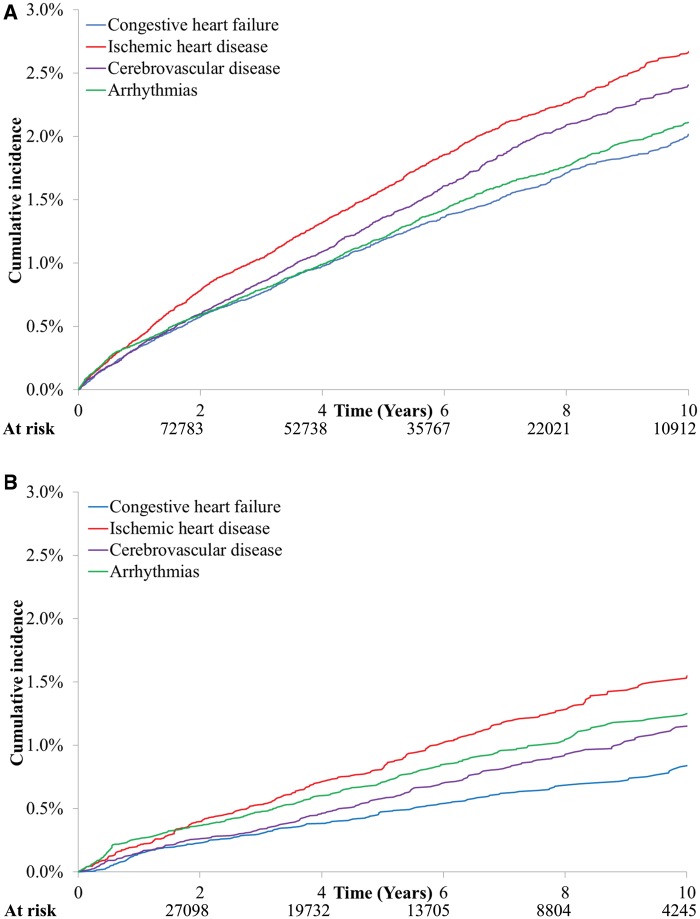
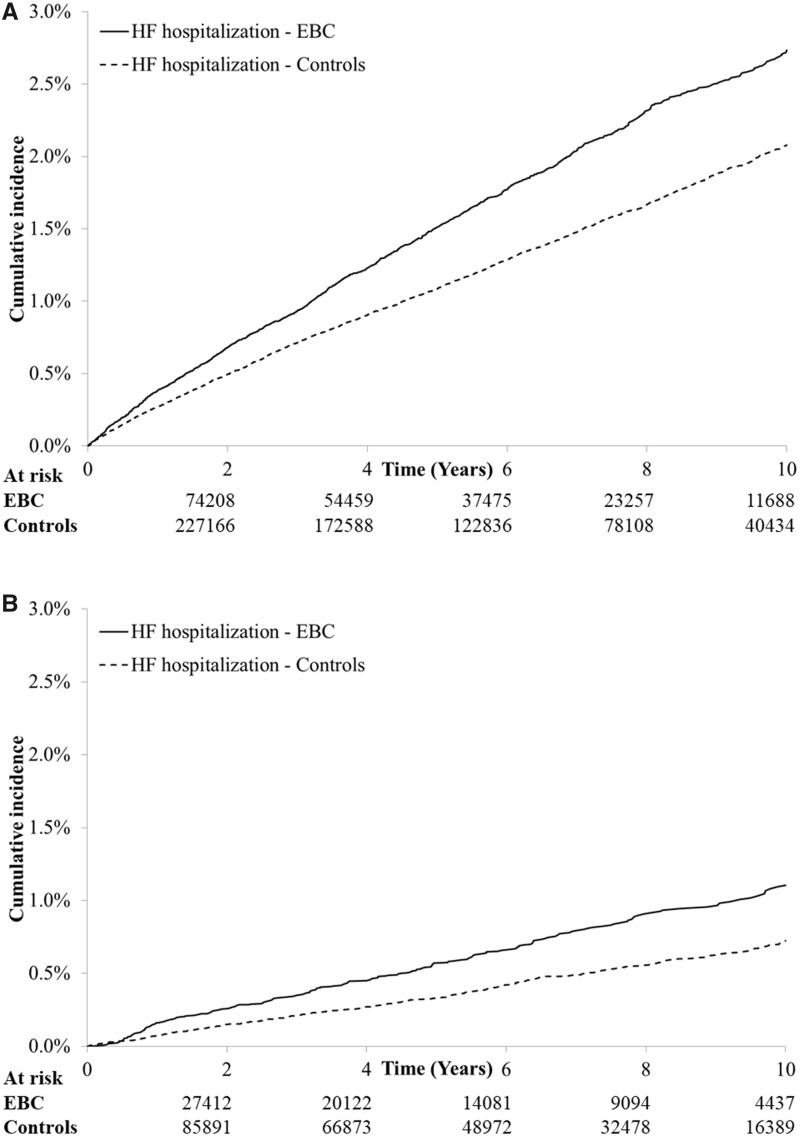
Results: We identified 78 318 EBC patients and 234 954 control subjects. The 10-year incidence of CVD hospitalization was 10.8% (95% confidence interval [CI] = 10.5% to 11.1%) after EBC and 9.1% (95% CI = 8.9% to 9.2%) in control subjects. Ischemic heart disease was the most common reason for CVD hospitalization after EBC. After regression adjustment, the relative rates compared with control subjects remained statistically significantly elevated for HF (hazard ratio [HR] = 1.21, 95% CI = 1.14 to 1.29, P < .001), arrhythmias (HR = 1.31, 95% CI = 1.23 to 1.39, P < .001), and cerebrovascular disease (HR 1.10, 95% CI = 1.04 to 1.17, P = .002) hospitalizations. It was rare for HF hospital presentations (2.9% of cases) to occur in EBC patients without recognized risk factors (age >60 years, hypertension, diabetes, prior CVD). Anthracycline and/or trastuzumab were used in 28 950 EBC patients; they were younger than the overall cohort with lower absolute rates of CVD, hypertension, and diabetes. However, they had higher relative rates of CVD in comparison with age-matched control subjects.
Conclusions: Atherosclerotic diagnoses, rather than HF, were the most common reasons for CVD hospitalization after EBC. HF hospital presentations were often preceded by risk factors other than chemotherapy, suggesting potential opportunities for prevention.
© The Author(s) 2019. Published by Oxford University Press.
Figures
Comment in
-
Cardiac Disease After Breast Cancer Treatment: Make Sure to Check Our Blind Spot!J Natl Cancer Inst. 2019 Aug 1;111(8):762-763. doi: 10.1093/jnci/djy219. J Natl Cancer Inst. 2019. PMID: 30715396 Free PMC article. No abstract available.
References
-
- Jones LW, Haykowsky MJ, Swartz JJ, et al. Early breast cancer therapy and cardiovascular injury. J Am Coll Cardiol. 2007;5015:1435–1441. - PubMed
-
- Abdel-Qadir H, Austin PC, Lee DS, et al. A population-based study of cardiovascular mortality following early-stage breast cancer. JAMA Cardiol. 2017;21:88–93. - PubMed
-
- Chen J, Long JB, Hurria A, et al. Incidence of heart failure or cardiomyopathy after adjuvant trastuzumab therapy for breast cancer. J Am Coll Cardiol. 2012;6024:2504–2512. - PubMed
-
- Cardinale D, Colombo A, Bacchiani G, et al. Early detection of anthracycline cardiotoxicity and improvement with heart failure therapy. Circulation. 2015;13122:1981–1988. - PubMed
-
- Thavendiranathan P, Abdel-Qadir H, Fischer HD, et al. Breast cancer therapy-related cardiac dysfunction in adult women treated in routine clinical practice: a population-based cohort study. J Clin Oncol. 2016;3419:2239–2246. - PubMed
Publication types
MeSH terms
Substances
Grants and funding
LinkOut - more resources
Full Text Sources
Medical
Research Materials
Miscellaneous
