. 2019 Feb;38(2):295-302.
doi: 10.1377/hlthaff.2018.05266.

Qualifying Conditions Of Medical Cannabis License Holders In The United States

Affiliations

Qualifying Conditions Of Medical Cannabis License Holders In The United States

Kevin F Boehnke et al. Health Aff (Millwood). 2019 Feb.

Erratum in

  • Errata.
    [No authors listed] [No authors listed] Health Aff (Millwood). 2019 Mar;38(3):511. doi: 10.1377/hlthaff.2019.00175. Health Aff (Millwood). 2019. PMID: 30830814 No abstract available.
  • Errata.
    [No authors listed] [No authors listed] Health Aff (Millwood). 2019 Nov;38(11):1953. doi: 10.1377/hlthaff.2019.01452. Health Aff (Millwood). 2019. PMID: 31682509 No abstract available.

Abstract

The evidence for cannabis's treatment efficacy across different conditions varies widely, and comprehensive data on the conditions for which people use cannabis are lacking. We analyzed state registry data to provide nationwide estimates characterizing the qualifying conditions for which patients are licensed to use cannabis medically. We also compared the prevalence of medical cannabis qualifying conditions to recent evidence from the National Academies of Sciences, Engineering, and Medicine report on cannabis's efficacy in treating each condition. Twenty states and the District of Columbia had available registry data on patient numbers, and fifteen states had data on patient-reported qualifying conditions. Chronic pain is currently and historically the most common qualifying condition reported by medical cannabis patients (64.9 percent in 2016). Of all patient-reported qualifying conditions, 85.5 percent had either substantial or conclusive evidence of therapeutic efficacy. As medical cannabis use continues to increase, creating a nationwide patient registry would facilitate better understanding of trends in use and of its potential effectiveness.


Figures
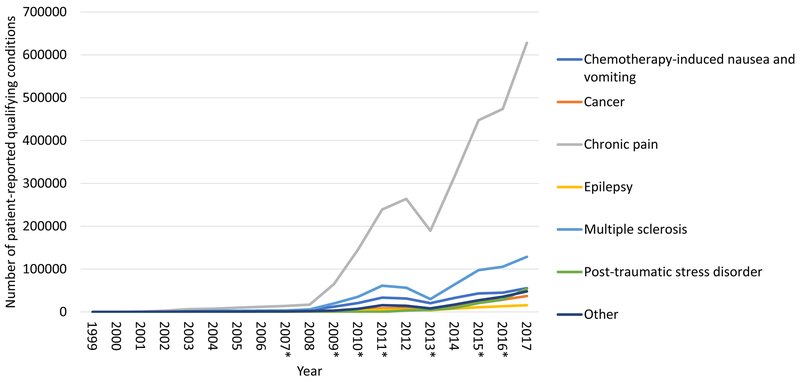
Exhibit 2:
Exhibit 2:
Changes in number of patient-reported qualifying conditions by year, 1999–2017 Notes. SOURCE: Author’s analysis of state medical cannabis registry data. Number of patient-reported qualifying conditions over time. *: indicates the years with missing values. For Michigan, data are missing for 2010 and 2013. For Rhode Island, data are missing for 2007, 2009, 2011, 2013, 2015, and 2016. A sharp dip in qualifying conditions exhibited in 2013 is attributable to the large number of patients in Michigan unaccounted for in this year.
Exhibit 3:
Exhibit 3:
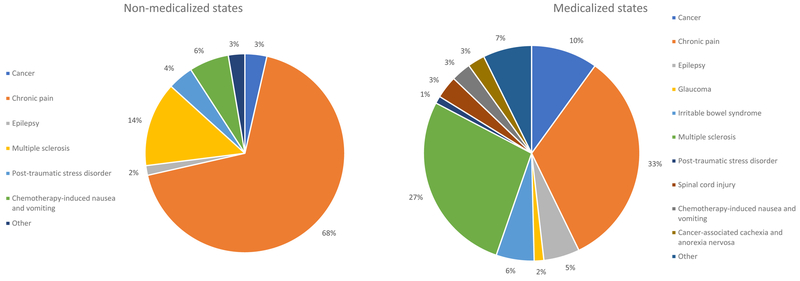
Differences in patient-reported qualifying conditions between medicalized and non-medicalized states in 2016 Notes. SOURCE: Author’s analysis of state medical cannabis registry data. Differences in patient-reported qualifying conditions between medicalized and non-medicalized states using active patient data from 2016. (6) There were n=46,386 patient-reported qualifying conditions and n=31,168 patients in medicalized states, where states have more than one requirements pertaining to doctor-patient relationship, physician training, supply chain, etc. There were n=675,475 qualifying conditions and n=560,728 patients in non-medicalized states, which have zero or one similar requirements. Not all 20 states with registries are included because several do not provide data on qualifying conditions. Non-medicalized states include: Arizona, Colorado, Hawaii, Michigan, Montana, Nevada, New Mexico, and Oregon. Medicalized states include Delaware, Illinois, Minnesota, New Hampshire, New Jersey, and New York.
Exhibit 4.
Exhibit 4.
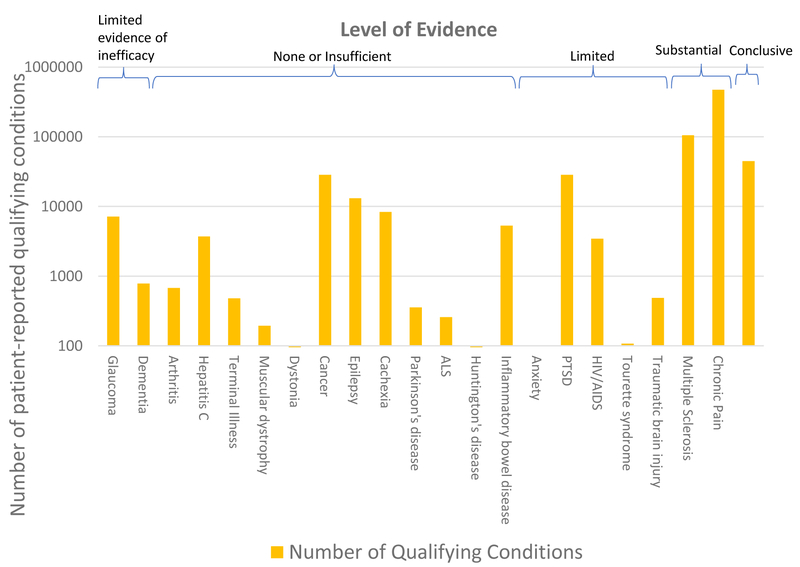
Medical cannabis: qualifying conditions counts, level of evidence, and state regulations. Notes. SOURCE: Author’s analysis of state medical cannabis registry data as of 2016. The number of patient-reported qualifying conditions is portrayed in gold. The level of evidence from the 2017 NASEM report is displayed in brackets at the top of the exhibit. All conditions had at least one associated patients except anxiety, which is currently allowed as a qualifying condition in West Virginia (a state with no available data) and was recently added in New Jersey.

References

    1. Procon.org. 33 Legal Medical Marijuana States and DC. 2018.
    1. Procon.org. Number of Legal Medical Marijuana Patients. 2018.
    1. Fairman BJ. Trends in registered medical marijuana participation across 13 US states and District of Columbia. Drug Alcohol Depend. 2016;159:72–9. - PMC - PubMed
    1. The National Academies of Sciences, Engineering, and Medicine. The Health Effects of Cannabis and Cannabinoids. 2017. Report No.: 978–0-309-45304-2.
    1. Institute of Medicine. Relieving Pain in America: A Blueprint for Transforming Prevention, Care, Education, and Research. Washington, DC: The National Academies Press; 2011. - PubMed

Publication types

Substances