


No Association Between Vitamin D Status and Risk of Barrett's Esophagus or Esophageal Adenocarcinoma: A Mendelian Randomization Study
- PMID: 30716477
- PMCID: PMC6675666
- DOI: 10.1016/j.cgh.2019.01.041
No Association Between Vitamin D Status and Risk of Barrett's Esophagus or Esophageal Adenocarcinoma: A Mendelian Randomization Study
Abstract
Background & aims: Epidemiology studies of circulating concentrations of 25 hydroxy vitamin D (25(OH)D) and risk of esophageal adenocarcinoma (EAC) have produced conflicting results. We conducted a Mendelian randomization study to determine the associations between circulating concentrations of 25(OH)D and risks of EAC and its precursor, Barrett's esophagus (BE).
Methods: We conducted a Mendelian randomization study using a 2-sample (summary data) approach. Six single-nucleotide polymorphisms (SNPs; rs3755967, rs10741657, rs12785878, rs10745742, rs8018720, and rs17216707) associated with circulating concentrations of 25(OH)D were used as instrumental variables. We collected data from 6167 patients with BE, 4112 patients with EAC, and 17,159 individuals without BE or EAC (controls) participating in the Barrett's and Esophageal Adenocarcinoma Consortium, as well as studies from Bonn, Germany, and Cambridge and Oxford, United Kingdom. Analyses were performed separately for BE and EAC.
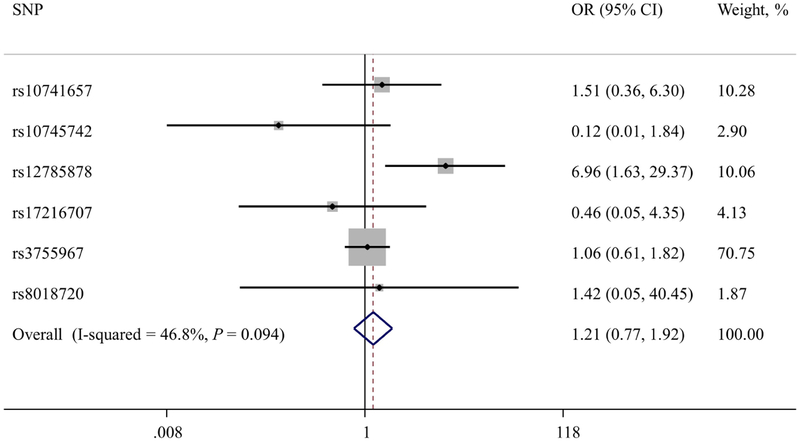
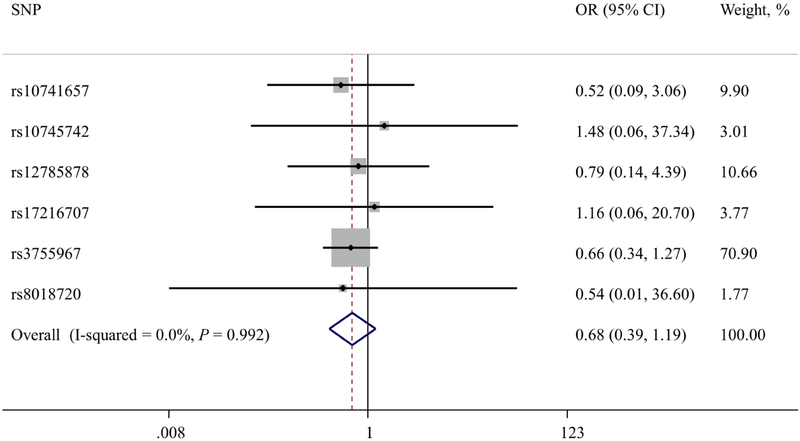
Results: Overall, we found no evidence for an association between genetically estimated 25(OH)D concentration and risk of BE or EAC. The odds ratio per 20 nmol/L increase in genetically estimated 25(OH)D concentration for BE risk estimated by combining the individual SNP association using inverse variance weighting was 1.21 (95% CI, 0.77-1.92; P = .41). The odds ratio for EAC risk, estimated by combining the individual SNP association using inverse variance weighting, was 0.68 (95% CI, 0.39-1.19; P = .18).
Conclusions: In a Mendelian randomization study, we found that low genetically estimated 25(OH)D concentrations were not associated with risk of BE or EAC.
Keywords: BEACON; Chemoprevention; Esophageal Cancer; Etiology; Risk Factors.
Copyright © 2019 AGA Institute. Published by Elsevier Inc. All rights reserved.
Conflict of interest statement
Figures
References
Publication types
MeSH terms
Substances
Supplementary concepts
Grants and funding
LinkOut - more resources
Full Text Sources
Medical
