Review
. 2019 Feb 1;9(2):52.
doi: 10.3390/biom9020052.

Biological Actions of the Hsp90-binding Immunophilins FKBP51 and FKBP52

Affiliations
Review

Biological Actions of the Hsp90-binding Immunophilins FKBP51 and FKBP52

Nadia R Zgajnar et al. Biomolecules. .

Abstract

Immunophilins are a family of proteins whose signature domain is the peptidylprolyl-isomerase domain. High molecular weight immunophilins are characterized by the additional presence of tetratricopeptide-repeats (TPR) through which they bind to the 90-kDa heat-shock protein (Hsp90), and via this chaperone, immunophilins contribute to the regulation of the biological functions of several client-proteins. Among these Hsp90-binding immunophilins, there are two highly homologous members named FKBP51 and FKBP52 (FK506-binding protein of 51-kDa and 52-kDa, respectively) that were first characterized as components of the Hsp90-based heterocomplex associated to steroid receptors. Afterwards, they emerged as likely contributors to a variety of other hormone-dependent diseases, stress-related pathologies, psychiatric disorders, cancer, and other syndromes characterized by misfolded proteins. The differential biological actions of these immunophilins have been assigned to the structurally similar, but functionally divergent enzymatic domain. Nonetheless, they also require the complementary input of the TPR domain, most likely due to their dependence with the association to Hsp90 as a functional unit. FKBP51 and FKBP52 regulate a variety of biological processes such as steroid receptor action, transcriptional activity, protein conformation, protein trafficking, cell differentiation, apoptosis, cancer progression, telomerase activity, cytoskeleton architecture, etc. In this article we discuss the biology of these events and some mechanistic aspects.

Keywords: FKBP51; FKBP52; Hsp90; NF-B; cell differentiation; dynein; neurodifferentiation; telomerase.


Conflict of interest statement

The authors declare no conflicts of interest.

Figures
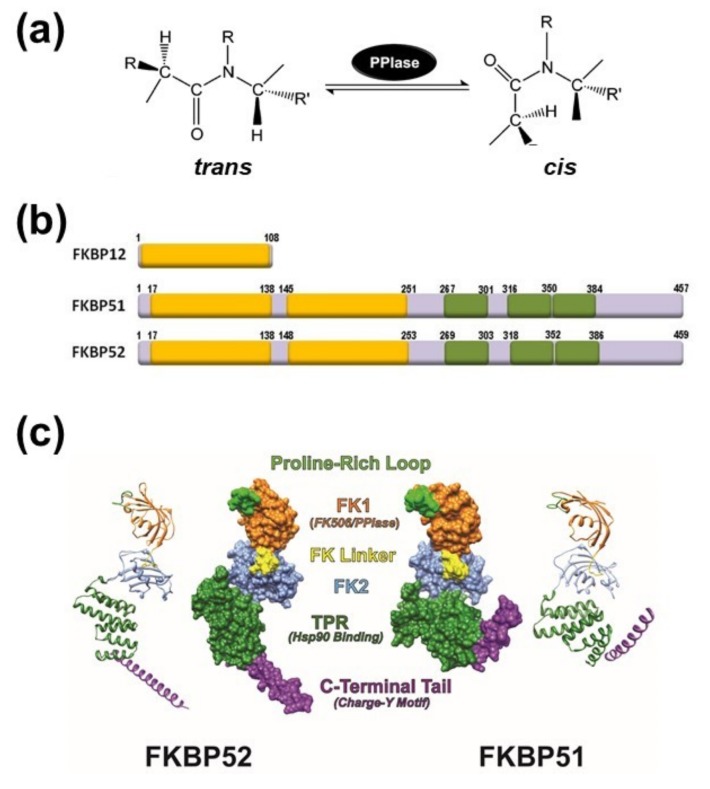
Figure 1
Figure 1
(a) Schematic representation of the peptidyl-prolyl isomerase (cis/trans) isomerization activity (PPIase). (b) Schematic structures of FK506-binding protein of 12-kDa (FKBP12) (acc.# AAA58476), FKBP51 (acc.# Q13451) and FKBP52 (acc.# NP_002005). The PPIase domain is depicted as yellow boxes. Only the FK1 domain (the extreme N-terminal of the protein) has PPIase activity. Tetratricopeptide repeats (TPRs) are shown in green color. (c) Ribbon and molecular surface depictions of hFKBP51 crystallo-graphic structure (right) and overlapping fragments encompassing the full length hFKBP52 crystallographic structure (left) are also shown. Note in both proteins that the FK1 domains (orange) containing the PPIase catalytic pocket and the Proline-Rich Loop (green) are connected to the FK2 domain (blue) by the FK Linker (yellow). Both proteins show TPR domains (purple) where Hsp90 binds. Structures were derived from the RCSB PDB (FKBP51: 1KT0; FKBP52: 1Q1C & 1P5Q) with Viewer-Lite 5.0 (Sharpened Productions Inc, Sioux City, IA, USA).
Figure 2
Figure 2
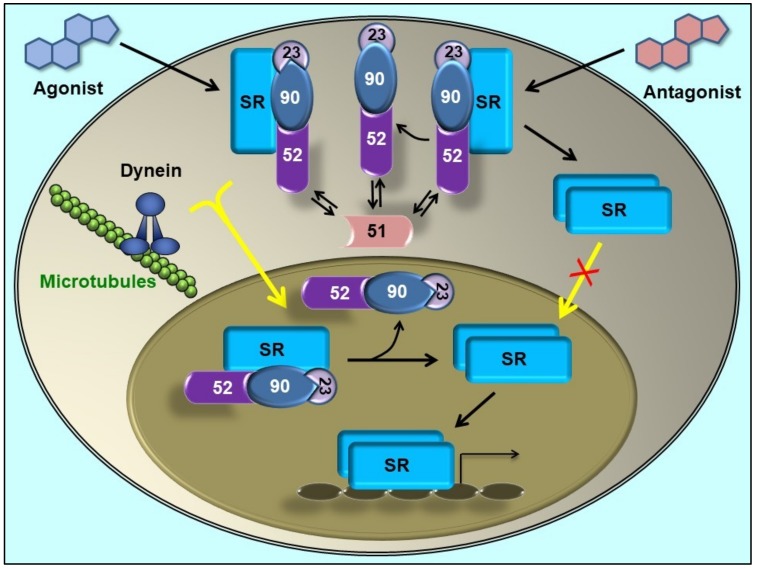
Steroid receptor (SR) retrotransport is affected by immunophilins. The mature form of SR forms complexes with a dimer of Hsp90, one molecule of Hsp70 (not depicted in this figure), the co-chaperone p23, and one TPR-domain immunophilin [51]. FKBP51 (unable to interact with dynein [18]) is associated to the empty SR. When the steroid binds, FKBP51 is exchanged by FKBP52 due to a ligand-induced conformational change of the receptor [52]. In turn, FKBP52 recruits the dynein-dynactin motor complex to its PPIase domain [41]. The complex is rapidly (T0.5= 5 min) transported to the nucleus on cytoskeleton tracks. SR ‘transformation’ (i.e. the dissociation of the Hsp90-based complex) is a nuclear event [42]. Some antagonists can promote the release of Hsp90 in the cytoplasm, such that SR does not reach the nucleus [50]. Note that regardless of the SR primary localization, they are constantly cycling between the nuclear and cytoplasmic subcellular compartments [45,53], even when the final equilibrium may be displaced to a given cell compartment. When the steroid promotes the full nuclear accumulation of the SR, it still cycles. The disruption of the “transportosome” by any means (Hsp90-disrupting drugs, dynein inhibitors, overexpression of the PPIase or TPR domain, ATP depletion, low temperature, etc.) does not prevent SR movement, but it is one order of magnitude slower (T0.5= 45–60 min) than the active mechanism. It is thought that this residual movement represents the diffusion of the complex through the crowded filamentous milieu [54] (Figure adapted from [55],with permission from the publisher).

References

    1. Schiene-Fischer C. Multidomain Peptidyl Prolyl cis/trans Isomerases. Biochim. Biophys. Acta. 2015;1850:2005–2016. doi: 10.1016/j.bbagen.2014.11.012. - DOI - PubMed
    1. Kang C.B., Hong Y., Dhe-Paganon S., Yoon H.S. FKBP family proteins: Immunophilins with versatile biological functions. Neurosignals. 2008;16:318–325. doi: 10.1159/000123041. - DOI - PubMed
    1. Kino T., Hatanaka H., Miyata S., Inamura N., Nishiyama M., Yajima T., Goto T., Okuhara M., Kohsaka M., Aoki H., et al. FK-506, a novel immunosuppressant isolated from a Streptomyces. II. Immunosuppressive effect of FK-506 in vitro. J. Antibiot. 1987;40:1256–1265. doi: 10.7164/antibiotics.40.1256. - DOI - PubMed
    1. Kino T., Hatanaka H., Hashimoto M., Nishiyama M., Goto T., Okuhara M., Kohsaka M., Aoki H., Imanaka H. FK-506, a novel immunosuppressant isolated from a Streptomyces. I. Fermentation, isolation, and physico-chemical and biological characteristics. J. Antibiot. 1987;40:1249–1255. doi: 10.7164/antibiotics.40.1249. - DOI - PubMed
    1. Ruegger A., Kuhn M., Lichti H., Loosli H.R., Huguenin R., Quiquerez C., von Wartburg A. [Cyclosporin A, a Peptide Metabolite from Trichoderma polysporum (Link ex Pers.) Rifai, with a remarkable immunosuppressive activity] Helv. Chim. Acta. 1976;59:1075–1092. doi: 10.1002/hlca.19760590412. - DOI - PubMed

Publication types

LinkOut - more resources