. 2019 Feb 2;16(3):443.
doi: 10.3390/ijerph16030443.

Control of Contaminant Transport Caused by Open-Air Heavy Metal Slag in Zhehai, Southwest China

Affiliations

Control of Contaminant Transport Caused by Open-Air Heavy Metal Slag in Zhehai, Southwest China

Jiang Zhao et al. Int J Environ Res Public Health. .

Abstract

Slag heaps are formed by mining waste materials, and the improper treatment of leachate from such heaps can threaten nearby aquifers. The Zhehai slag heap in Yunnan Province, China, contains 2.7 million tons of zinc and cadmium slag, and is considered a heavy metal source threatening the local groundwater safety, however, the severity of contamination remains unknown. In this study, numerical modeling was used to predict the groundwater flow and contaminant transport in this area based on field data. The results show that the atmospheric precipitation infiltration recharge at the top of the heap is 81.8 m³/d, accounting for 93.76% of total infiltration. The south and east sides of the area are the main outflow channels for contaminants, accounting for 93.25% of the total discharge around the heap. To reduce aquifer contamination, an in situ system involving a "controlling the source, 'breaking' the path, and intercepting the flow" (CSBPIF) strategy is established. The results indicate that the system performs well because it not only decreases the flow velocity but also reduces the concentrations of contaminants adsorbed by clay media. Moreover, the equivalent bottom liner thicknesses of the clay layers were calculated to improve the applicability of the CSBPIF system. Compared with ex situ disposal, this scheme provides an economic and effective solution and can be used to prevent and control groundwater pollution in China.

Keywords: groundwater modeling; in situ treatment; open-air heavy metal; reactive transport.


Conflict of interest statement

The authors declare no conflict of interest.

Figures

Figure 1
Figure 1
Flow chart for control of contaminant transport caused by open-air heavy metal slag.
Figure 2
Figure 2
(a): Geological–hydrogeological map of the study area in the northwestern Zhehai Basin, northeastern Yunnan Province (China). (b): Locations map of the hydraulic head and groundwater quality observation points (boreholes, farm wells and depression springs). The study area border, the gullies (①-East gully, ② and ③-West gullies) and the research cross-sections (A–A’ and B–B’) is also located.
Figure 3
Figure 3
Cross-sections A–A’ (A) and B–B’ (B) of the geometrical-structural and two-aquifer groundwater system in the study area (Figure 2 shows cross-section locations).
Figure 4
Figure 4
Groundwater level contour map in 2014: (a) is the water level contour map of pore water, and (b) is the water level contour map of lower pore-fissure water.
Figure 5
Figure 5
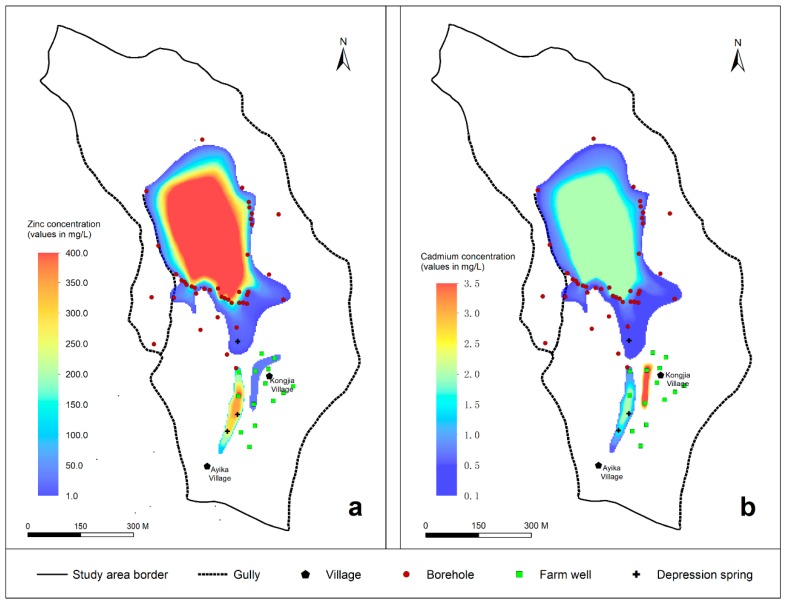
Concentrations of the characteristic pollutants in the pore water: (a) Zn and (b) Cd.
Figure 6
Figure 6
Three-dimensional(3D) numerical model and boundary conditions of the study area.
Figure 7
Figure 7
Hydraulic conductivity zone map: (a)-Slag heap layer (A), (b)-Earth filling layer (B), (c)-Deluvial material layer (C1, C2, C3, C4, and C5), (d)-Eluvial deposit layer (D), and (e)-Decayed basalt (E).
Figure 8
Figure 8
Model-simulated groundwater level contour maps and calibration curves under steady flow conditions: (a) Pore space groundwater level map, (b) Deep pore-fissure groundwater level map and (c) Calibration curves of the simulated and observed groundwater levels (comparison with 2014 values for 58 observation points).
Figure 9
Figure 9
Comparison of the simulated groundwater level and measured groundwater level in different long-term observation wells under unsteady flow conditions (from January 2014 to January 2015).
Figure 10
Figure 10
Model-simulated concentrations of the characteristic pollutants in the pore water: (a) Zn; (b) Cd; (c) Cross-section A1–A1’; and (d) Cross-section B1–B1’. DM: Deluvial Material, ED: Eluvial Deposit, BS: Basalt Stone.
Figure 11
Figure 11
Schematic diagram showing the area of the numerical model consisting of six parts: precipitation-induced infiltration and pore water flows to the north, east, west, south and bottom of the DM aquifer.
Figure 12
Figure 12
Daily average flow map for each area of the model.
Figure 13
Figure 13
Dynamic flow plot of the areas in the model.
Figure 14
Figure 14
Diagram of the groundwater pollution prevention and control engineering strategy for the slag heap, including an ecological cover project for “controlling the source”, a vertical physical barrier for “‘breaking’ the path”, and a hydraulic interception project for “intercepting the flow”.
Figure 15
Figure 15
Model-forecasted concentrations of Zn and Cd in the pore water: (a) scenario A (Zn); (b) scenario B (Zn); (c) scenario A (Cd); (d) scenario B (Cd); (e) Cross-section A2–A2’; and (f) Cross-section B2–B2’.

References

    1. De Caritat P., Danilova S., Jaeger O., Reimann C., Storro G. Groundwater composition near the nickel-copper smelting industry on the Kola Peninsula, central Barents Region (NW Russia and NE Norway) J. Hydrol. 1998;208:92–107. doi: 10.1016/S0022-1694(98)00147-4. - DOI
    1. Wurl J., Mendez-Rodriguez L., Acosta-Vargas B. Arsenic content in groundwater from the southern part of the San Antonio-El Triunfo mining district, Baja California Sur, Mexico. J. Hydrol. 2014;518:447–459. doi: 10.1016/j.jhydrol.2014.05.009. - DOI
    1. Gong X., Chen Z.H., Luo Z.H. Spatial distribution, temporal variation, and sources of heavy metal pollution in groundwater of a century-old nonferrous metal mining and smelting area in China. Environ. Monit. Assess. 2014;186:9101–9116. doi: 10.1007/s10661-014-4069-y. - DOI - PubMed
    1. Song Y.N., Hou D.Y., Zhang J.L., O’Connor D., Li G.H., Cu Q.B., Li S.P., Liu P. Environmental and socio-economic sustainability appraisal of contaminated land remediation strategies: A case study at a mega-site in China. Sci. Total Environ. 2018;610:391–401. doi: 10.1016/j.scitotenv.2017.08.016. - DOI - PubMed
    1. Khan S., Hesham A.E.L., Qiao M., Rehman S., He J.Z. Effects of Cd and Pb on soil microbial community structure and activities. Environ. Sci. Pollut. Res. 2010;17:288–296. doi: 10.1007/s11356-009-0134-4. - DOI - PubMed

Publication types