Review
. 2019 Mar;48(1):109-124.
doi: 10.1016/j.ecl.2018.11.007.

Genetic-guided Risk Assessment and Management of Thyroid Cancer

Affiliations
Review

Genetic-guided Risk Assessment and Management of Thyroid Cancer

Mingzhao Xing. Endocrinol Metab Clin North Am. 2019 Mar.

Abstract

Controversies exist on how to optimally manage thyroid cancer because the prognosis is often uncertain based on clinical backgrounds. This can now be helped with prognostic genetic markers in thyroid cancer, exemplified by BRAF V600E and TERT promoter mutations, which have been well characterized and widely appreciated. The genetic duet of BRAF V600E/RAS and TERT promoter mutations is a most robust prognostic genetic pattern for poor prognosis of differentiated thyroid cancer. The high negative predictive values of the prognostic genetic markers are equally valuable. The best prognostic value of genetic markers in thyroid cancer is achieved through a clinical risk level-based and genotype-individualized manner.

Keywords: BRAF V600E mutation; Genetic molecular marker; Prognosis; RAS mutation; Risk stratification; TERT promoter Mutation; Thyroid cancer.


Conflict of interest statement

Conflict of Interest Disclosure:

Mingzhao Xing receives royalties as co-holder of a licensed USA patent related to BRAF V600E mutation in thyroid cancer.

Figures

Figure 1.
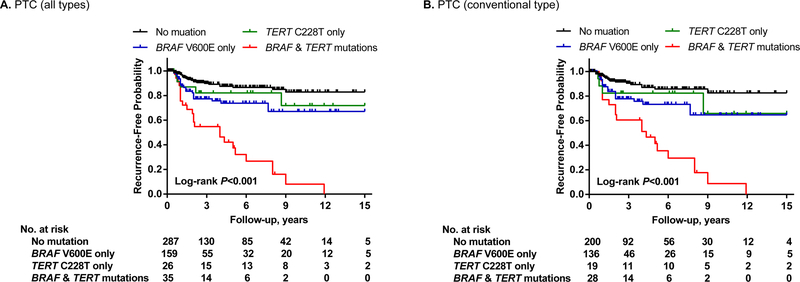
Figure 1.. Impacts of BRAF V600E or TERT promoter mutation alone or their coexistence on disease-free survival of patients with papillary thyroid cancer (PTC).
Kaplan-Meier analyses of 507 patients with PTC were performed. Panel A shows the analysis results of patients with PTC of all types and Panel B shows the analysis results of patients with conventional-variant PTC only. Four groups of patients were included in each panel, including patients with neither mutation (black line), TERT mutation only (green line), BRAF V600E mutation only (blue line), and the genetic duet of the two coexisting mutations (red line). Adapted from Xing et al. J Clin Oncol. 2014;32(25):2718–26 (Reference 45) with permission.
Figure 2.
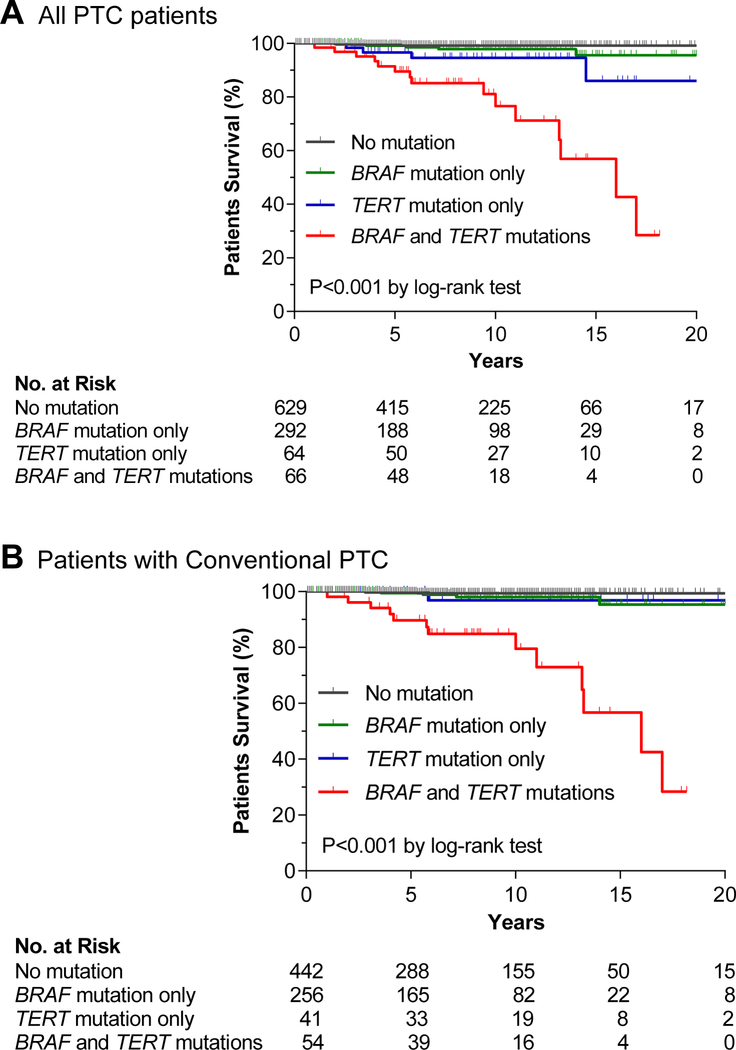
Figure 2.. Impacts of BRAF V600E or TERT promoter mutation alone or their coexistence on disease-specific survival of patients with papillary thyroid cancer (PTC).
Kaplan-Meier analyses of 1,051 patients with PTC were performed. Panels A and B show the analysis results of patients with PTC of all types and only patients with conventional-variant PTC, respectively. In each panel, the patients were divided into four genotype groups— no mutation (black line), BRAF V600E only (green line), TERT promoter mutation only (blue line), and genetic duet of the two coexisting mutations (red line). Adapted from Liu R et al. JAMA Oncol. 2017;3(2):202– 208 (Reference 39) with permission.
Figure 3.
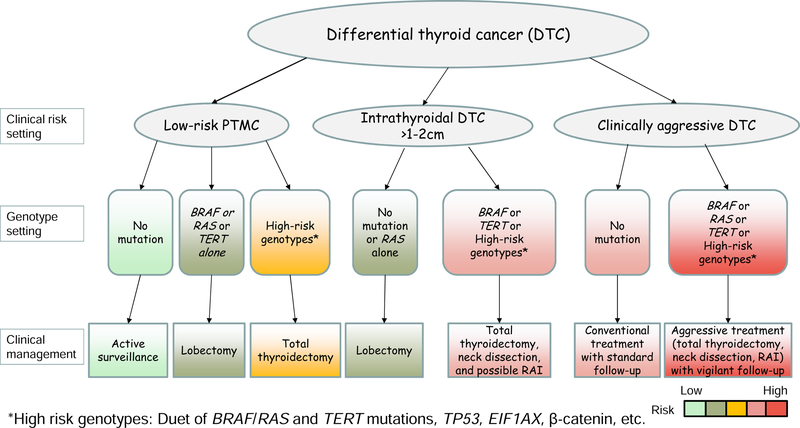
Figure 3.. Summary of the clinical application of major prognostic genetic markers in thyroid cancer.
The diagram shows how thyroid cancer at different clinical risk levels in various clinical settings can be appropriately treated with the guidance of specific individual genotypes. DTC, differentiated thyroid cancer; PTMC, papillary thyroid microcarcinoma; RAI, radioactive iodine. *High-risk genotypes include the duet of BRAF V600E/RAS and TERT promoter mutations, TP53, EIF1A, β-catenin mutations, etc.

References

    1. Xing M Molecular pathogenesis and mechanisms of thyroid cancer. Nat Rev Cancer 2013;13(3):184–99. - PMC - PubMed
    1. Mao Y, Xing M. Recent incidences and differential trends of thyroid cancer in the USA. Endocr Relat Cancer 2016;23(4):313–22. - PMC - PubMed
    1. Shi X, Liu R, Basolo F, et al. Differential Clinicopathological Risk and Prognosis of Major Papillary Thyroid Cancer Variants. J Clin Endocrinol Metab 2016;101(1):264–74. - PMC - PubMed
    1. Lloyd RV, Osamura RY, Klöppel G, Rosai J, eds. WHO classification of tumours of endocrine organs (4th ed). Lyon, France: International Agency for Research on Cancer (IARC); 2017.
    1. Haugen BR, Alexander EK, Bible KC, et al. 2015 American Thyroid Association Management Guidelines for Adult Patients with Thyroid Nodules and Differentiated Thyroid Cancer: The American Thyroid Association Guidelines Task Force on Thyroid Nodules and Differentiated Thyroid Cancer. Thyroid 2016;26(1):1–133. - PMC - PubMed

Publication types

Substances