


Visit-to-visit HbA1c and glucose variability and the risks of macrovascular and microvascular events in the general population
- PMID: 30718626
- PMCID: PMC6362217
- DOI: 10.1038/s41598-018-37834-7
Visit-to-visit HbA1c and glucose variability and the risks of macrovascular and microvascular events in the general population
Abstract
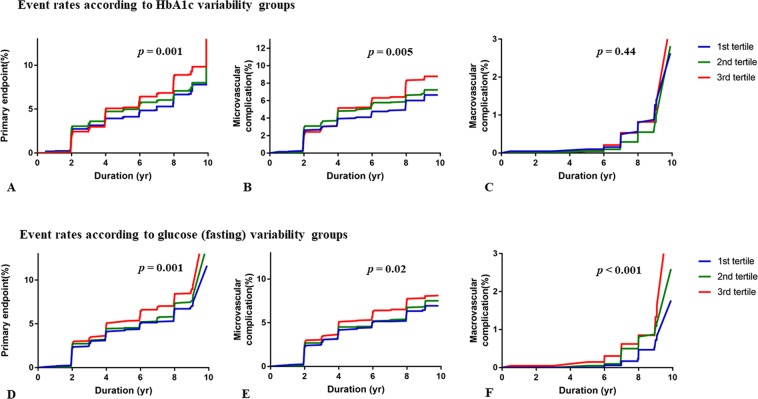
This study evaluate association between glycemic variability and adverse vascular events in nondiabetic middle-aged adults. From 10,020 Ansung-Ansan cohort, Korean Genome, and Epidemiology Study (KoGES) data. 6,462 nondiabetic adults aged <65 years was analyzed. The mean and coefficient of variation (CV) of all biannually recorded HbA1c, fasting blood glucose(FBG), and post 2 hr blood glucose (PBG) were calculated and divided into 3 groups based on tertile of CV at each measurement, respectively. Primary endpoint was composite of Macro (composite of Coronary artery disease, Myocardial infarction, Congestive heart failure or Stroke) and Microvascular event (Creatine Clearance <60 ml/min/1.73 m2). The participants (mean age: 50 years, 50% men) were followed for a median of 9.9 (9.1-10.0) years. The high HbA1c-CV tertile (odds ratio 1.30; 1.01-1.66) was independent risk factor for microvascular events. In contrast, high FBG-CV tertile (2.32; 1.30-4.12) and PBG-CV (1.85; 1.05-3.26) was for macrovascular events. In this 10-year prespective cohort study, higher HbA1c-CV tertile was associated with higher composite of macro- and microvascular events and independent risk factor in non-DM middle-aged participants. In addition, higher tertile of FBG-CV and PBG-CV were risk factors for macrovascular events.
Conflict of interest statement
The authors declare no competing interests.
Figures
References
Publication types
MeSH terms
Substances
LinkOut - more resources
Full Text Sources
Medical
