. 2019 Jan 21:9:2394.
doi: 10.3389/fpsyg.2018.02394. eCollection 2018.

Adverse Behavioral Changes in Adult Mice Following Neonatal Repeated Exposure to Pain and Sucrose

Affiliations

Adverse Behavioral Changes in Adult Mice Following Neonatal Repeated Exposure to Pain and Sucrose

Manon Ranger et al. Front Psychol. .

Abstract

Sucrose is recommended for the treatment of pain during minor procedures in preterm infants in the neonatal intensive care unit (NICU) and is currently used worldwide as the standard of care. We recently reported that adult mice repetitively exposed to sucrose compared to water during the first week of life, irrespective of exposure to an intervention, had significantly smaller brain volumes in large white matter, cortical and subcortical structures (e.g., hippocampus, striatum, fimbria). These structures are important for stress regulation and memory formation. Here, we report the effects of repeated neonatal exposure to pain and sucrose on adult behavior in mice. Neonatal C57BL/6J mice (N = 160, 47% male) were randomly assigned to one of two treatments (sucrose, water) and one of three interventions (needle-prick, tactile, handling). Pups received 10 interventions daily from postnatal day 1 (P1) to P6. A single dose of 24% sucrose or water was given orally 2 min before each intervention. At adulthood (P60-85) mice underwent behavioral testing to assess spatial memory, anxiety, motor function, pain sensitivity, and sugar preference. We found that mice that had received sucrose and handling only, had poorer short-term memory in adulthood compared to water/handling controls (p < 0.05). When exposed to pain, mice treated with repetitive sucrose or water did not differ on memory performance (p = 0.1). A sugar preference test showed that adult mice that received sucrose before an intervention as pups consumed less sugar solution compared to controls or those that received water before pain (p < 0.05). There were no significant group differences in anxiety, motor, or pain sensitivity. In a mouse model that closely mimics NICU care, we show for the first time that memory in adulthood was poorer for mice exposed to pain during the first week of life, irrespective of sucrose treatment, suggesting that sucrose does not protect memory performance when administered for pain. In the absence of pain, early repetitive sucrose exposure induced poorer short-term memory, highlighting the importance of accurate pain assessment.

Keywords: NICU; mouse model; neurodevelopmental outcomes; pain; prematurity; sucrose.


Figures
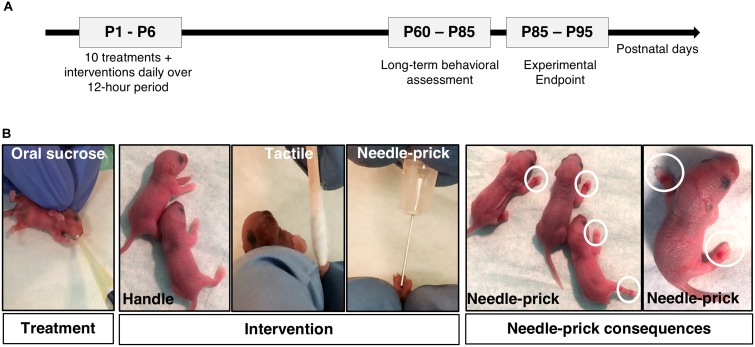
FIGURE 1
FIGURE 1
Neonatal mouse model of repetitive sucrose exposure given for procedural pain [adapted from Tremblay et al. (2017b)]. (A) Schematic illustrating the experimental protocol timeline. Long-term behavioral testing were performed between postnatal day (P) 60–85 following neonatal treatment/intervention period. (B) Images showing C57Bl/6J mouse pups receiving oral sucrose or water treatment preceding 10 daily interventions: Handle, Tactile, or Needle-prick. White circles are highlighting ecchymosis and inflamed paws seen on pups after needle-prick intervention. P, postnatal day.
FIGURE 2
FIGURE 2
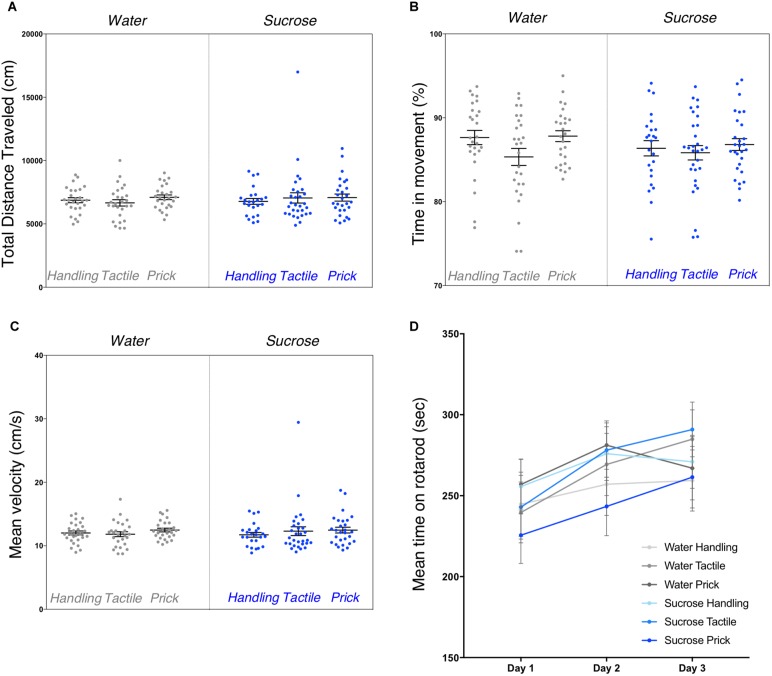
Assessment of general motor function and coordination after neonatal repetitive exposure to treatment prior to an intervention. Open-field testing performed to assess locomotion capacities in adult mice from six experimental groups. Box plots show the total distance traveled (p = 0.83) (A), the percentage of time spent in movement (p = 0.23) (B) and mean velocities (p = 0.78) (C) measured between groups. Data presented as scatter plots with mean ± SEM; horizontal bars represent mean values; black asterisks and bars denote statistical significance using ANOVA. Graph in (D) shows the mean time adult mice spent on rotarod (i.e., latency to fall) learning curves between the six experimental groups. All groups learned to stay longer on the rod over the 3 days (p < 0.0001), but there were no significant differences in time to learn over days between experimental groups (p = 0.58), or interaction between trials and groups (p = 0.58). n = 24–27 per group.
FIGURE 3
FIGURE 3
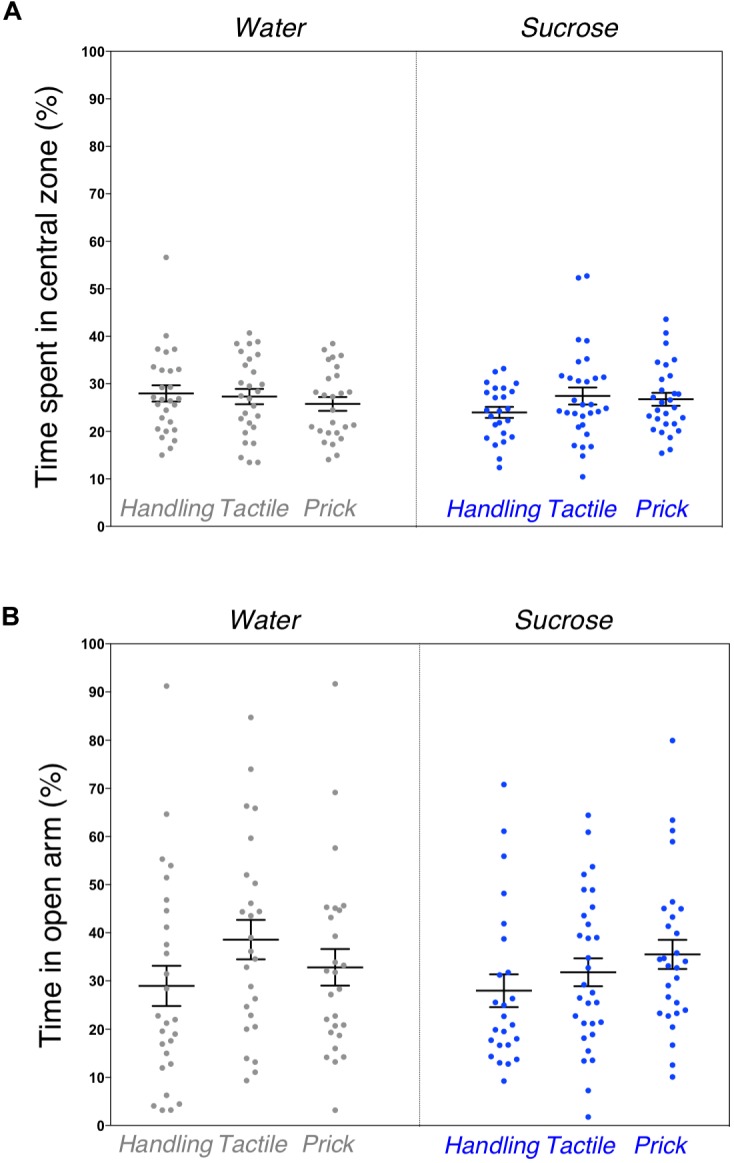
Assessment of anxious behavior after neonatal repeated exposure to treatment prior to an intervention. Box plots comparing six experimental groups (A) showing the time spent in central zone of a novel environment measured during the open field test (p = 0.55). (B) Percent of time spent in open arms of an elevated plus maze (p = 0.32). Data presented as scatter plots with mean ± SEM; horizontal bars represent mean values; black asterisks and bars denote statistical significance using ANOVA. n = 24–27 per group.
FIGURE 4
FIGURE 4
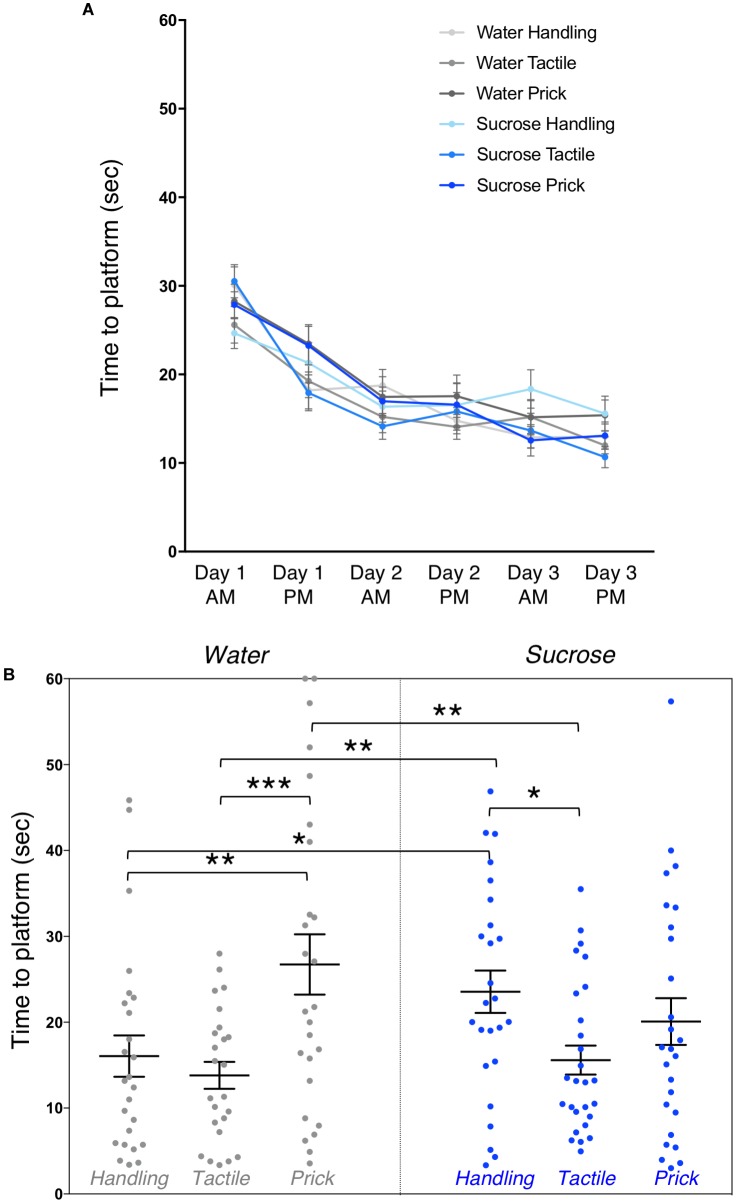
Effects of treatment and intervention on short-term memory in adulthood (Morris water maze test). (A) Training. Morris water maze learning curves are shown from testing day 1 to day 3. All groups learned to locate the platform over their six trials (p < 0.0001), but there were no significant differences in time to learn over days between experimental groups (p = 0.57), or interaction between trials and groups (p = 0.13). (B) Short-term memory. Group comparison of adult mice time to reach the area where the platform was during training during the first testing probe (1 day post-training). Compared to adult mice in the Water/Needle-prick group, mice in the Water/Handling (p = 0.003), Water/Tactile (p < 0.001) and Sucrose/Tactile (p = 0.002) groups took significantly less time to locate the “platform” on the MWM test. Compared to mice in the Sucrose/Handling group, those in the Water/Handling (p = 0.04) and Water/Tactile (p = 0.01) and Sucrose/Tactile (p = 0.02) took less time to locate the “platform.” Data presented as scatter plots with mean ± SEM; horizontal bars represent mean values; black asterisks and bars denote statistical significance using ANOVA. n = 24–27 per group. p < 0.05; ∗∗p < 0.01; ∗∗∗p < 0.001.
FIGURE 5
FIGURE 5
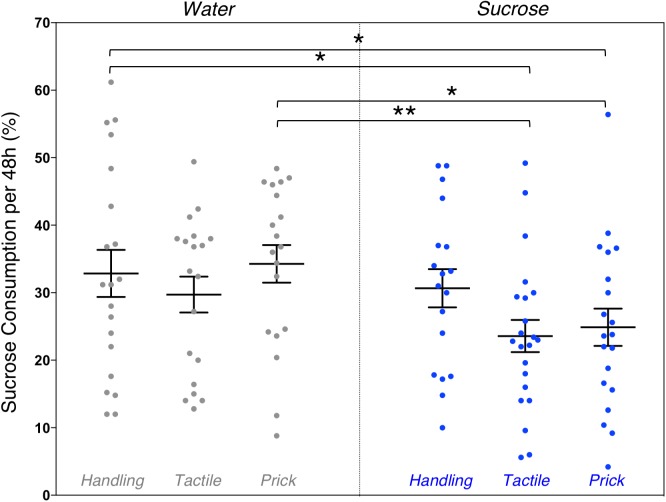
Effects of treatment and intervention on sugar preference test. Group comparisons of percent of 10% sucrose water consumed from the total liquid consumption during the 48 h sugar preference test. Compared to adult mice in the Water/Handling group (controls), those in the Sucrose/Tactile (p = 0.019) and Sucrose/Needle-prick (p = 0.047) groups consumed significantly less 10% sucrose water. Adult mice in the neonatal Sucrose/Tactile (p = 0.008) and Sucrose/Needle-prick (p = 0.021) groups consumed significantly less 10% sucrose water compared to those in the Water/Needle-prick group. Data presented as scatter plots with mean ± SEM; horizontal bars represent mean values; black asterisks and bars denote statistical significance using ANOVA. n = 18–22 per group. p < 0.05; ∗∗p < 0.01.
FIGURE 6
FIGURE 6
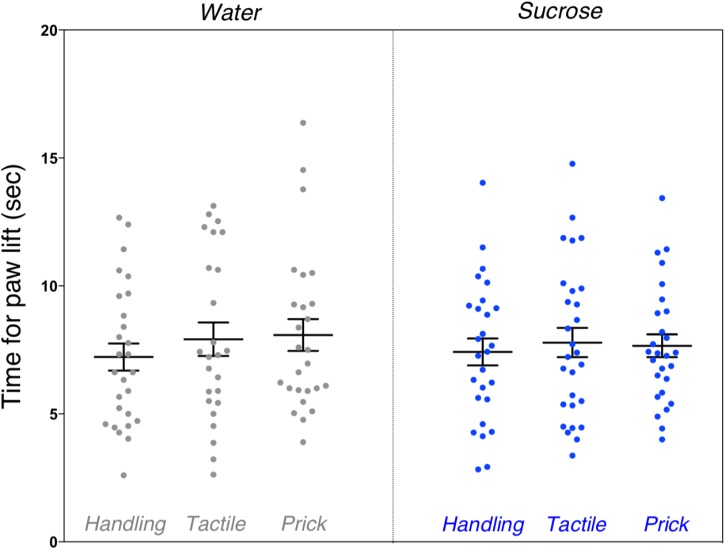
Assessment of pain threshold during hot plate test after neonatal repetitive exposure to treatment prior to an intervention. Adult mice’s mean time taken for paw lift in response to hot plate test indicative of pain threshold comparing each group. No significant difference was found between the six groups (p = 0.61). Data presented as scatter plots with mean ± SEM; horizontal bars represent mean values; black asterisks and bars denote statistical significance using ANOVA. n = 24–27 per group.

References

    1. Anand K., Coskun V., Thrivikraman K., Nemeroff C., Plotsky P. (1999). Long-term behavioral effects of repetitive pain in neonatal rat pups. Physiol. Behav. 66 627–637. 10.1016/S0031-9384(98)00338-2 - DOI - PMC - PubMed
    1. Anseloni V. C. Z., Ren K., Dubner R., Ennis M. (2005). A brainstem substrate for analgesia elicited by intraoral sucrose. Neuroscience 133 231–243. 10.1016/j.neuroscience.2005.01.055 - DOI - PubMed
    1. Avena N. M., Carrillo C. A., Needham L., Leibowitz S. F., Hoebel B. G. (2004). Sugar-dependent rats show enhanced intake of unsweetened ethanol. Alcohol 34 203–209. 10.1016/j.alcohol.2004.09.006 - DOI - PubMed
    1. Avena N. M., Rada P., Hoebel B. G. (2008). Evidence for sugar addiction: behavioral and neurochemical effects of intermittent, excessive sugar intake. Neurosci. Biobehav. Rev. 32 20–39. 10.1016/j.neubiorev.2007.04.019 - DOI - PMC - PubMed
    1. Bachmanov A. A., Reed D. R., Tordoff M. G., Price R. A., Beauchamp G. K. (1996a). Intake of ethanol, sodium chloride, sucrose, citric acid, and quinine hydrochloride solutions by mice: a genetic analysis. Behav. Genet. 26 563–573. - PMC - PubMed