


The intestinal vitamin D receptor in inflammatory bowel disease: inverse correlation with inflammation but no relationship with circulating vitamin D status
- PMID: 30719077
- PMCID: PMC6348511
- DOI: 10.1177/1756284818822566
The intestinal vitamin D receptor in inflammatory bowel disease: inverse correlation with inflammation but no relationship with circulating vitamin D status
Abstract
Background: The intestinal vitamin D receptor (VDR) remains poorly characterized in patients with inflammatory bowel disease (IBD).
Methods: Colonoscopic biopsies and intestinal resection specimens from the terminal ileum, ascending and sigmoid colon, from patients with and without IBD, were analyzed for VDR mRNA quantification by polymerase chain reaction, and protein localization and semi-quantification by immunohistochemistry. The relationship between VDR and intestinal inflammation, serum 25(OH)D and oral vitamin D intake was elicited.
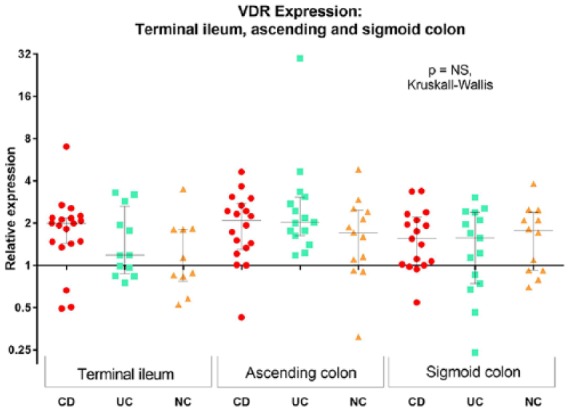
Results: A total of 725 biopsies from 20 patients with Crohn's disease (CD), 15 with ulcerative colitis (UC) and 14 non-IBD controls who underwent colonoscopy were studied. VDR gene expression and protein staining intensity was similar across all three groups, and across the intestinal segments. Sigmoid colon VDR mRNA expression inversely correlated with faecal calprotectin (r = -0.64, p = 0.026) and histological score (r = -0.67, p = 0.006) in UC, and histological score (r = -0.58, p = 0.019) in patients with CD. VDR staining intensity was higher in quiescent than diseased segments. No relationship with serum 25(OH)D or oral vitamin D intake was noted. Immunohistochemical staining of 28 intestinal resection specimens from 15 patients (5 each with CD, UC and non-IBD controls) showed diffuse VDR staining in the mucosa, submucosa and circular muscle.
Conclusions: VDR transcript expression and protein staining intensity are inversely related to inflammation in IBD, but unrelated to serum 25(OH)D, and similar to non-IBD controls. Strategies to upregulate intestinal VDR, potentially translating to modulation of disease activity, require investigation.
Keywords: Crohn’s disease; inflammatory bowel disease; ulcerative colitis; vitamin D; vitamin D receptor.
Conflict of interest statement
Conflict of interest statement: The authors declare that there is no conflict of interest.
Figures


References
-
- Garg M, Lubel JS, Sparrow MP, et al. Review article: vitamin D and inflammatory bowel disease-established concepts and future directions. Aliment Pharmacol Ther 2012; 36: 324–344. - PubMed
-
- Kong J, Zhang Z, Musch MW, et al. Novel role of the vitamin D receptor in maintaining the integrity of the intestinal mucosal barrier. Am J Physiol Gastrointest Liver Physiol 2008; 294: G208–G216. - PubMed
-
- Flanagan P. Vitamin D enhances macrophage function and improves killing of Crohn’s associated E. coli. J Crohns Colitis 2013; 7: S20.
LinkOut - more resources
Full Text Sources
