Review
. 2019 Jan 14:11:1756287218820807.
doi: 10.1177/1756287218820807. eCollection 2019 Jan-Dec.

Efficacy and safety of fexapotide triflutate in outpatient medical treatment of male lower urinary tract symptoms associated with benign prostatic hyperplasia

Affiliations
Review

Efficacy and safety of fexapotide triflutate in outpatient medical treatment of male lower urinary tract symptoms associated with benign prostatic hyperplasia

Neal Shore et al. Ther Adv Urol. .

Abstract

Male lower urinary tract symptoms (LUTS) is an increasingly important problem for the majority of late middle aged and elderly men. Fexapotide triflutate (FT) is a first in-class compound given by local injection via the transrectal intraprostatic route under ultrasound guidance. Data from >1700 FT and control injections in prospective randomized blinded controlled multicenter trials are reviewed and discussed in relation to current developments in the field of treatments for LUTS associated with benign prostatic hyperplasia (BPH). Long-term studies of FT in the United States have shown statistically significant improvement in BPH symptoms and objective outcomes including significant reduction in both spontaneous acute urinary retention as well as the subsequent incidence of BPH surgery. FT has been shown to be well tolerated with an excellent safety profile, and is an efficacious clinic-based treatment for BPH involving an intraprostatic injection that requires only a few minutes to administer, with no catheter nor anesthesia requirements.

Keywords: BPH; LUTS; fexapotide triflutate; urology.


Conflict of interest statement

Conflict of interest statement: Authors Shore and Tutrone are consultants/speakers for NeoTract. Author Shore is a consultant for NxThera. Authors Shore, Tutrone and Roehrborn are consultants for Nymox. Author Tutrone owns stock in Nymox. Author Roehrborn has a financial interest or other relationship with NxThera, NeoTract, Procept, ZenFlow and Meditate.

Figures

Figure 1.
Figure 1.
(a). Normal rat prostate gland, hematoxylin-eosin, X 400 (Figure courtesy of Nymox Corp.) (b). Rat injected intraprostatically with FT 1 mg/ml, showing apoptotic cell loss after 72 h. Hematoxylin-eosin, X400 (Figure courtesy of Nymox Corp.) (c, d). Rat injected intraprostatically with FT 1 mg/ml, showing more advanced extensive apoptotic cell loss after 72 h. Hematoxylin-eosin, X400 (Figure courtesy of Nymox Corp.) (e). Rat prostate 12 months after FT single injection 1 mg/ml, showing near total loss of prostatic glandular epithelial cell population and marked shrinkage of gland. Hematoxylin-eosin, X20 (Figure courtesy of Nymox Corp.) FT, fexapotide triflutate.
Figure 2.
Figure 2.
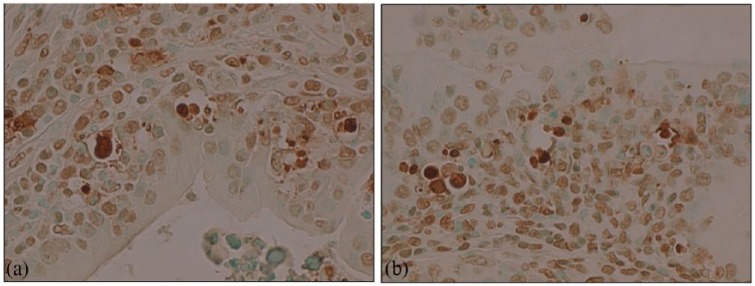
(a, b). Rat prostate after FT single injection 1 mg/ml, showing positive staining with TUNEL, X400 original magnification (Figures courtesy of Nymox Corp.). FT, fexapotide triflutate.
Figure 3.
Figure 3.
(a). LNCAP prostate cancer cells in vitro 48 h post-treatment with FT 2.5 mg/ml, TUNEL stain, viewed under UV light, X600. Green fluorescence indicates cells undergoing apoptosis (Figures courtesy of Nymox Corp.). (b). Electron micrograph of apoptotic cell in vitro 48 h after FT 2.5 mg/ml treatment illustrating prominent nuclear bleb formation (Figure courtesy of Nymox Corp.). FT, fexapotide triflutate; LNCAP, lymph node carcinoma of the prostate; UV, ultraviolet.
Figure 4.
Figure 4.
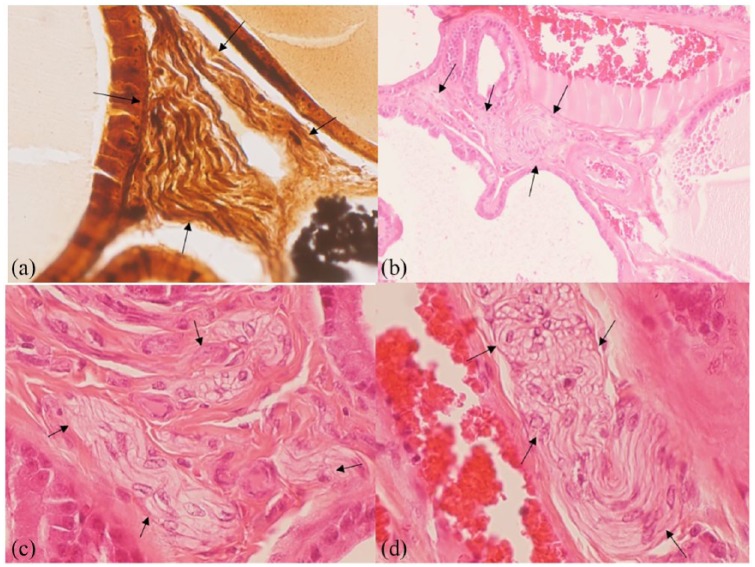
Rat prostate after FT administration with near total loss of glandular epithelial cell populations, showing normal surviving nerve fibers (arrows) in fields with total loss of prostate glandular epithelium. (a). Rat prostate 3 months after FT 2 mg/ml administration once weekly for 1st month. Bielschowsky, X400 (Figure courtesy of Nymox Corp.). (b, c). Rat prostate 12 months after FT 1 mg/ml administration once weekly for 1st month. Hematoxylin-eosin, B) X100; C) X400 (Figure courtesy of Nymox Corp.). (d). Rat prostate 12 months after FT 2 mg/ml administration once weekly for 1st month. Hematoxylin-eosin X400 (Figure courtesy of Nymox Corp.). FT, fexapotide triflutate.
Figure 5.
Figure 5.
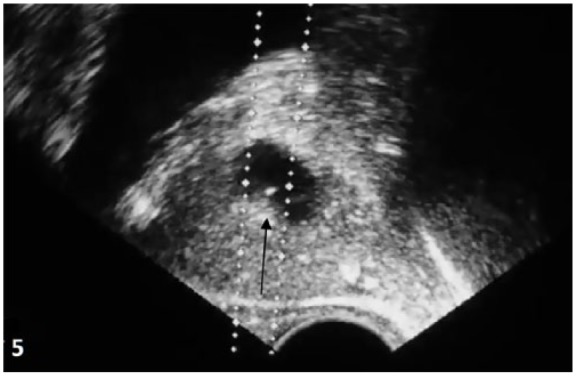
Ultrasound image showing FT injection (arrow) in parasagittal view. FT, fexapotide triflutate.
Figure 6.
Figure 6.
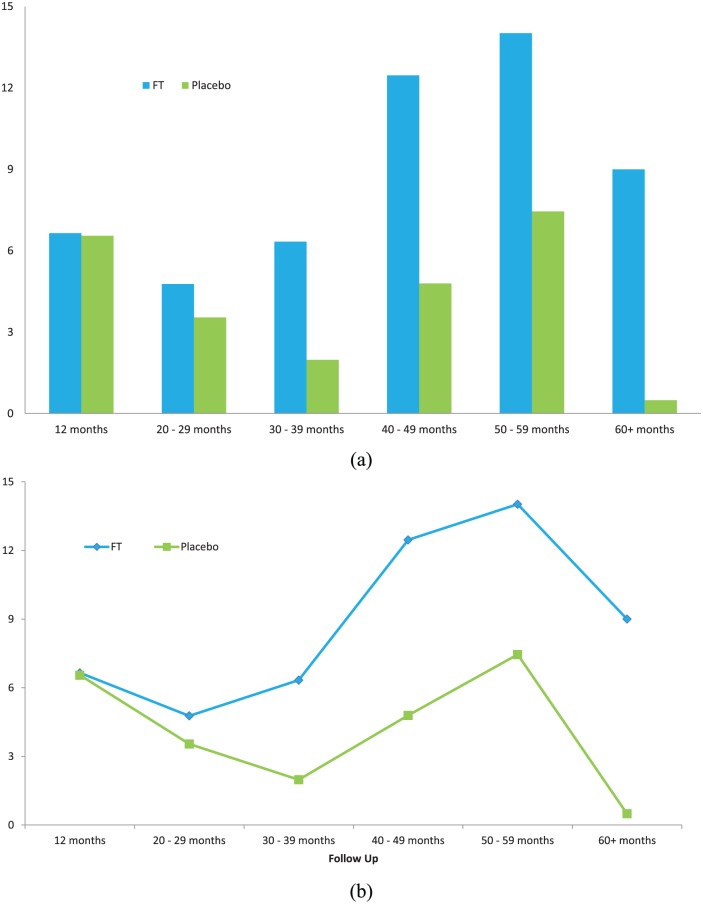
Time-weighted mean values of IPSS improvement (reduction) from baseline plotted versus time in (a) bar graph; and (b) time curve showing mean of time-weighted IPSS improvement from baseline versus time. The overall time-weighted mean IPSS improvement for the pivotal phase III trials (including all first year values) was statistically significant versus placebo [FT mean 8.87 SD 3.68, placebo mean 4.13 SD 2.67; p = 0.0287 95% confidence interval (CI) .6043–8.8757]. For this comparison, double-blind follow-up IPSS values were plotted according to follow-up interval (time from randomization to follow up) and weighted by duration (each value multiplied by time in years). All failures (e.g. withdrawals due to lack of efficacy, BPH surgical treatments) were carried forward (i.e. included in subsequent time interval mean efficacy values). BPH, benign prostatic hyperplasia; CI, confidence interval; FT, fexapotide triflutate; IPSS, International Prostate Symptom Score; SD, standard deviation.

References

    1. Bushman W. Etiology, epidemiology, and natural history of benign prostatic hyperplasia. Urol Clin North Am 2009; 36: 403–415. - PubMed
    1. Jacobsen SJ, Girman CJ, Lieber MM. Natural history of benign prostatic hyperplasia. Urology 2001; 58: 5–16; discussion 16. - PubMed
    1. Fitzpatrick JM. The natural history of benign prostatic hyperplasia. BJU Int 2006; 97(Suppl. 2): 3–6. - PubMed
    1. Chute CG, Panser LA, Girman CJ, et al. The prevalence of prostatism: a population-based survey of urinary symptoms. J Urol 1993; 150: 85–89. - PubMed
    1. Chapple CR, Wein AJ, Abrams P. Lower urinary tract symptoms revisited: a broader clinical perspective. Eur Urol 2008; 54: 563–569. - PubMed

LinkOut - more resources