


The IMPACT study: early loss of skeletal muscle mass in advanced pancreatic cancer patients
- PMID: 30719874
- PMCID: PMC6463465
- DOI: 10.1002/jcsm.12368
The IMPACT study: early loss of skeletal muscle mass in advanced pancreatic cancer patients
Abstract
Background: Pancreatic cancer (PC) patients have multiple risk factors for sarcopenia and loss of skeletal muscle mass (LSMM), which may cause greater treatment toxicities, reduced response to cancer therapy, prolonged hospitalization, impaired quality of life, and worse prognosis.
Methods: This is a retrospective study on advanced PC patients treated at the Department of Oncology of Udine, Italy, from January 2012 to November 2017. Among 162 patients who received chemotherapy, 94 consecutive patients with an available computed tomography (CT) scan were retrospectively analyzed. The primary objective of our study was to explore if an early LSMM ≥ 10% (measured at first radiological evaluation and compared with baseline) and/or baseline sarcopenia may impact prognosis. Baseline sarcopenia was defined according to Prado's criteria. Skeletal muscle area was measured as cross-sectional areas (cm2 ) using CT scan data through the Picture archiving and communication system (PACS) image system.
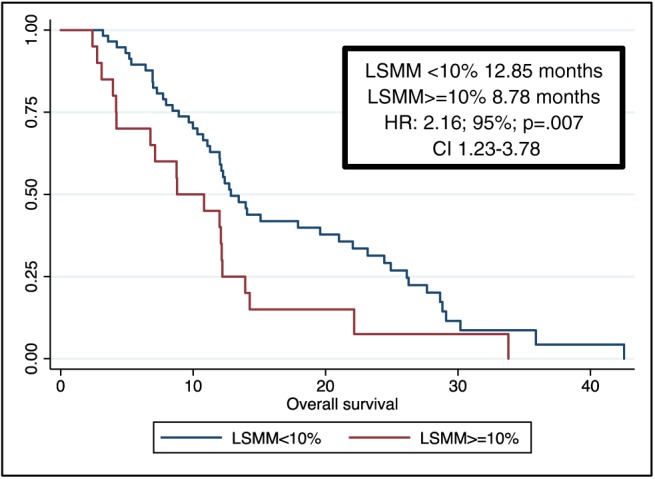
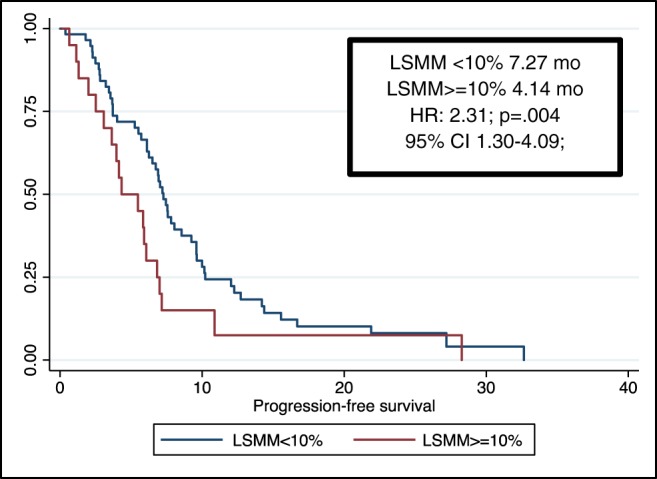
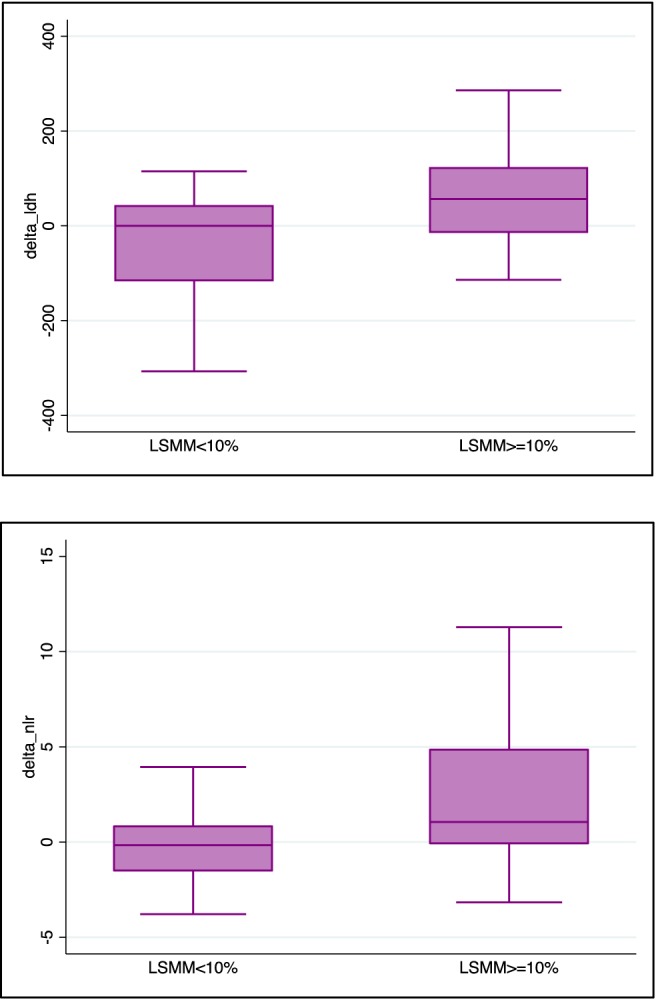
Results: In the whole cohort, 48% of patients were ≤70 years old, and 50% had metastatic disease. At baseline, 73% of patients had sarcopenia, and 16% presented a visceral fat area ≥ 44 cm2 /m2 . Overall, 21% experienced an early LSMM ≥ 10%. Approximately 33% of sarcopenic patients at baseline and ~35% of patients with early LSMM ≥ 10% had a body mass index > 25 kg/m2 . Of note, 71% of patients were evaluated by a nutritionist, and 56% received a dietary supplementation (oral and/or parenteral). After a median follow-up of 30.44 months, median overall survival (OS) was 11.28 months, whereas median progression-free survival (PFS) was 5.72 months. By multivariate analysis, early LSMM ≥ 10% was significantly associated with worse OS [hazard ratio (HR): 2.16; 95% confidence interval (CI) 1.23-3.78; P = 0.007] and PFS (HR: 2.31; 95% CI 1.30-4.09; P = 0.004). Moreover, an exploratory analysis showed that inflammatory indexes, such as neutrophil-lymphocyte ratio variation, impact early LSMM ≥ 10% (odds ratio 1.31, 95% CI 1.06-1.61, P = 0.010).
Conclusions: Early LSMM ≥ 10% has a negative prognostic role in advanced PC patients. Further prospective investigations are needed to confirm these preliminary data.
Keywords: Muscle depletion; Muscle loss; Pancreatic cancer; Sarcopenia.
© 2019 The Authors. Journal of Cachexia, Sarcopenia and Muscle published by John Wiley & Sons Ltd on behalf of the Society on Sarcopenia, Cachexia and Wasting Disorders.
Conflict of interest statement
The authors declare no competing financial interests.
Figures
References
-
- Siegel RL, Miller KD, Jemal A. Cancer statistics, 2018. CA Cancer J Clin 2018;68:7–30. - PubMed
-
- Prado CMM, Lieffers JR, McCargar LJ, Reiman T, Sawyer MB, Martin L, et al. Prevalence and clinical implications of sarcopenic obesity in patients with solid tumours of the respiratory and gastrointestinal tracts: a population‐based study. Lancet Oncol 2008;9:629–635. - PubMed
-
- Tan BHL, Birdsell LA, Martin L, Baracos VE, Fearon KCH. Sarcopenia in an overweight or obese patient is an adverse prognostic factor in pancreatic cancer. Clin Cancer Res Off J Am Assoc Cancer Res 2009;15:6973–6979. - PubMed
-
- Ozola Zalite I, Zykus R, Francisco Gonzalez M, Saygili F, Pukitis A, Gaujoux S, et al. Influence of cachexia and sarcopenia on survival in pancreatic ductal adenocarcinoma: a systematic review. Pancreatol Off J Int Assoc Pancreatol IAP Al 2015;15:19–24. - PubMed
-
- Ryan AM, Power DG, Daly L, Cushen SJ, Ní Bhuachalla Ē, Prado CM. Cancer‐associated malnutrition, cachexia and sarcopenia: the skeleton in the hospital closet 40 years later. Proc Nutr Soc 2016;75:199–211. - PubMed
MeSH terms
Substances
LinkOut - more resources
Full Text Sources
Medical
