The Effects of Dietary Improvement on Symptoms of Depression and Anxiety: A Meta-Analysis of Randomized Controlled Trials
- PMID: 30720698
- PMCID: PMC6455094
- DOI: 10.1097/PSY.0000000000000673
The Effects of Dietary Improvement on Symptoms of Depression and Anxiety: A Meta-Analysis of Randomized Controlled Trials
Erratum in
-
The Effects of Dietary Improvement on Symptoms of Depression and Anxiety: A Meta-Analysis of Randomized Controlled Trials: Erratum.Psychosom Med. 2020 Jun;82(5):536. doi: 10.1097/PSY.0000000000000807. Psychosom Med. 2020. PMID: 32310838 Free PMC article. No abstract available.
-
The Effects of Dietary Improvement on Symptoms of Depression and Anxiety: A Meta-Analysis of Randomized Controlled Trials: Second Erratum.Psychosom Med. 2021 Feb-Mar 01;83(2):196. doi: 10.1097/PSY.0000000000000914. Psychosom Med. 2021. PMID: 33534436 No abstract available.
Abstract
Objective: Poor diet can be detrimental to mental health. However, the overall evidence for the effects of dietary interventions on mood and mental well-being has yet to be assessed. We conducted a systematic review and meta-analysis examining effects of dietary interventions on symptoms of depression and anxiety.
Methods: Major electronic databases were searched through March 2018 for all randomized controlled trials of dietary interventions reporting changes in symptoms of depression and/or anxiety in clinical and nonclinical populations. Random-effects meta-analyses were conducted to determine effect sizes (Hedges' g with 95% confidence intervals [CI]) for dietary interventions compared with control conditions. Potential sources of heterogeneity were explored using subgroups and meta-regression analyses.
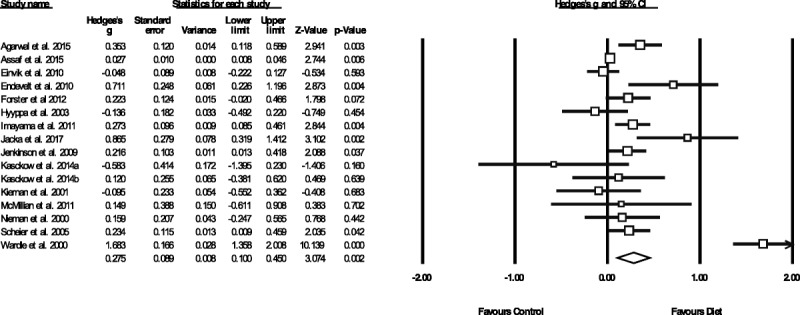
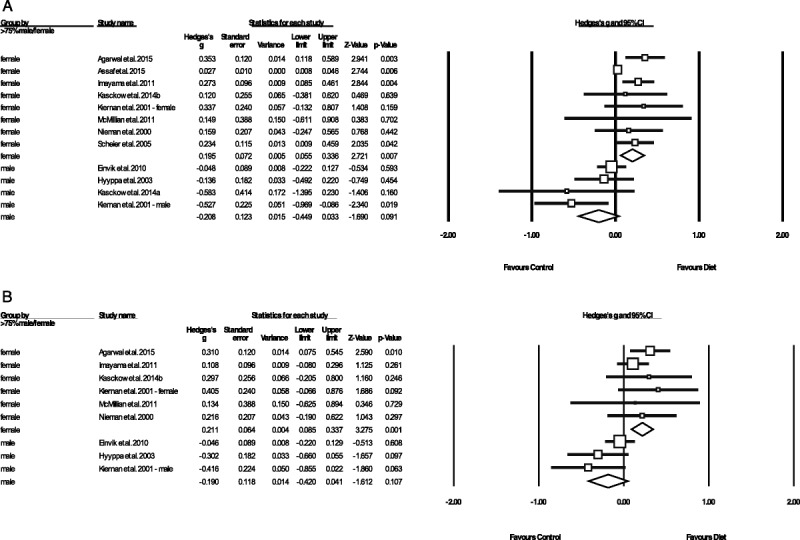
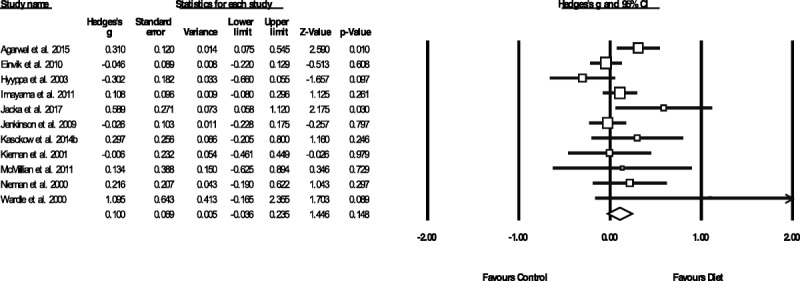
Results: Results: Sixteen eligible randomized controlled trials (published in English) with outcome data for 45,826 participants were included; the majority of which examined samples with nonclinical depression (n = 15 studies). Nonetheless, dietary interventions significantly reduced depressive symptoms (g = 0.162, 95% CI = 0.055 to 0.269, p = 0.003). Similar effects were observed among high-quality trials (g = 0.171, 95% C.I.=0.057 to 0.286, p=0.003) and when compared with both inactive (g = 0.114, 95% C.I.=0.008 to 0.219, p=0.035) and active controls (g = 0.224, 95% C.I.= 0.052 to 0.397, p = 0.011). No effect of dietary interventions was observed for anxiety (k = 11, n = 2270, g = 0.085, 95% C.I. = -0.031 to 0.202, p=0.151). Studies with female samples observed significantly greater benefits from dietary interventions, for symptoms of both depression and anxiety.
Conclusions: Dietary interventions hold promise as a novel intervention for reducing symptoms of depression across the population. Future research is required to determine the specific components of dietary interventions that improve mental health, explore underlying mechanisms, and establish effective schemes for delivering these interventions in clinical and public health settings.
Registration: PROSPERO Online Protocol: CRD42018091256.
Figures
Comment in
-
Editorial Comment on Firth et al. (2019).Psychosom Med. 2020 Jun;82(5):532-533. doi: 10.1097/PSY.0000000000000805. Psychosom Med. 2020. PMID: 32265373 Free PMC article.
-
Authors' Response.Psychosom Med. 2020 Jun;82(5):534-535. doi: 10.1097/PSY.0000000000000806. Psychosom Med. 2020. PMID: 32265374 No abstract available.
References
-
- Hawton K, Casañas I Comabella C, Haw C, Saunders K. Risk factors for suicide in individuals with depression: a systematic review. J Affect Disord 2013;147:17–28. - PubMed
-
- McCrone PR, Dhanasiri S, Patel A, Knapp M, Lawton-Smith S. Paying the price: the cost of mental health care in England to 2026. London, UK: King's Fund; 2008.
-
- Casacalenda N, Perry JC, Looper K. Remission in major depressive disorder: a comparison of pharmacotherapy, psychotherapy, and control conditions. Am J Psychiatry 2002;159:1354–60. - PubMed
-
- Johnson J, Weissman MM, Klerman GL. Service utilization and social morbidity associated with depressive symptoms in the community. JAMA 1992;267:1478–83. - PubMed