Review
. 2019 Feb 4;20(3):671.
doi: 10.3390/ijms20030671.

Signaling Crosstalk between Salicylic Acid and Ethylene/Jasmonate in Plant Defense: Do We Understand What They Are Whispering?

Affiliations
Review

Signaling Crosstalk between Salicylic Acid and Ethylene/Jasmonate in Plant Defense: Do We Understand What They Are Whispering?

Ning Li et al. Int J Mol Sci. .

Abstract

During their lifetime, plants encounter numerous biotic and abiotic stresses with diverse modes of attack. Phytohormones, including salicylic acid (SA), ethylene (ET), jasmonate (JA), abscisic acid (ABA), auxin (AUX), brassinosteroid (BR), gibberellic acid (GA), cytokinin (CK) and the recently identified strigolactones (SLs), orchestrate effective defense responses by activating defense gene expression. Genetic analysis of the model plant Arabidopsis thaliana has advanced our understanding of the function of these hormones. The SA- and ET/JA-mediated signaling pathways were thought to be the backbone of plant immune responses against biotic invaders, whereas ABA, auxin, BR, GA, CK and SL were considered to be involved in the plant immune response through modulating the SA-ET/JA signaling pathways. In general, the SA-mediated defense response plays a central role in local and systemic-acquired resistance (SAR) against biotrophic pathogens, such as Pseudomonas syringae, which colonize between the host cells by producing nutrient-absorbing structures while keeping the host alive. The ET/JA-mediated response contributes to the defense against necrotrophic pathogens, such as Botrytis cinerea, which invade and kill hosts to extract their nutrients. Increasing evidence indicates that the SA- and ET/JA-mediated defense response pathways are mutually antagonistic.

Keywords: hormones; plant defense; signaling pathway.


Conflict of interest statement

The authors declare no conflict of interest.

Figures
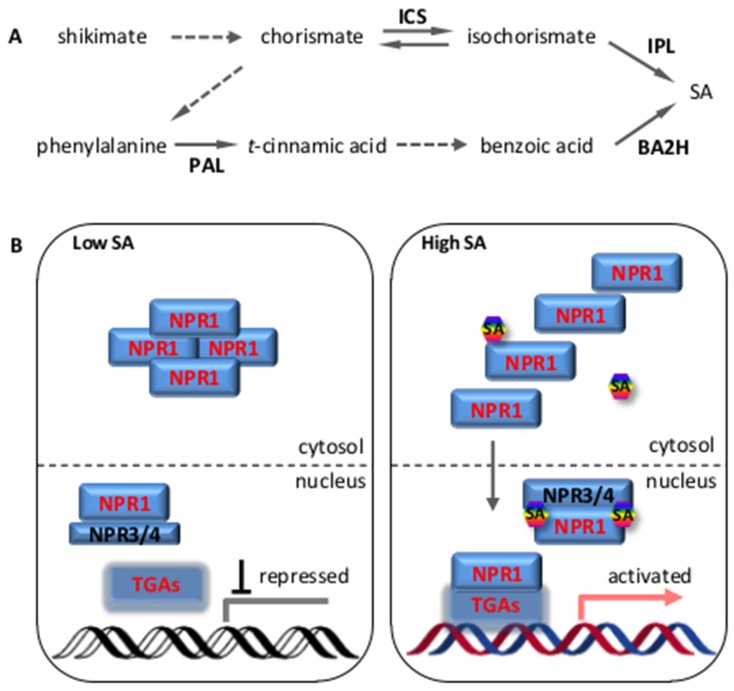
Figure 1
Figure 1
Salicylic acid biosynthesis and signaling pathway. (A) Proposed model for salicylic acid (SA) biosynthesis in Arabidopsis. Upper panel: the isochorismate pathway revealed by genetic studies. Lower panel: the phenylpropanoid pathway revealed by biochemical studies. (B) A simplified model for the SA signaling pathway according to Ding et al. [18] and Mou et al. [19]. In cells with low SA levels, NPR1 forms oligomer and remains in the cytosol, NPR3 and NPR4 bind residual NPR1 in the nucleus to prevent NPR1 function. In cell with high SA levels, NPR1 becomes monomeric and enters the nucleus, where SA binds to NPR3 and NPR4 to block their transcriptional repression activity. NPR1 interacts with TGAs in SA-responsive promoters, leading to the activation of defense responses. Abbreviations: BA2H, benzoic acid 2-hydroxylase; ICS, isochorismate synthase; IPL, isochorismate pyruvate lyase; NPR, non-expresser of pathogenesis-related genes; PAL, phenylalanine ammonia lyase; SA, salicylic acid; TGA, TGACG-binding factor.
Figure 2
Figure 2
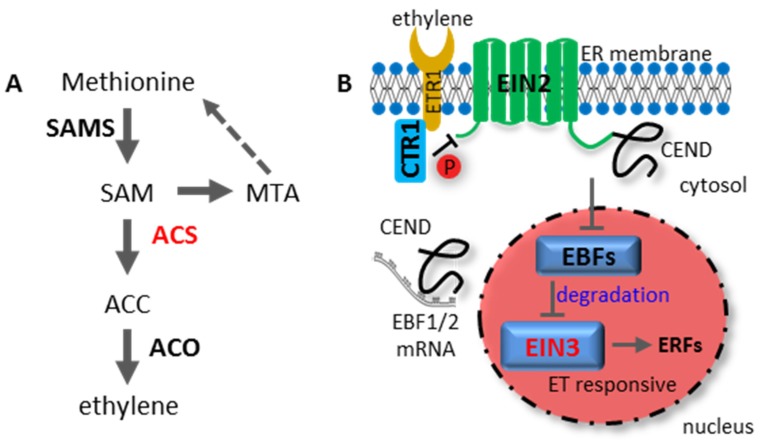
Ethylene (ET) biosynthesis and the signaling cascade pathway. (A) Model for the ET biosynthesis pathway. The precursor SAM is produced by SAMS with methionine as substrate. SAM is converted to the intermediate chemical ACC by ACS with the release of MTA as byproduct. MTA is recycled to methionine through the so-called Yang cycle. The rate-limiting enzyme ACS is highlighted in red. (B) Model for the ET signaling cascade. In the absence of ET, CTR1 phosphorylates EIN2 and the ET pathway is therefore blocked. In the presence of ET and when it is perceived by ET receptor (i.e., ETR1, ETHYLENE RESISTANT 1), the kinase activity of CTR1 is inactivated, the EIN2 CEND becomes dephosphorylated and cleaved. CEND subsequently translocates into the nucleus to attenuate EBFs E3 ligase function. In addition, CEND may bind to the UTR of EBF1/2 mRNA to perturb EBF1/2 translation in cytosol. Stabilized EIN3 protein then activates ERF transcription factors (i.e., ERF1 and ORA59) to elicit the ET response. Abbreviations: ACC, 1-Aminocyclopropane-1-carboxylic acid; ACO, ACC-oxidase; ACS, ACC synthase; CEND, C-terminal end of EIN2; CTR1, constitutive triple response 1; EBF1/2, EIN3-binding F-Box 1/2; EIN, ethylene insensitive; ER, endoplasmic reticulum; ERF, ethylene-response factor; ET, ethylene; ETR1: ethylene-resistant 1; MTA, methylthioadenosine; SAM, S-adenosyl methionine; SAMS, SAM synthase.
Figure 3
Figure 3
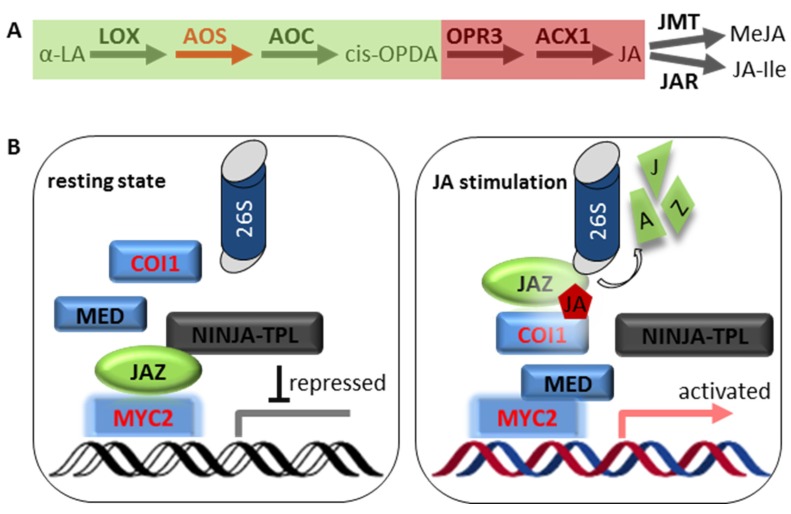
Jasmonate (JA) biosynthesis and signaling transduction pathway. (A) Model for the JA biosynthesis pathway. The intermediate OPDA is synthesized in the chloroplasts. JA is synthesized in the peroxisomes and exported to the cytosol, where it is converted to other bioactive derivates (i.e., JA-Ile). The key enzyme AOS is highlighted in red. (B) Model for the JA signaling transduction pathway of the MYC-branch in Arabidopsis. In the non-induced cells (left, low JA level), MYC2 activity is repressed by JAZ proteins that interact with NINJA to recruit transcriptional repressor TPL. In the JA-stimulated cell (right, high JA level), JAZ proteins are degraded by the SCFCOI1-mediated 26S-proteosome. MYC2 is released to interact with the transcriptional mediator to activate JA-responsive gene expression. Abbreviations: α-LA, α-linolenic acid; ACX1, acyl-CoA-oxidase 1; AOC, allene oxide cyclase; AOS, allene oxide synthase; COI1, coronatine insensitive 1; JA, jasmonic acid; JA-Ile, Jasmonic acid-isoleucine conjugate; JAR, jasmonate resistant; JAZ, jasmonate ZIM domain; JMT, JA methyl transferase; LOX, 13-lipoxygenase; MeJA, methyl jasmonate; MED, mediator; NINJA, novel interactor of JAZ; OPDA, 12-oxophytodienoic; OPR3, OPDA Reductase 3; TPL, TOPLESS.
Figure 4
Figure 4
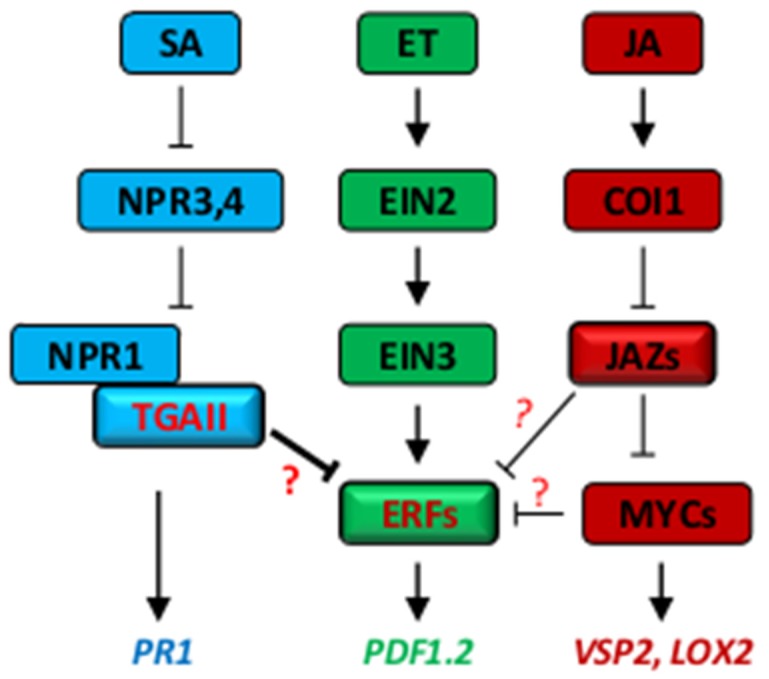
A simplified schematic representation of the signaling network between defense hormones, highlighting the crosstalk at the transcriptional level. Arrows indicate positive effects (activation), blunt-ended lines indicate negative effects (repression), questions indicate unknown mechanisms underlying the repression of ERFs by TGAs, JAZs and MYCs.

References

    1. Glazebrook J. Contrasting mechanisms of defense against biotrophic and necrotrophic pathogens. Annu. Rev. Phytopathol. 2005;43:205–227. doi: 10.1146/annurev.phyto.43.040204.135923. - DOI - PubMed
    1. Gaffney T., Friedrich L., Vernooij B., Negrotto D., Nye G., Uknes S., Ward E., Kessmann H., Ryals J. Requirement of salicylic Acid for the induction of systemic acquired resistance. Science. 1993;261:754–756. doi: 10.1126/science.261.5122.754. - DOI - PubMed
    1. Wildermuth M.C., Dewdney J., Wu G., Ausubel F.M. Isochorismate synthase is required to synthesize salicylic acid for plant defence. Nature. 2001;414:562–565. doi: 10.1038/35107108. - DOI - PubMed
    1. Ádám A.L., Nagy Z.Á., Kátay G., Mergenthaler E., Viczián O. Signals of Systemic Immunity in Plants: Progress and Open Questions. Int. J. Mol. Sci. 2018;19:1146. doi: 10.3390/ijms19041146. - DOI - PMC - PubMed
    1. Thomma B.P., Eggermont K., Penninckx I.A., Mauch-Mani B., Vogelsang R., Cammue B.P., Broekaert W.F. Separate jasmonate-dependent and salicylate-dependent defense-response pathways in Arabidopsis are essential for resistance to distinct microbial pathogens. Proc. Natl. Acad. Sci. USA. 1998;95:15107–15111. doi: 10.1073/pnas.95.25.15107. - DOI - PMC - PubMed

MeSH terms