. 2019 Mar 15;14(3):361-368.
doi: 10.1021/acschembio.9b00092. Epub 2019 Feb 22.

SPR-Measured Dissociation Kinetics of PROTAC Ternary Complexes Influence Target Degradation Rate

Affiliations

SPR-Measured Dissociation Kinetics of PROTAC Ternary Complexes Influence Target Degradation Rate

Michael J Roy et al. ACS Chem Biol. .

Abstract

Bifunctional degrader molecules, known as proteolysis-targeting chimeras (PROTACs), function by recruiting a target to an E3 ligase, forming a target/PROTAC/ligase ternary complex. Despite the importance of this key intermediate species, no detailed validation of a method to directly determine binding parameters for ternary complex kinetics has been reported, and it remains to be addressed whether tuning the kinetics of PROTAC ternary complexes may be an effective strategy to improve the efficiency of targeted protein degradation. Here, we develop an SPR-based assay to quantify the stability of PROTAC-induced ternary complexes by measuring for the first time the kinetics of their formation and dissociation in vitro using purified proteins. We benchmark our assay using four PROTACs that target the bromodomains (BDs) of bromodomain and extraterminal domain proteins Brd2, Brd3, and Brd4 to the von Hippel-Lindau E3 ligase (VHL). We reveal marked differences in ternary complex off-rates for different PROTACs that exhibit either positive or negative cooperativity for ternary complex formation relative to binary binding. The positively cooperative degrader MZ1 forms comparatively stable and long-lived ternary complexes with either Brd4BD2 or Brd2BD2 and VHL. Equivalent complexes with Brd3BD2 are destabilized due to a single amino acid difference (Glu/Gly swap) present in the bromodomain. We observe that this difference in ternary complex dissociative half-life correlates to a greater initial rate of intracellular degradation of Brd2 and Brd4 relative to Brd3. These findings establish a novel assay to measure the kinetics of PROTAC ternary complexes and elucidate the important kinetic parameters that drive effective target degradation.


Conflict of interest statement

The authors declare the following competing financial interest(s): The Ciulli laboratory receives sponsored research support from Boehringer Ingelheim and Nurix, Inc. A.C. is a scientific founder, director, and shareholder of Amphista Therapeutics, a company that is developing targeted protein degradation therapeutic platforms.

Figures
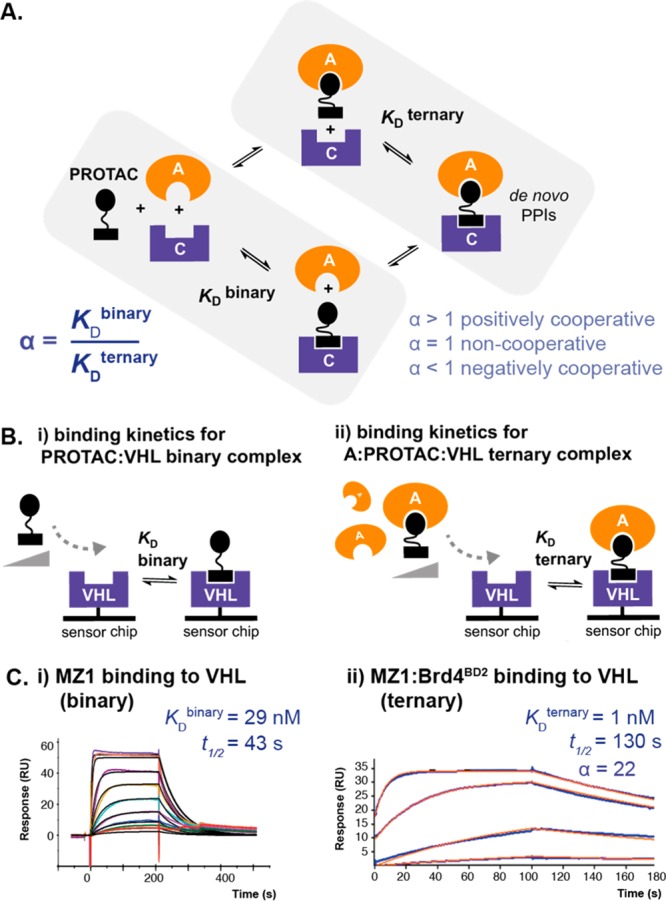
Figure 1
Figure 1
Schematic and binding data illustrating our SPR approach for measuring binding kinetics and determining cooperativity (α) for PROTAC binary and ternary complex formation. (A) Ternary binding equilibria, as occurs for bivalent molecules (such as PROTACs binding to two proteins, a target “A” and an E3 ligase “C”) may involve cooperativity effects, whereby the affinity of the bivalent molecule to one protein (binary complex formation) may be enhanced or decreased when it is already bound to the second protein (ternary complex formation). This may result from additional interactions present in the ternary complex, such as induced de novo protein–protein interactions (PPIs). This effect can be represented by a cooperativity factor (α), where α = KDbinary/KDternary. (B) To measure the kinetics of PROTAC ternary complexes and determine cooperativity effects, we have developed an SPR assay in which we immobilized the E3 ligase (in our case, VHL) onto a sensor chip and measured binding of a PROTAC in either the (i) absence (binary binding) or (ii) presence (ternary binding) of near-saturating concentrations of the target protein (in our case, a bromodomain and extraterminal domain). (C) Representative SPR binding data are shown using this assay for (i) MZ1 or (ii) the MZ1:Brd4BD2 complex binding to immobilized VHL. Binary and ternary binding experiments were performed at 285.15 K in multicycle kinetic format and 298.15 K in single-cycle kinetic (SCK) format, respectively. For each sensorgram, values shown represent fitted dissociation constants for binary or ternary complex formation (KDbinary and KDternary, respectively), dissociative half-life of the ternary complex (t1/2) (calculated as t1/2 = ln2/koff), and cooperativity factor (α) (calculated as α = KDbinary/KDternary).
Chart 1
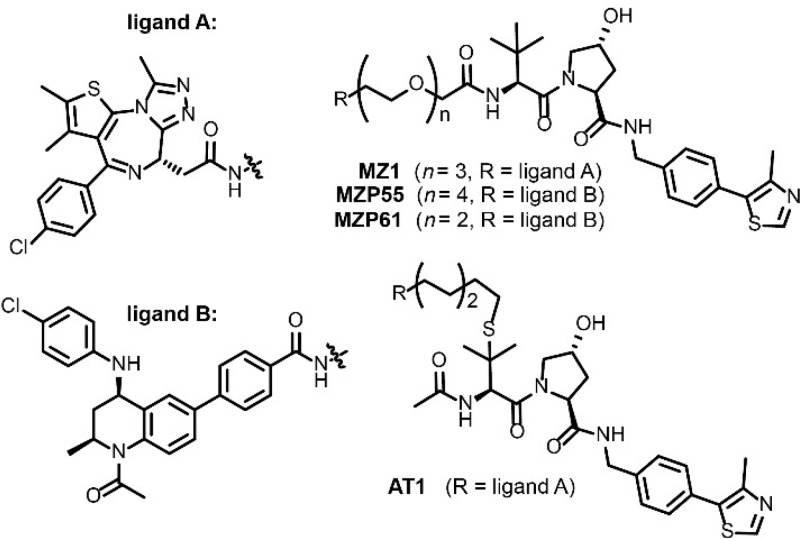
Chart 1. PROTACs Utilized in This Study
Figure 2
Figure 2
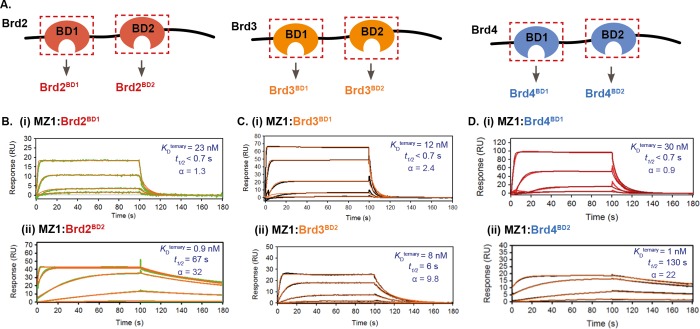
(A) Diagram of BET proteins Brd2, Brd3, and Brd4, showing individual bromodomains (BDs) used in this study; these BET proteins exhibit different degradation profiles in response to MZ1 treatment., To study the relative kinetics and cooperativity for ternary complex formation with MZ1 and VHL, MZ1/BD complexes were prepared and binding to immobilized VHL measured by SPR. (B) SPR sensorgrams for different MZ1/BD complexes reveal marked differences in binding kinetics, particularly VHL/MZ1/Brd2BD2 and VHL/MZ1/Brd4BD2 ternary complexes dissociated relatively slowly (as a result of the high positive cooperativity, α, and greater complex stability). Ternary binding experiments were performed at 298.15 K in single-cycle kinetic (SCK) format. For each sensorgram, values shown represent fitted dissociation constants for ternary complex formation (KDternary), dissociative half-life of the ternary complex (t1/2) (calculated as t1/2 = ln2/koff) and cooperativity factor (α) (calculated as α = KDbinary/KDternary).
Figure 3
Figure 3
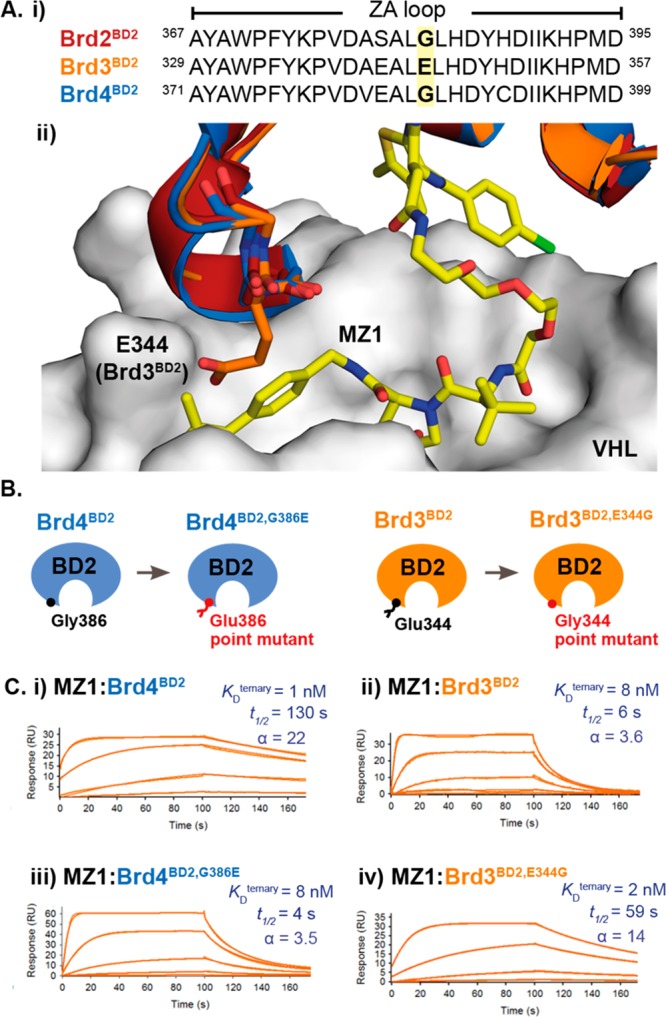
(A) Overlay of Brd2BD2 (PDB: 3ONI) and Brd3BD2 (PDB: 3S92) with the crystal structure of the VCB/MZ1/Brd4BD2 ternary complex (PDB: 5T35) suggests that a VHL/MZ1/Brd3BD2 ternary complex adopting the equivalent close-packing interaction would likely be less stable due to steric clash with the VHL/MZ1 of a single amino acid within the ZA loop of the bromodomain (Glu344 of Brd3BD2, which corresponds to Gly386 in Brd4BD2). (B) Diagram of point mutants generated to explore reciprocal swap of the amino acid at this position. (C) Reciprocal exchange of this single Gly/Glu residue in Brd4BD2 (i, iii) or Brd3BD2 (ii, iv) yields a corresponding swap of the kinetic profile in the resulting VHL/MZ1/BD ternary complex SPR sensorgram. For each sensorgram, values shown represent fitted dissociation constants for ternary complex formation (KDternary), dissociative half-life of the ternary complex (t1/2) (calculated as t1/2 = ln2/koff) and cooperativity factor (α) (calculated as α = KDbinary/KDternary).
Figure 4
Figure 4
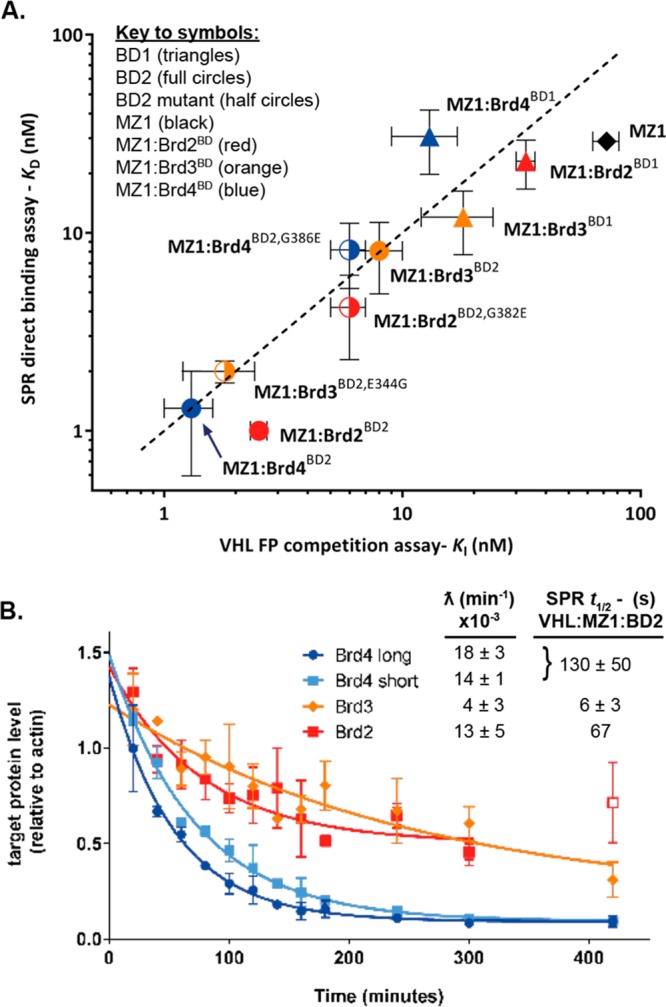
(A) Correlation between binary (MZ1) and ternary (MZ1/BD complex) binding to VHL via SPR or FP (mean plus or minus the standard deviation, SD). (B) Initial degradation profile for BET proteins in HEK293 cells in response to MZ1 treatment (333 nM), with initial degradation rates (ƛ) estimated from data fitting (mean plus or minus the standard error of the mean, N = 3) and SPR ternary half-lives for corresponding VHL/MZ1/BD2 complexes (mean ± SD for N = 2). Note that short and long isoforms of Brd4 differ in the length of the C-terminus after the tandem bromodomains.

References

    1. Bondeson D. P.; Crews C. M. (2017) Targeted Protein Degradation by Small Molecules. Annu. Rev. Pharmacol. Toxicol. 57, 107–123. 10.1146/annurev-pharmtox-010715-103507. - DOI - PMC - PubMed
    1. Gadd M. S.; Testa A.; Lucas X.; Chan K. H.; Chen W.; Lamont D. J.; Zengerle M.; Ciulli A. (2017) Structural basis of PROTAC cooperative recognition for selective protein degradation. Nat. Chem. Biol. 13, 514–521. 10.1038/nchembio.2329. - DOI - PMC - PubMed
    1. Douglass E. F. Jr.; Miller C. J.; Sparer G.; Shapiro H.; Spiegel D. A. (2013) A comprehensive mathematical model for three-body binding equilibria. J. Am. Chem. Soc. 135, 6092–6099. 10.1021/ja311795d. - DOI - PMC - PubMed
    1. Fisher S. L.; Phillips A. J. (2018) Targeted protein degradation and the enzymology of degraders. Curr. Opin. Chem. Biol. 44, 47–55. 10.1016/j.cbpa.2018.05.004. - DOI - PubMed
    1. Churcher I. (2018) Protac-Induced Protein Degradation in Drug Discovery: Breaking the Rules or Just Making New Ones?. J. Med. Chem. 61, 444–452. 10.1021/acs.jmedchem.7b01272. - DOI - PubMed

Publication types