


Prescription Drug Monitoring Programs and Opioid Overdoses: Exploring Sources of Heterogeneity
- PMID: 30721165
- PMCID: PMC6437666
- DOI: 10.1097/EDE.0000000000000950
Prescription Drug Monitoring Programs and Opioid Overdoses: Exploring Sources of Heterogeneity
Abstract
Background: Prescription drug monitoring program are designed to reduce harms from prescription opioids; however, little is known about what populations benefit the most from these programs. We investigated how the relation between implementation of online prescription drug monitoring programs and rates of hospitalizations related to prescription opioids and heroin overdose changed over time, and varied across county levels of poverty and unemployment, and levels of medical access to opioids.
Methods: Ecologic county-level, spatiotemporal study, including 990 counties within 16 states, in 2001-2014. We modeled overdose counts using Bayesian hierarchical Poisson models. We defined medical access to opioids as the county-level rate of hospital discharges for noncancer pain conditions.
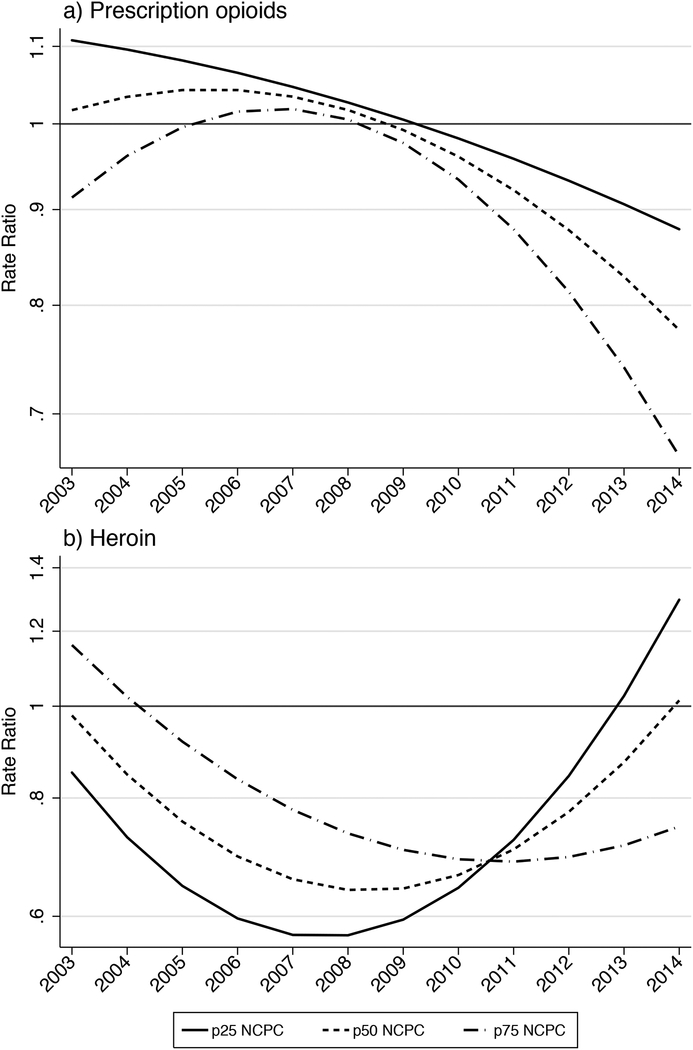
Results: In 2010-2014, online prescription drug monitoring programs were associated with lower rates of prescription opioid-related hospitalizations (rate ratio 2014 = 0.74; 95% credible interval = 0.69, 0.80). The association between online prescription drug monitoring programs and heroin-related hospitalization was also negative but tended to increase in later years. Counties with lower rates of noncancer pain conditions experienced a lower decrease in prescription opioid overdose and a faster increase in heroin overdoses. No differences were observed across different county levels of poverty and unemployment.
Conclusions: Areas with lower levels of noncancer pain conditions experienced the smallest decrease in prescription opioid overdose and the faster increase in heroin overdose following implementation of online prescription drug monitoring programs. Our results are consistent with the hypothesis that prescription drug monitoring programs are most effective in areas where people are likely to access opioids through medical providers.
Conflict of interest statement
Conflict of Interests: None.
Figures

References
-
- CDC. Ten Leading Causes of Death and Injury, United States, 2016. https://www.cdc.gov/injury/wisqars/LeadingCauses.html Accessed 05/04, 2018.
-
- CDC. Wide-ranging online data for epidemiologic research (WONDER). http://wonder.cdc.gov Accessed 05/04, 2018.
-
- Rutkow L, Chang HY, Daubresse M, Webster DW, Stuart EA, Alexander GC. Effect of Florida’s Prescription Drug Monitoring Program and Pill Mill Laws on Opioid Prescribing and Use. JAMA Intern Med 2015;175(10):1642–9. - PubMed
-
- Pardo B Do more robust prescription drug monitoring programs reduce prescription opioid overdose? Addiction 2016. - PubMed
