The First Decade of Web-Based Sports Injury Surveillance: Descriptive Epidemiology of Injuries in US High School Boys' Ice Hockey (2008-2009 Through 2013-2014) and National Collegiate Athletic Association Men's and Women's Ice Hockey (2004-2005 Through 2013-2014)
- PMID: 30721630
- PMCID: PMC6365065
- DOI: 10.4085/1062-6050-176-17
The First Decade of Web-Based Sports Injury Surveillance: Descriptive Epidemiology of Injuries in US High School Boys' Ice Hockey (2008-2009 Through 2013-2014) and National Collegiate Athletic Association Men's and Women's Ice Hockey (2004-2005 Through 2013-2014)
Abstract
Context: Web-based sports injury surveillance via programs such as the High School Reporting Information Online system and the National Collegiate Athletic Association Injury Surveillance Program has aided efforts to collect data on ice hockey injuries.
Objective: To describe the epidemiology of injuries sustained in high school boy's ice hockey in the 2008-2009 through 2013-2014 academic years and collegiate men's and women's ice hockey in the 2004-2005 through 2013-2014 academic years using Web-based surveillance.
Design: Descriptive epidemiology study.
Setting: Online injury surveillance of ice hockey teams of high school boys (annual average = 34), collegiate men (annual average = 20), and collegiate women (annual average = 11).
Patients or other participants: Boys', men's, and women's ice hockey players who participated in practices and competitions during the 2008-2009 through 2013-2014 high school academic years or the 2004-2005 through 2013-2014 collegiate academic years.
Main outcome measure(s): Athletic trainers collected time-loss (≥24 hours) injury and exposure data. We calculated injury rates per 1000 athlete-exposures (AEs), injury rate ratios (IRRs) with 95% confidence intervals (CIs), and injury proportions by body site and diagnosis.
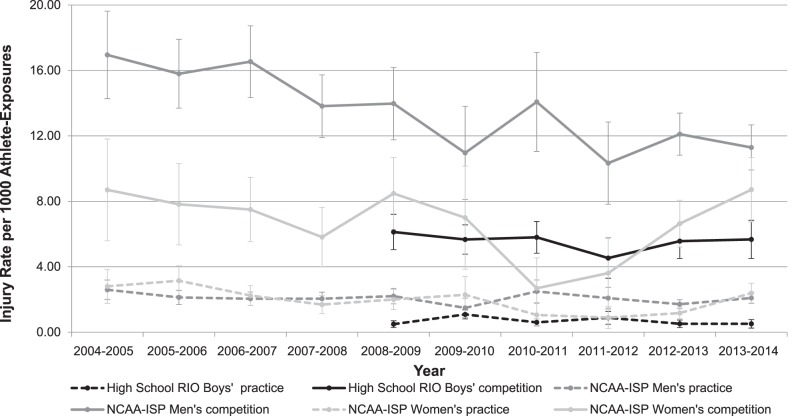
Results: The High School Reporting Information Online system documented 831 boys' ice hockey time-loss injuries during 356 997 AEs; the National Collegiate Athletic Association Injury Surveillance Program documented 2611 men's ice hockey time-loss injuries during 552 642 AEs and 752 women's ice hockey injuries during 232 051 AEs. Injury rates were higher in collegiate men than in high school boys during 2008-2009 through 2013-2014 (4.38 versus 2.33/1000 AEs; IRR = 1.88; 95% CI = 1.73, 2.05) and collegiate women during 2004-2005 through 2013-2014 (IRR = 1.46; 95% CI = 1.34, 1.58). Most injuries occurred during competitions (boys = 80.0%, men = 66.9%, women = 55.3%); injury rates were higher in competitions than in practices for boys (IRR = 8.14; 95% CI = 6.87, 9.65), men (IRR = 6.58; 95% CI = 6.06, 7.13), and women (IRR = 3.63; 95% CI = 3.14, 4.19). At all levels, most injuries occurred to the head/face and shoulder/clavicle and resulted in concussions, contusions, or ligament sprains.
Conclusions: Injury rates varied across sports but were consistently higher in competitions than in practices. In competitions, concussions were common injuries, highlighting the need for continued development of injury-prevention strategies.
Keywords: concussions; injury rate; ligament sprains; musculoskeletal injuries.
Figures
References
-
- Student-athlete participation: 1981-82 – 2014-15. National Collegiate Athletic Association Web site. 2018 http://www.ncaa.org/sites/default/files/Participation%20Rates%20Final.pdf Accessed January 23,
-
- Participation statistics. National Federation of State High School Associations Web site. 2018 http://www.nfhs.org/ParticipationStatics/ParticipationStatics.aspx/ Accessed January 23,
-
- Tuominen M, Stuart MJ, Aubry M, Kannus P, Tokola K, Parkkari J. Injuries in women's international ice hockey: an 8-year study of the World Championship tournaments and Olympic Winter Games. Br J Sports Med. 2016;50(22):1406–1412. - PubMed
MeSH terms
Grants and funding
LinkOut - more resources
Full Text Sources
Medical