


Body composition and atrial fibrillation: a Mendelian randomization study
- PMID: 30721963
- PMCID: PMC6475522
- DOI: 10.1093/eurheartj/ehz003
Body composition and atrial fibrillation: a Mendelian randomization study
Abstract
Aims: Increases in fat-free mass and fat mass have been associated with higher risk of atrial fibrillation (AF) in observational studies. It is not known whether these associations reflect independent causal processes. Our aim was to evaluate independent causal roles of fat-free mass and fat mass on AF.
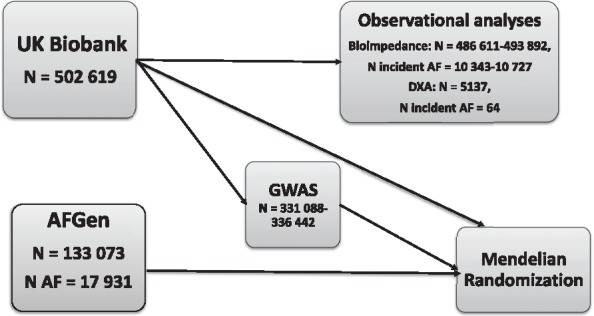
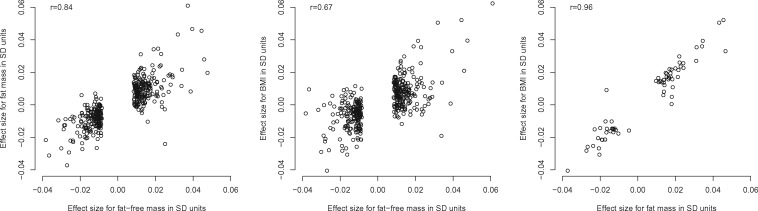
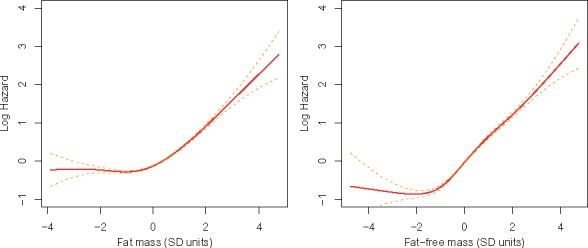
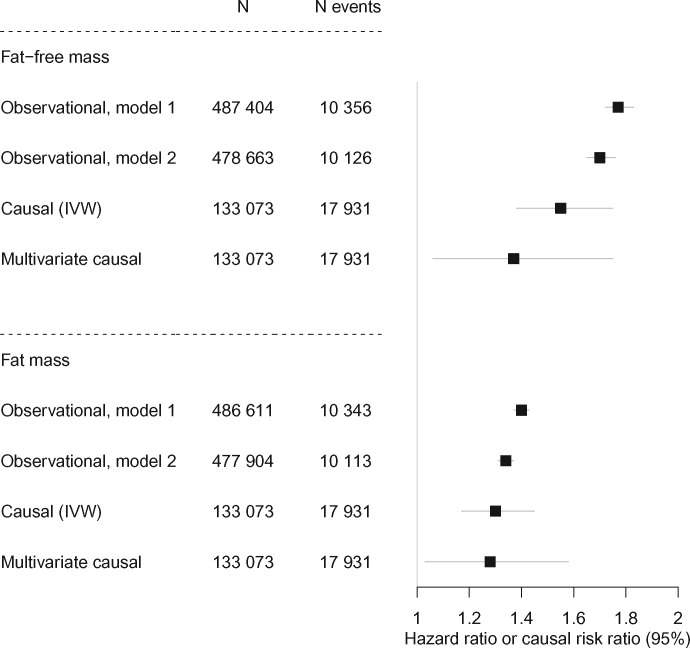
Methods and results: We conducted a large observational study to estimate the associations between fat-free mass and fat mass on incident AF in the UK Biobank (N = 487 404, N events = 10 365). Genome-wide association analysis was performed to obtain genetic instruments for Mendelian randomization (MR). We evaluated the causal effects of fat-free mass and fat mass on AF with two-sample method by using genetic associations from AFGen consortium as outcome. Finally, we evaluated independent causal effects of fat-free mass and fat mass with multivariate MR. Both fat-free mass and fat mass had observational associations with incident AF [hazard ratio (HR) = 1.77, 95% confidence interval (CI) 1.72-1.83; HR = 1.40, 95% CI 1.37-1.43 per standard deviation increase in fat-free and fat mass, respectively]. The causal effects using the inverse-variance weighted method were 1.55 (95% CI 1.38-1.75) for fat-free mass and 1.30 (95% CI 1.17-1.45) for fat mass. Weighted median, Egger regression, and penalized methods showed similar estimates. The multivariate MR analysis suggested that the causal effects of fat-free and fat mass were independent of each other (causal risk ratios: 1.37, 95% CI 1.06-1.75; 1.28, 95% CI 1.03-1.58).
Conclusion: Genetically programmed increases in fat-free mass and fat mass independently cause an increased risk of AF.
Keywords: Atrial fibrillation; Bioimpedance; Causal effect; Fat mass; Fat-free mass; Genetics.
Published on behalf of the European Society of Cardiology. All rights reserved. © The Author(s) 2019. For permissions, please email: journals.permissions@oup.com.
Figures
Comment on
-
Data-driven discovery and validation of circulating blood-based biomarkers associated with prevalent atrial fibrillation.Eur Heart J. 2019 Apr 21;40(16):1268-1276. doi: 10.1093/eurheartj/ehy815. Eur Heart J. 2019. PMID: 30615112 Free PMC article.
References
-
- Rahman F, Kwan GF, Benjamin EJ.. Global epidemiology of atrial fibrillation. Nat Rev Cardiol 2014;11:639–654. - PubMed
-
- Ball J, Carrington MJ, McMurray JJ, Stewart S.. Atrial fibrillation: profile and burden of an evolving epidemic in the 21st century. Int J Cardiol 2013;167:1807–1824. - PubMed
-
- Aune D, Sen A, Schlesinger S, Norat T, Janszky I, Romundstad P, Tonstad S, Riboli E, Vatten LJ.. Body mass index, abdominal fatness, fat mass and the risk of atrial fibrillation: a systematic review and dose-response meta-analysis of prospective studies. Eur J Epidemiol 2017;32:181–192. - PMC - PubMed
-
- Karas MG, Yee LM, Biggs ML, Djousse L, Mukamal KJ, Ix JH, Zieman SJ, Siscovick DS, Gottdiener JS, Rosenberg MA, Kronmal RA, Heckbert SR, Kizer JR.. Measures of body size and composition and risk of incident atrial fibrillation in older people: the cardiovascular health study. Am J Epidemiol 2016;183:998–1007. - PMC - PubMed
Publication types
MeSH terms
Substances
Grants and funding
LinkOut - more resources
Full Text Sources
Medical
