


Bacterial sexually transmitted infections in France: recent trends and patients' characteristics in 2016
- PMID: 30722812
- PMCID: PMC6386212
- DOI: 10.2807/1560-7917.ES.2019.24.5.1800038
Bacterial sexually transmitted infections in France: recent trends and patients' characteristics in 2016
Abstract
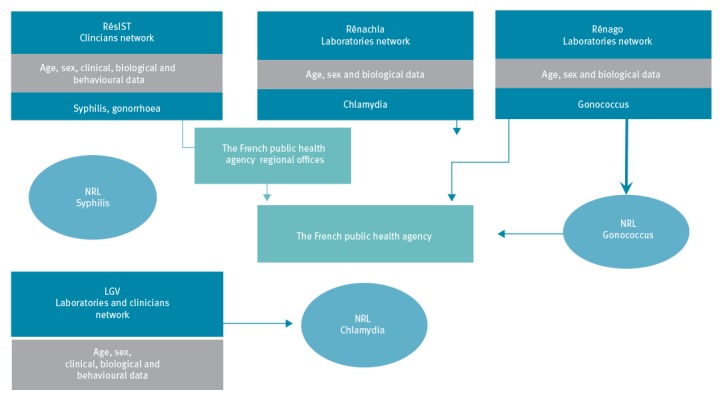
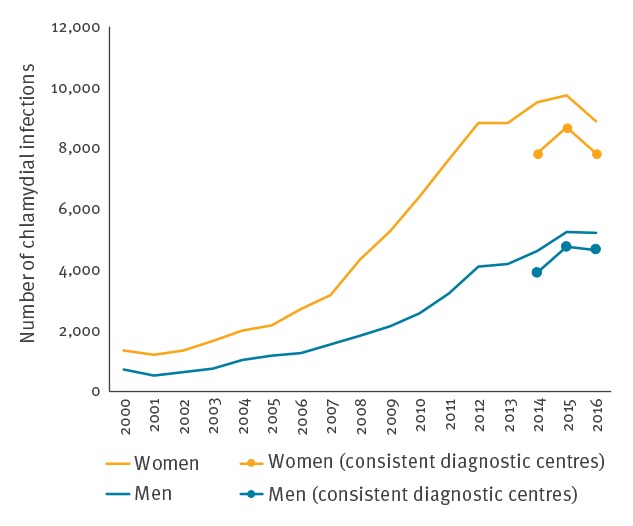
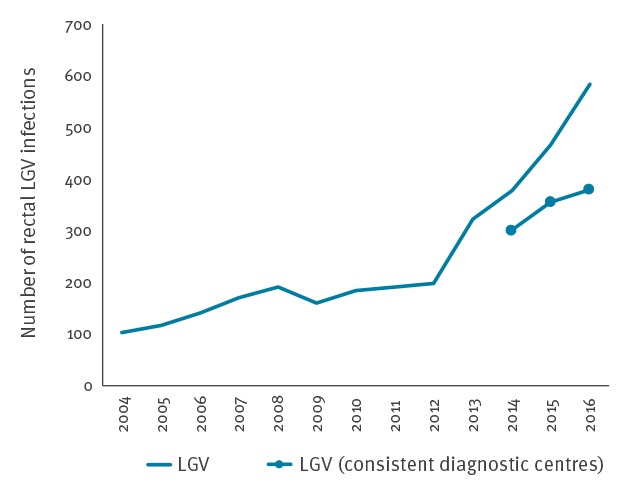
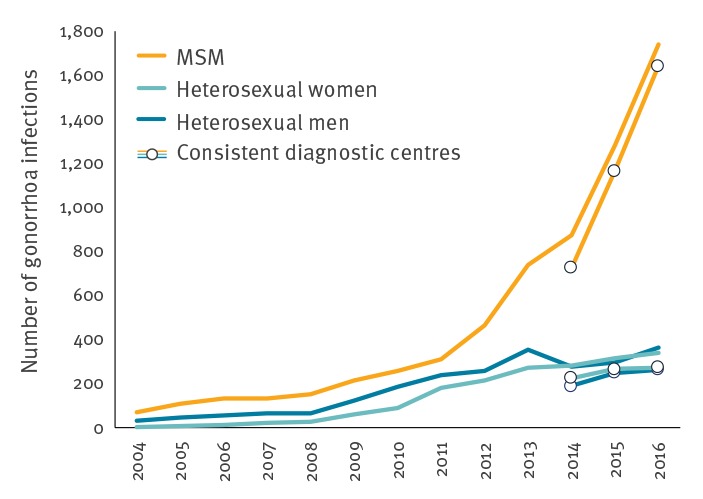
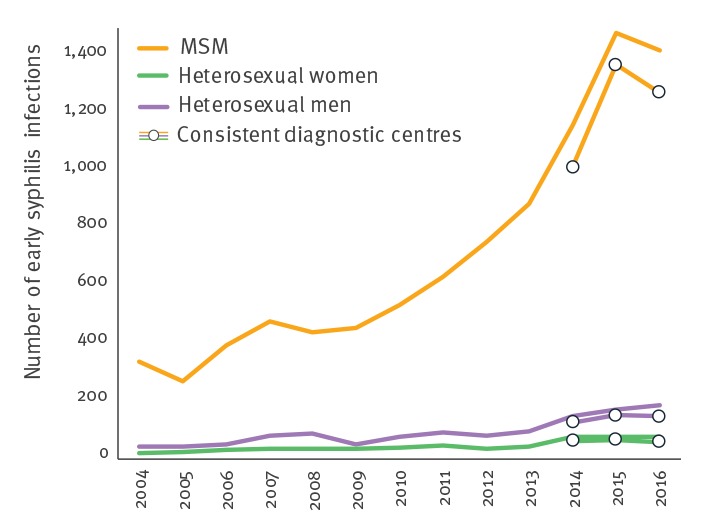
Diagnoses of bacterial sexually transmitted infections (STI) have been increasing in France since their resurgence in the late 1990s. This article presents recent epidemiological trends until 2016 and the patients' characteristics. STI surveillance relies on sentinel networks: a clinician-based network RésIST (clinical, biological and behavioural data for early syphilis and gonorrhoea), the lymphogranuloma venereum (LGV) network (clinical, biological and behavioural data for rectal LGV, and the laboratory networks Rénachla and Rénago (demographic and biological data for chlamydial infections and gonorrhoea, respectively). Here we describe trends between 2014 and 2016, using data from diagnostic centres which participated regularly during the study period. The number of early syphilis, gonorrhoea and LGV diagnoses increased between 2014 and 2016, particularly in men who have sex with men. An increase in syphilis and gonorrhoea cases was also observed in heterosexuals. Nevertheless, we observed a drop in 2016 for syphilis and chlamydial infections after two decades of increases. Under-reporting and shortage of benzathine penicillin in 2016 may explain this latest evolution. Regular screening of patients and partners, followed by prompt treatment, remains essential to interrupt STI transmission in a context where human immunodeficiency virus (HIV) prevention has expanded towards biomedical prophylaxis.
Keywords: Chlamydia; MSM; gonorrhoea; sexually transmitted infections; syphilis.
Conflict of interest statement
Figures
Comment in
-
Authors' response: Prevention of bacterial sexually transmitted infections (STI) in France: a comprehensive approach.Euro Surveill. 2019 Mar;24(12):1900187. doi: 10.2807/1560-7917.ES.2019.24.12.1900187. Euro Surveill. 2019. PMID: 30914074 Free PMC article. No abstract available.
-
Letter to the editor: Prevention of bacterial sexually transmitted infections (STI) in France: why not recommend using condoms and safer sex?Euro Surveill. 2019 Mar;24(12):1900171. doi: 10.2807/1560-7917.ES.2019.24.12.1900171. Euro Surveill. 2019. PMID: 30914079 Free PMC article. No abstract available.
References
-
- Ndeikoundam N, Viriot D, Fournet N, De Barbeyrac B, Goubard A, Dupin N, et al. Les infections sexuellement transmissibles bactériennes. en France: situation en 2015 et évolutions récentes. [Bacterial sexually transmitted infections in France: recent trends and characteristics in 2015]. Bull Epidemiol Hebd (Paris). 2016; (41-42):738-44. French. Available from: http://invs.santepubliquefrance.fr/beh/2016/41-42/2016_41-42_1.html
-
- Agence Nationale d'Accréditation et d'Evaluation en Santé. Évaluation du dépistage des infections uro-génitales basses à Chlamydia trachomatis en France. [Evaluation of screening for urogenital chlamydia trachomatis infections in France]. Saint Denis: Agence Nationale d'Accréditation et d'Evaluation en Santé; 2003. French. Available from: https://www.has-sante.fr/portail/upload/docs/application/pdf/Chlamydia_t...
-
- Centre National de Référence des infections à chlamydiae. Protocole de surveillance epidémiologique. Surveillance des ano-rectites à Chlamydia trachomatis(CT). [Epidemiological surveillance protocol. Surveillance of ano-rectitis caused by Chlamydia trachomatis]. Bordeaux: Centre National de Référence des infections à chlamydiae; 2010. French. Available from: http://www.cnrchlamydiae.u-bordeaux.fr/wp-content/uploads/2010/04/Protoc...
-
- Haute Autorité de Santé. Évaluation a priori du dépistage de la syphilis en France. [Evaluation of syphilis screening in France]. Saint Denis: Haute Autorité de Santé; 2007. French. Available from: https://www.has-sante.fr/portail/jcms/c_548127/fr/evaluation-a-priori-du...
MeSH terms
LinkOut - more resources
Full Text Sources