


Efficacy of the pharmacologic chaperone migalastat in a subset of male patients with the classic phenotype of Fabry disease and migalastat-amenable variants: data from the phase 3 randomized, multicenter, double-blind clinical trial and extension study
- PMID: 30723321
- PMCID: PMC6752321
- DOI: 10.1038/s41436-019-0451-z
Efficacy of the pharmacologic chaperone migalastat in a subset of male patients with the classic phenotype of Fabry disease and migalastat-amenable variants: data from the phase 3 randomized, multicenter, double-blind clinical trial and extension study
Abstract
Purpose: Outcomes in patients with Fabry disease receiving migalastat during the phase 3 FACETS trial (NCT00925301) were evaluated by phenotype.
Methods: Data were evaluated in two subgroups of patients with migalastat-amenable GLA variants: "classic phenotype" (n = 14; males with residual peripheral blood mononuclear cell α-galactosidase A <3% normal and multiorgan system involvement) and "other patients" (n = 36; males not meeting classic phenotype criteria and all females). Endpoints included estimated glomerular filtration rate (eGFR), left ventricular mass index (LVMi), Gastrointestinal Symptoms Rating Scale diarrhea subscale (GSRS-D), renal peritubular capillary (PTC) globotriaosylceramide (GL-3) inclusions, and plasma globotriaosylsphingosine (lyso-Gb3).
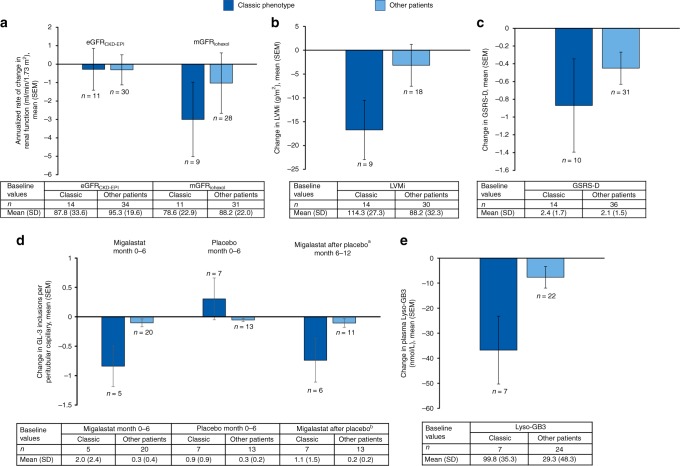
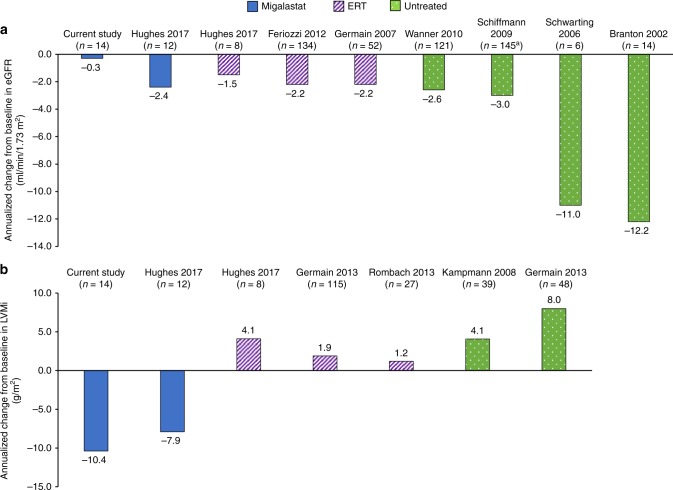
Results: Baseline measures in the classic phenotype patients suggested a more severe phenotype. At month 24, mean (SD) annualized change in eGFRCKD-EPI with migalastat was -0.3 (3.76) mL/min/1.73 m2 in the classic phenotype subgroup; changes in LVMi, GSRS-D, and lyso-Gb3 were -16.7 (18.64) g/m2, -0.9 (1.66), and -36.8 (35.78) nmol/L, respectively. At month 6, mean PTC GL-3 inclusions decreased with migalastat (-0.8) and increased with placebo (0.3); switching from placebo to migalastat, PTC inclusions decreased by -0.7. Numerically smaller changes in these endpoints were observed in the other patients.
Conclusion: Migalastat provided clinical benefit to patients with Fabry disease and amenable variants, regardless of disease severity.
Keywords: Fabry disease; classic; migalastat; pharmacogenetics; precision medicine.
Conflict of interest statement
D.P.G. has received honoraria and research grants from Amicus, Sanofi Genzyme, and Shire. K.N. has served as an advisor for Amicus, Shire, and Sanofi Genzyme, has received research support from Amicus and Shire, and has received travel support from Sanofi Genzyme. R.G. has received honoraria from Amicus, BioMarin, Sanofi Genzyme, and Shire. D.G.B. has received research funding, serves as a consultant, and is on the speaker’s bureau for Amicus and Sanofi Genzyme, and has received research funding from Shire. D.A.H. has served as a consultant for and received research funding and honoraria from Amicus, Shire, Sanofi Genzyme, Protalix, and Actelion. L.M.B. has served as a consultant for Protalix. R.B.C. has served as a consultant for Amicus and has received grants from the National Institutes of Health. N.S., J.P.C., E.B., and J.A.B. are employees of and hold stock in Amicus. At the time the work was done, C.V. was an employee and held stock in Amicus. J.C.J. declares no conflicts of interest.
Figures
References
-
- Amicus Therapeutics Inc. Galafold (migalastat) amenability table website. http://www.galafoldamenabilitytable.com. Accessed 15 October 2018.
Publication types
MeSH terms
Substances
Associated data
LinkOut - more resources
Full Text Sources
Other Literature Sources
Medical
Molecular Biology Databases
Research Materials
Miscellaneous
