. 2019 Feb 6;14(2):e0210952.
doi: 10.1371/journal.pone.0210952. eCollection 2019.

Genome-enhanced detection and identification of fungal pathogens responsible for pine and poplar rust diseases

Affiliations

Genome-enhanced detection and identification of fungal pathogens responsible for pine and poplar rust diseases

Marie-Josée Bergeron et al. PLoS One. .

Abstract

Biosurveillance is a proactive approach that may help to limit the spread of invasive fungal pathogens of trees, such as rust fungi which have caused some of the world's most damaging diseases of pines and poplars. Most of these fungi have a complex life cycle, with up to five spore stages, which is completed on two different hosts. They have a biotrophic lifestyle and may be propagated by asymptomatic plant material, complicating their detection and identification. A bioinformatics approach, based on whole genome comparison, was used to identify genome regions that are unique to the white pine blister rust fungus, Cronartium ribicola, the poplar leaf rust fungi Melampsora medusae and Melampsora larici-populina or to members of either the Cronartium and Melampsora genera. Species- and genus-specific real-time PCR assays, targeting these unique regions, were designed with the aim of detecting each of these five taxonomic groups. In total, twelve assays were developed and tested over a wide range of samples, including different spore types, different infected plant parts on the pycnio-aecial or uredinio-telial host, and captured insect vectors. One hundred percent detection accuracy was achieved for the three targeted species and two genera with either a single assay or a combination of two assays. This proof of concept experiment on pine and poplar leaf rust fungi demonstrates that the genome-enhanced detection and identification approach can be translated into effective real-time PCR assays to monitor tree fungal pathogens.


Conflict of interest statement

The authors have declared that no competing interests exist.

Figures
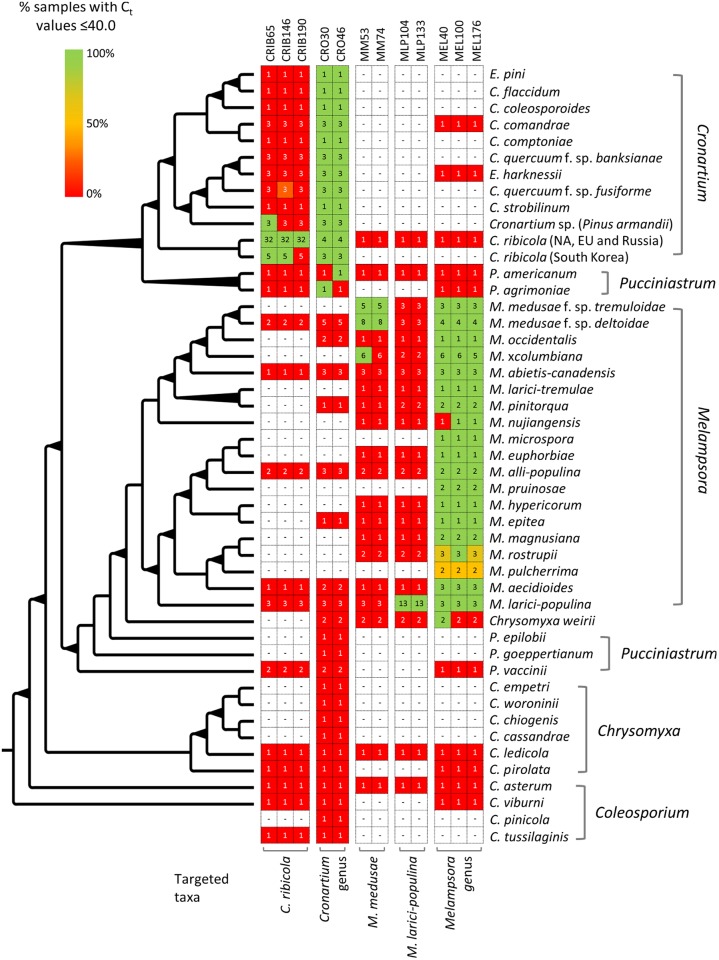
Fig 1
Fig 1. Specificity of the pine and poplar rust assays.
The NJ phylogenetic tree represents evolutionary relationships among the rust samples used, inferred from an alignment of ITS sequences; bolded nodes received bootstrap values ≥ 80%. Rows represent the number of rust samples used within each taxon and columns stand for the different assays. For each taxon, the relative abundance of samples with Ct values ≤ 40.0, as determined by real-time PCR, is depicted by color scale with the legend at the upper left side.
Fig 2
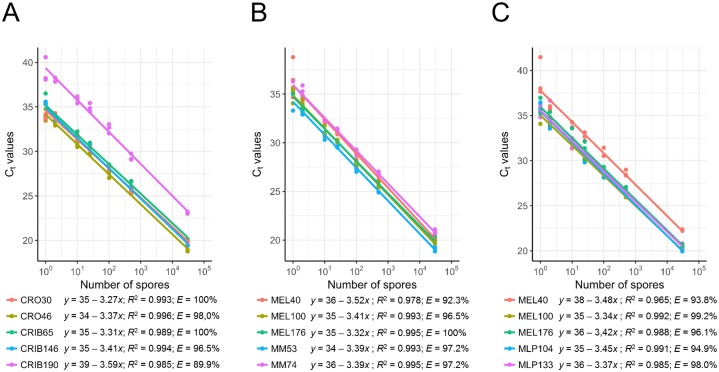
Fig 2. Relationship between the number of Cronartium ribicola (A), Melampsora medusae f. sp. deltoidae (B) and Melampsora larici-populina (C) spores from which DNA was isolated and Ct values, as determined by real-time PCR.
Each dot represents a biological independent replicate (corresponding to a known amount of spores), which was obtained by averaging the Ct values of three technical real-time PCR replicates.
Fig 3
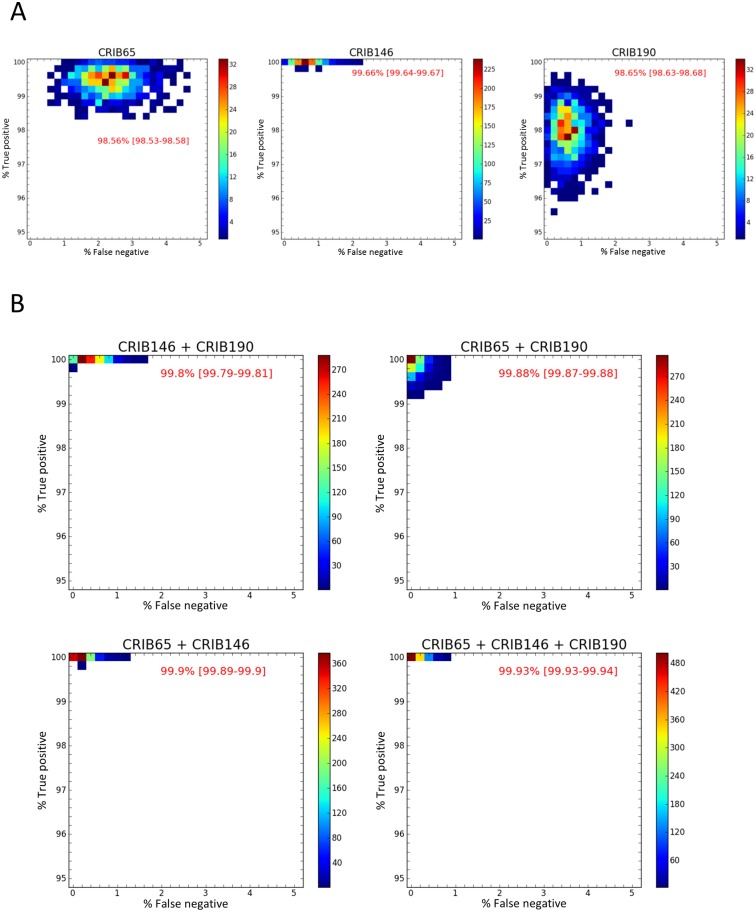
Fig 3. Distribution of true positive (TP) and false positive (FP) rates estimated with a naïve Bayes classifier, over 1,000 simulations of 500 positive and 500 negative samples, for the three specific assays targeting Cronartium ribicola.
Results are presented for each single assay (A) and for all possible combinations of two or three assays (B). Color scale represents the number of simulations that were assigned into each TP rate X FP rate category. Values in red represent the percentage of accuracy with 95% confidence intervals.

References

    1. Santini A, Ghelardini L, De Pace C, Desprez-Loustau M-L, Capretti P, Chandelier A, et al. Biogeographical patterns and determinants of invasion by forest pathogens in Europe. New Phytol. 2013;197(1):238–250. 10.1111/j.1469-8137.2012.04364.x - DOI - PubMed
    1. Pautasso M, Schlegel M, Holdenrieder O. Forest health in a changing world. Microbial Ecology. 2015;69(4):826–842. 10.1007/s00248-014-0545-8 - DOI - PubMed
    1. Loo JA. Ecological impacts of non-indigenous invasive fungi as forest pathogens. Biological Invasions. 2009;11(1):81–96. - PMC - PubMed
    1. Fisher MC, Henk DA, Briggs CJ, Brownstein JS, Madoff LC, McCraw SL, et al. Emerging fungal threats to animal, plant and ecosystem health. Nature. 2012;484(7393):186 10.1038/nature10947 - DOI - PMC - PubMed
    1. Leung B, Lodge DM, Finnoff D, Shogren JF, Lewis MA, Lamberti G. An ounce of prevention or a pound of cure: bioeconomic risk analysis of invasive species. Proceedings of the Royal Society of London B: Biological Sciences. 2002;269(1508):2407–2413. - PMC - PubMed

Publication types

MeSH terms