. 2019 Mar 31;42(3):210-217.
doi: 10.14348/molcells.2018.0352. Epub 2019 Feb 1.

Alleviation of Senescence via ATM Inhibition in Accelerated Aging Models

Affiliations

Alleviation of Senescence via ATM Inhibition in Accelerated Aging Models

Myeong Uk Kuk et al. Mol Cells. .

Abstract

The maintenance of mitochondrial function is closely linked to the control of senescence. In our previous study, we uncovered a novel mechanism in which senescence amelioration in normal aging cells is mediated by the recovered mitochondrial function upon Ataxia telangiectasia mutated (ATM) inhibition. However, it remains elusive whether this mechanism is also applicable to senescence amelioration in accelerated aging cells. In this study, we examined the role of ATM inhibition on mitochondrial function in Hutchinson-Gilford progeria syndrome (HGPS) and Werner syndrome (WS) cells. We found that ATM inhibition induced mitochondrial functional recovery accompanied by metabolic reprogramming, which has been known to be a prerequisite for senescence alleviation in normal aging cells. Indeed, the induced mitochondrial metabolic reprogramming was coupled with senescence amelioration in accelerated aging cells. Furthermore, the therapeutic effect via ATM inhibition was observed in HGPS as evidenced by reduced progerin accumulation with concomitant decrease of abnormal nuclear morphology. Taken together, our data indicate that the mitochondrial functional recovery by ATM inhibition might represent a promising strategy to ameliorate the accelerated aging phenotypes and to treat age-related disease.

Keywords: ATM inhibition; HGPS; KU-60019; WS; mitochondrial function.


Figures
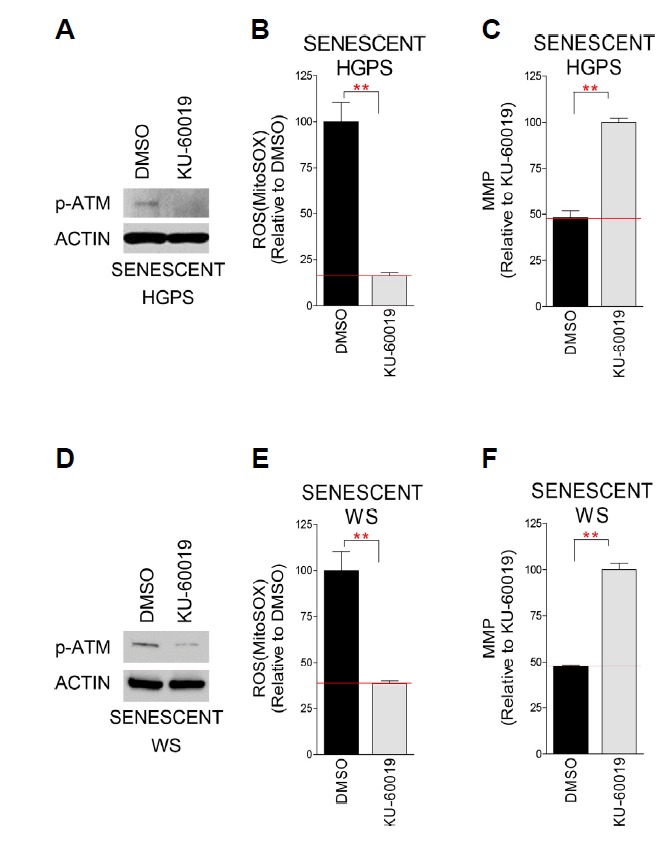
Fig. 1
Fig. 1. Functional recovery of mitochondria by ATM inhibition in senescent HGPS and WS fibroblasts
Specificity of KU-60019 as an ATM inhibitor in senescent HGPS (A) and WS (D) fibroblasts. Flow cytometric analysis of mitochondrial ROS levels using MitoSOX in senescent HGPS (B) and WS (E) fibroblasts (*P < 0.05, **P < 0.01, Student’s t-test). Mean ± S.D., N = 3. Flow cytometric analysis of mitochondrial membrane potential using JC-1 in senescent HGPS (C) and WS (F) fibroblasts (**P < 0.01, Student’s t-test). Means ± S.D., N = 3.
Fig. 2
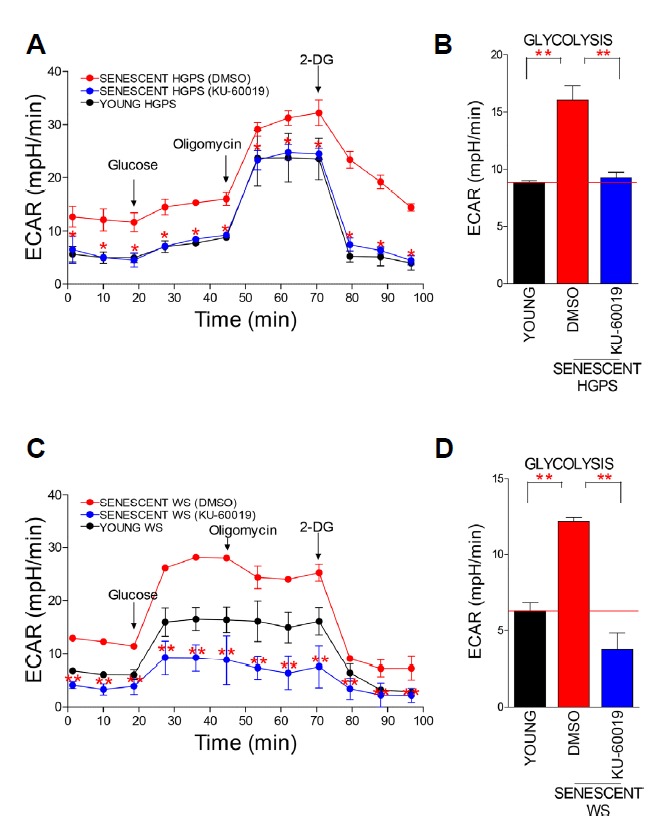
Fig. 2. ATM inhibition induces metabolic reprogramming in senescent HGPS and WS fibroblasts
Measurement of ECAR in HGPS (A) and WS (C) fibroblasts (black line: young cells, red line: DMSO-treated senescent cells, and blue line: KU-60019-treated senescent cells) (*P < 0.05, Student’s t-test). Means ± S.D., N = 3. Measurement of the glycolysis level in HGPS (B) and WS (D) fibroblasts (**P < 0.01, Student’s t-test). Means ± S.D., N = 3.
Fig. 3
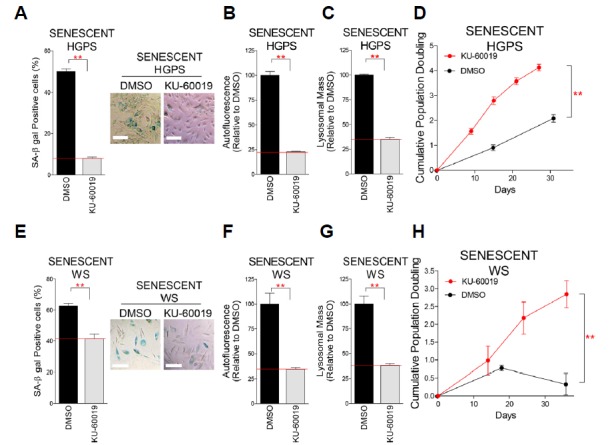
Fig. 3. ATM as a potential target for ameliorating senescence in senescent HGPS and WS fibroblasts
Quantification of SA-β gal positive cells in senescent HGPS (A) and WS (E) fibroblasts (**P < 0.01, Student’s t-test; scale bar 20: μm). Means ± S.D., N = 3. Flow cytometric analysis of autofluorescence in senescent HGPS (B) and WS (F) fibroblasts (**P < 0.01, Student’s t-test). Means ± S.D., N = 3. Flow cytometric analysis of lysosomal mass in senescent HGPS (C) and WS (G) fibroblasts (**P < 0.01, Student’s t-test). Means ± S.D., N = 3. Effects of KU-60019 treatment on CPD in senescent HGPS (D) and WS (H) fibroblasts. (**P < 0.01, Student’s t-test). Means ± S.D., N = 3.
Fig. 4
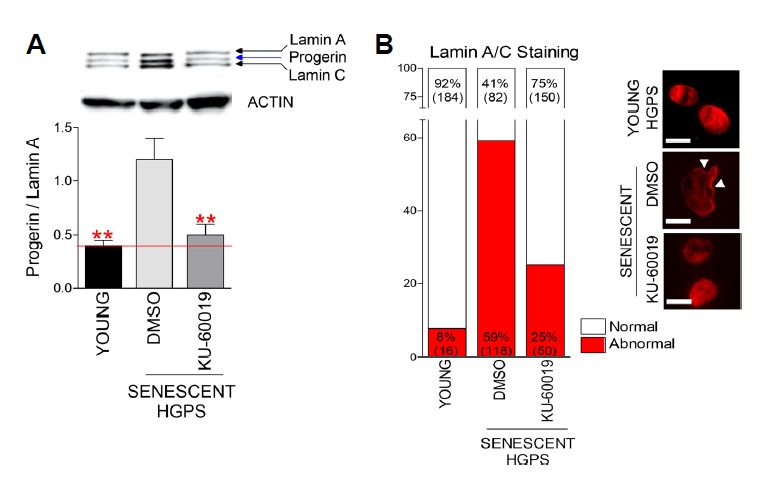
Fig. 4. Restorative effect afforded by ATM inhibition on progerin accumulation and nuclear morphology in senescent HGPS fibroblasts
(A) The ratio of progerin to lamin A as a criterion to determine disease severity in HGPS. (**P < 0.01, one-way ANOVA followed by Bonferroni’s multiple comparison test). Means ± S.D., N = 3. (B) Measurement of abnormal nuclear structures (red: lamin A/C, arrow head: abnormal nuclear structure, scale bar: 5 μm). N = 200. Cells were treated with DMSO or 0.5 μM KU-60019 for 14 days.
Fig. 5
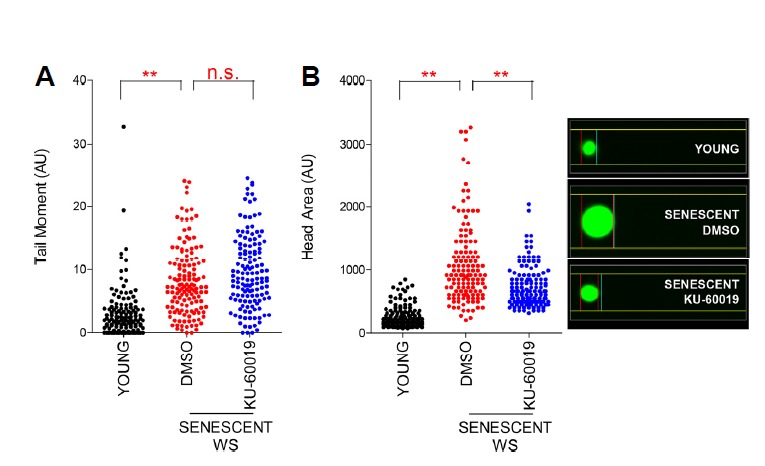
Fig. 5. Restorative effect afforded by ATM inhibition on DNA DSBs and nuclear size in senescent WS fibroblasts
(A) Neutral comet assay to measure tail moment (A) and head area (B) in WS fibroblasts (**P < 0.01, n.s.: not significant, one-way ANOVA followed by Bonferroni’s multiple comparison test). Means ± S.D., N = 100. Cells were treated with DMSO or 0.5 μM KU-60019 for 14 days.

References

    1. Azqueta A., Slyskova J., Langie S.A.S., O’Neill Gaivão I., Collins A. Comet assay to measure DNA repair: approach and applications. Front Genet. 2014;5:288. - PMC - PubMed
    1. Benhammou V., Tardieu M., Warszawski J., Rustin P., Blanche S. Clinical mitochondrial dysfunction in uninfected children born to HIV-infected mothers following perinatal exposure to nucleoside analogues. Environ Mol Mutagen. 2007;48:173–178. - PubMed
    1. Brand Martin D., Nicholls David G. Assessing mitochondrial dysfunction in cells. Biochem J. 2011;435:297–312. - PMC - PubMed
    1. Brunk U.T., Terman A. Lipofuscin: mechanisms of age-related accumulation and influence on cell function. Free Radic Biol Med. 2002;33:611–619. - PubMed
    1. Cocheme H.M., Murphy M.P. Complex I is the major site of mitochondrial superoxide production by paraquat. J Biol Chem. 2008;283:1786–1798. - PubMed

MeSH terms