


Dietary Insulin Load and Cancer Recurrence and Survival in Patients With Stage III Colon Cancer: Findings From CALGB 89803 (Alliance)
- PMID: 30726946
- PMCID: PMC6376913
- DOI: 10.1093/jnci/djy098
Dietary Insulin Load and Cancer Recurrence and Survival in Patients With Stage III Colon Cancer: Findings From CALGB 89803 (Alliance)
Abstract
Background: Evidence suggests that diets inducing postprandial hyperinsulinemia may be associated with increased cancer-related mortality. The goal of this study was to assess the influence of postdiagnosis dietary insulin load and dietary insulin index on outcomes of stage III colon cancer patients.
Methods: We conducted a prospective observational study of 1023 patients with resected stage III colon cancer enrolled in an adjuvant chemotherapy trial who reported dietary intake halfway through and six months after chemotherapy. We evaluated the association of dietary insulin load and dietary insulin index with cancer recurrence and survival using Cox proportional hazards regression adjusted for potential confounders; statistical tests were two-sided.
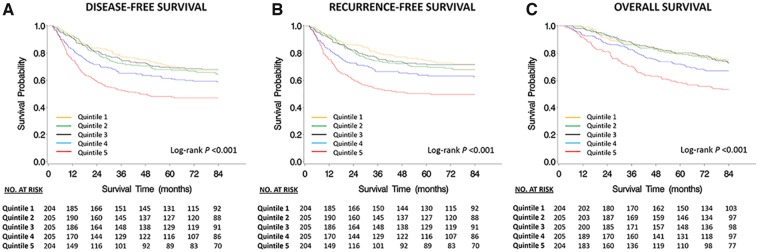
Results: High dietary insulin load had a statistically significant association with worse disease-free survival (DFS), comparing the highest vs lowest quintile (adjusted hazard ratio [HR] = 2.77, 95% confidence interval [CI] = 1.90 to 4.02, Ptrend < .001). High dietary insulin index was also associated with worse DFS (highest vs lowest quintile, HR = 1.75, 95% CI = 1.22 to 2.51, Ptrend= .01). The association between higher dietary insulin load and worse DFS differed by body mass index and was strongest among patients with obesity (HR = 3.66, 95% CI = 1.88 to 7.12, Pinteraction = .04). The influence of dietary insulin load on cancer outcomes did not differ by mutation status of KRAS, BRAF, PIK3CA, TP53, or microsatellite instability.
Conclusions: Patients with resected stage III colon cancer who consumed a high-insulinogenic diet were at increased risk of recurrence and mortality. These findings support the importance of dietary management following resection of colon cancer, and future research into underlying mechanisms of action is warranted.
© The Author(s) 2018. Published by Oxford University Press. All rights reserved. For permissions, please email: journals.permissions@oup.com.
Figures

Comment in
-
Too Early to Worry About Blueberries.J Natl Cancer Inst. 2019 Feb 1;111(2):103-104. doi: 10.1093/jnci/djy101. J Natl Cancer Inst. 2019. PMID: 30768207 No abstract available.
References
-
- Meyerhardt JA, Heseltine D, Niedzwiecki D, et al. Impact of physical activity on cancer recurrence and survival in patients with stage III colon cancer: Findings from CALGB 89803. J Clin Oncol. 2006;2422:3535–3541. - PubMed
-
- Meyerhardt JA, Giovannucci EL, Holmes MD, et al. Physical activity and survival after colorectal cancer diagnosis. J Clin Oncol. 2006;2422:3527–3534. - PubMed
-
- Meyerhardt JA, Niedzwiecki D, Hollis D, et al. Association of dietary patterns with cancer recurrence and survival in patients with stage III colon cancer. JAMA. 2007;2987:754–764. - PubMed
Publication types
MeSH terms
Substances
Grants and funding
- R35 CA197735/CA/NCI NIH HHS/United States
- R01 CA118553/CA/NCI NIH HHS/United States
- R01 CA149222/CA/NCI NIH HHS/United States
- U10 CA180821/CA/NCI NIH HHS/United States
- U10 CA180836/CA/NCI NIH HHS/United States
- R01 CA205406/CA/NCI NIH HHS/United States
- U10 CA041287/CA/NCI NIH HHS/United States
- U10 CA180882/CA/NCI NIH HHS/United States
- U10 CA180820/CA/NCI NIH HHS/United States
- U10 CA180867/CA/NCI NIH HHS/United States
- U10 CA138561/CA/NCI NIH HHS/United States
- K07 CA148894/CA/NCI NIH HHS/United States
- U10 CA032291/CA/NCI NIH HHS/United States
- U10 CA045808/CA/NCI NIH HHS/United States
- UG1 CA189974/CA/NCI NIH HHS/United States
- P30 CA008748/CA/NCI NIH HHS/United States
- U10 CA180791/CA/NCI NIH HHS/United States
- U10 CA077651/CA/NCI NIH HHS/United States
- R01 CA169141/CA/NCI NIH HHS/United States
- UG1 CA233180/CA/NCI NIH HHS/United States
- U10 CA180888/CA/NCI NIH HHS/United States
- P50 CA127003/CA/NCI NIH HHS/United States
LinkOut - more resources
Full Text Sources
Medical
Research Materials
Miscellaneous
