How Patients Use a Patient Portal: An Institutional Case Study of Demographics and Usage Patterns
- PMID: 30727003
- PMCID: PMC6365289
- DOI: 10.1055/s-0038-1677528
How Patients Use a Patient Portal: An Institutional Case Study of Demographics and Usage Patterns
Abstract
Background: Given the widespread electronic health record adoption, there is increasing interest to leverage patient portals to improve care.
Objective: To determine characteristics of patient portal users and the activities they accessed in the patient portal.
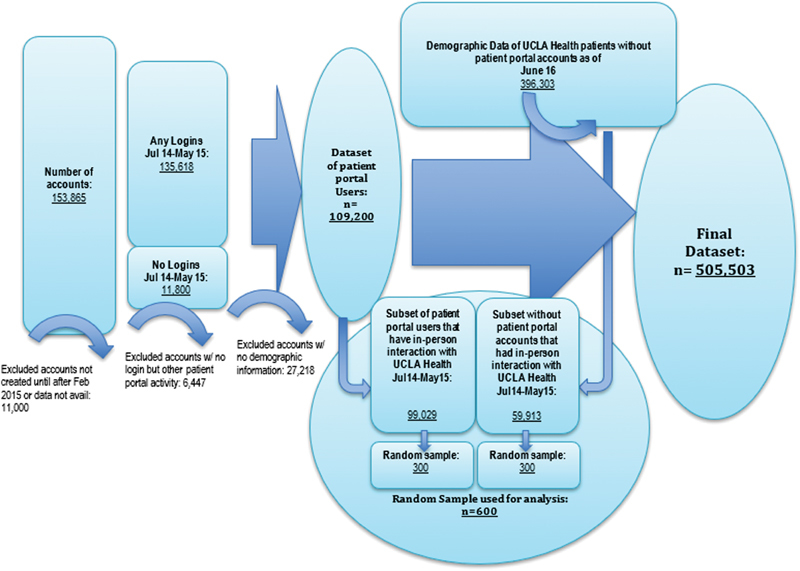
Methods: We performed a retrospective analysis of patient portal usage at University of California, Los Angeles, Health from July 2014 to May 2015. A total dataset of 505,503 patients was compiled with 396,303 patients who did not register for the patient portal and 109,200 patients who registered for a patient portal account. We compared patients who did not register for the online portal to the top 75th percentile of users based on number of logins, which was done to exclude those who only logged in to register. Finally, to avoid doing statistical analysis on too large of a sample and overpower the analysis, we performed statistical tests on a random sample of 300 patients in each of the two groups.
Results: Patient portal users tended to be older (49.45 vs. 46.22 years in the entire sample, p = 0.008 in the random sample) and more likely female (62.59 vs. 54.91% in the entire sample, p = 0.035 in the random sample). Nonusers had more monthly emergency room (ER) visits on average (0.047 vs. 0.014, p < 0.001). The most frequently accessed activity on the portal was viewing laboratory results (79.7% of users looked at laboratory results).
Conclusion: There are differences between patient portal users and nonusers, and further understanding of these differences can serve as foundation for further investigation and possible interventions to drive patient engagement and health outcomes.
Georg Thieme Verlag KG Stuttgart · New York.
Conflict of interest statement
None declared.
Figures
References
-
- Henry J, Pylypchuk Y, Searcy T, Patel V.Adoption of electronic health record systems among US non-federal acute care hospitals: 2008–2015ONC Data Brief. 2016;35:1–9. Available at:https://www.healthit.gov/sites/default/files/briefs/2015_hospital_adopti.... Accessed December 27, 2018
-
- Jamoom E W, Yang N, Hing E. Adoption of certified electronic health record systems and electronic information sharing in physician offices: United States, 2013 and 2014. NCHS Data Brief. 2016;(236):1–8. - PubMed
-
- Jamoom E, Yang N.Table of electronic health record adoption and use among office-based physicians in the U.S., by state: 2015 National Electronic Health Records SurveyAvailable at:https://www.cdc.gov/nchs/data/ahcd/nehrs/2015_nehrs_web_table.pdf. Published 2016. Accessed December 27, 2018
-
- Henry J, Pylypchuk Y, Patel V.Electronic capabilities for patient engagement among US non-federal acute care hospitals: 2012–2015The Office of the National Coordinator for Health Information Technology. 2016. Available at:https://dashboard.healthit.gov/evaluations/data-briefs/hospitals-patient.... Accessed December 27, 2018
-
- Leventhal R.Survey: portals aren't enough for successful patient engagement. Healthcare Informatics MagazineAvailable at:https://www.healthcare-informatics.com/news-item/himss-analytics-survey-.... Accessed October 26, 2018
Publication types
MeSH terms
Grants and funding
LinkOut - more resources
Full Text Sources