


Pathological profiles and clinical management challenges of breast cancer emerging in young women in Indonesia: a hospital-based study
- PMID: 30728000
- PMCID: PMC6364389
- DOI: 10.1186/s12905-019-0724-3
Pathological profiles and clinical management challenges of breast cancer emerging in young women in Indonesia: a hospital-based study
Abstract
Background: Breast cancer diagnosed at a young age is often associated with aggressive biology, advanced stage, and unfavorable prognosis. The median age of breast cancer diagnosis in Indonesia is younger (48 vs. 68 years-old in Europe) with a relatively higher proportion of patients younger than 40 years old. Although prognosis and outcome of young breast cancer are well studied in developed nations, research evaluating biological characteristics, delivered treatment, and clinical outcomes is very limited in Indonesia.
Methods: We analyzed all breast cancer patients who underwent surgery at Dr. Sardjito Hospital, Indonesia, in 2012-2017. Details of pathology profiles, treatment administrated, and outcomes, as well as reproductive factors among patients younger than 40 years old, were collected and analyzed. Kaplan-Meier curve was used to assess conditional survival based on baseline characteristics.
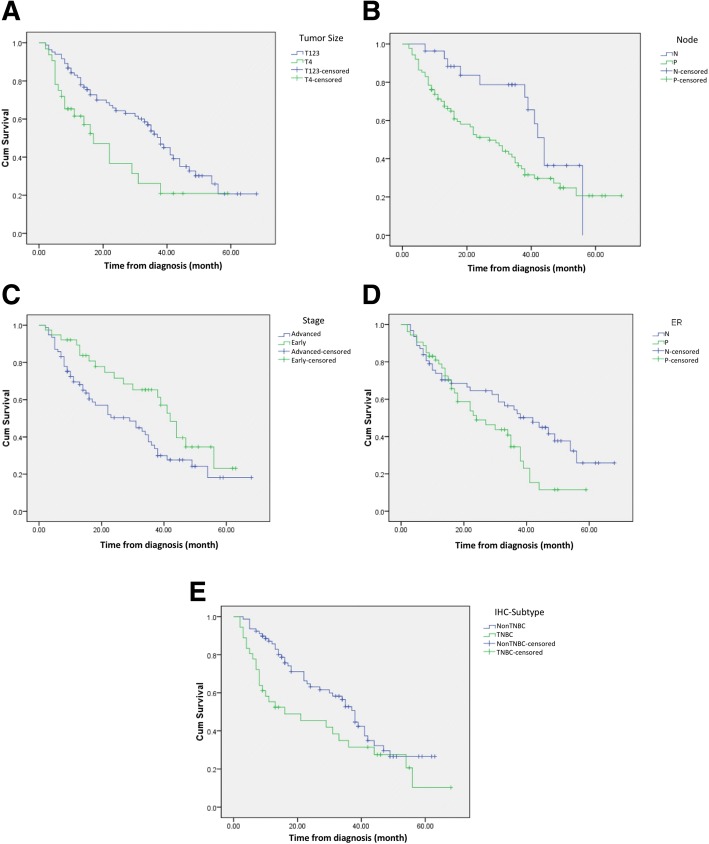
Results: From the total of 1259 breast cancer patients (median age 51 years), 144 (11.4%) were younger than 40 years old (median age 37 years). Of these young patients, 19 (13.2%) were bilateral and 92 (64%) were diagnosed in advanced stages (stages IIIA-C and IV). Median tumor diameter was 5.5 cm and nodal infiltration was present in 73%. Distant metastasis was found in 16% at the time of diagnosis. Moderate and poor differentiation of tumor were 20.8 and 78.5%, respectively, and lymphovascular invasion was found in 90.3%. Around 40% were hormone receptor-positive, 30.6% human epidermal growth factor receptor 2 positive, and 38.2% triple negative. Patients underwent radical surgery in 121 cases (84%) and breast conserving surgery in 7 cases (4.9%). Adjuvant chemotherapy was administrated in 68% and hormonal therapy in 34%. Progression-free survival was significantly shorter in patients with advanced stage, skin and chest wall involvement (T4), positive lymph node infiltration, positive hormonal receptor, and triple negative subtype (log-rank Mantel-Cox tests, p < 0.05).
Conclusion: We found a high frequency of young breast cancer with biologically more aggressive tumors, late diagnosis, frequent relapse, and poor prognosis. Further actions to improve clinical management and meet psychosocial needs in young breast cancer patients are warranted.
Keywords: Indonesia; Progression free survival; Psychosocial need; Subtype; Young breast cancer.
Conflict of interest statement
Ethics approval and consent to participate
The study was approved by the Medical and Health Research Ethics Committee of the Faculty of Medicine Public Health and Nursing, Universitas Gadjah Mada Indonesia (601/EC/2014 and 1143/EC/2017). All participants gave written informed consent prior to participating in this study.
Consent for publication
Not applicable.
Competing interests
All authors declare that they have no competing interests.
Publisher’s Note
Springer Nature remains neutral with regard to jurisdictional claims in published maps and institutional affiliations.
Figures
References
-
- World Health Organization. Cancer country profile 2014. Cancer Country Profile: Indonesia 2014. https://www.who.int/cancer/country-profiles/idn_en.pdf?ua=1. Accessed 29 Jan 2019.
Publication types
MeSH terms
Substances
LinkOut - more resources
Full Text Sources
Medical
Research Materials
