


Cervical microbiota in women with cervical intra-epithelial neoplasia, prior to and after local excisional treatment, a Norwegian cohort study
- PMID: 30728029
- PMCID: PMC6364458
- DOI: 10.1186/s12905-019-0727-0
Cervical microbiota in women with cervical intra-epithelial neoplasia, prior to and after local excisional treatment, a Norwegian cohort study
Abstract
Background: Local treatment for cervical intraepithelial neoplasia (CIN) by Loop Electrosurgical Excision Procedure (LEEP) has been correlated with reproductive morbidity, while the cervicovaginal microbiota is also known to affect the risk of preterm delivery. CIN and treatment by LEEP might change the cervical microbiota. The main aim of this study was to describe the cervical microbiota before and after LEEP and assess its associaton with cone depth and HPV persistence. Further, we aimed to compare the microbiota to references with normal cervical cytology.
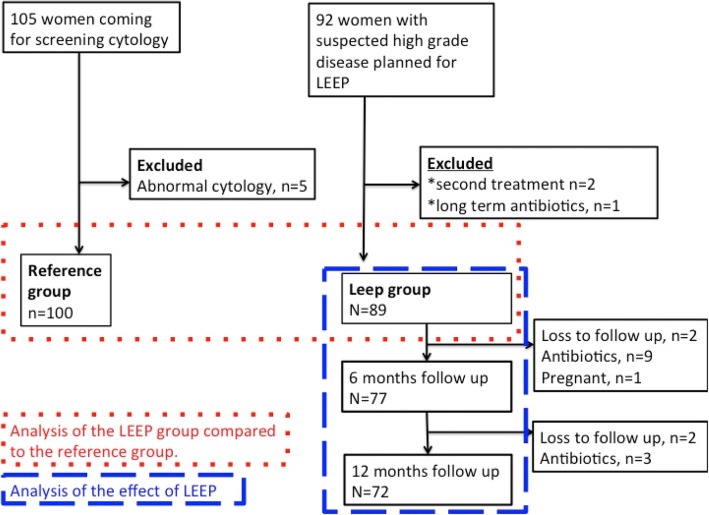
Methods: Between 2005 and 2007, we prospectively identified 89 women planned for LEEP in a Norwegian hospital and recruited 100 references with a normal cervical cytology. Endocervical swabs were collected prior to treatment and at six (n = 77) and 12 months (n = 72) post LEEP for bacterial culture and PCR, and post LEEP for DNA testing for human papillomavirus (HPV). We compared the cervical microbiota composition before and after treatment and between women planned for LEEP vs references.
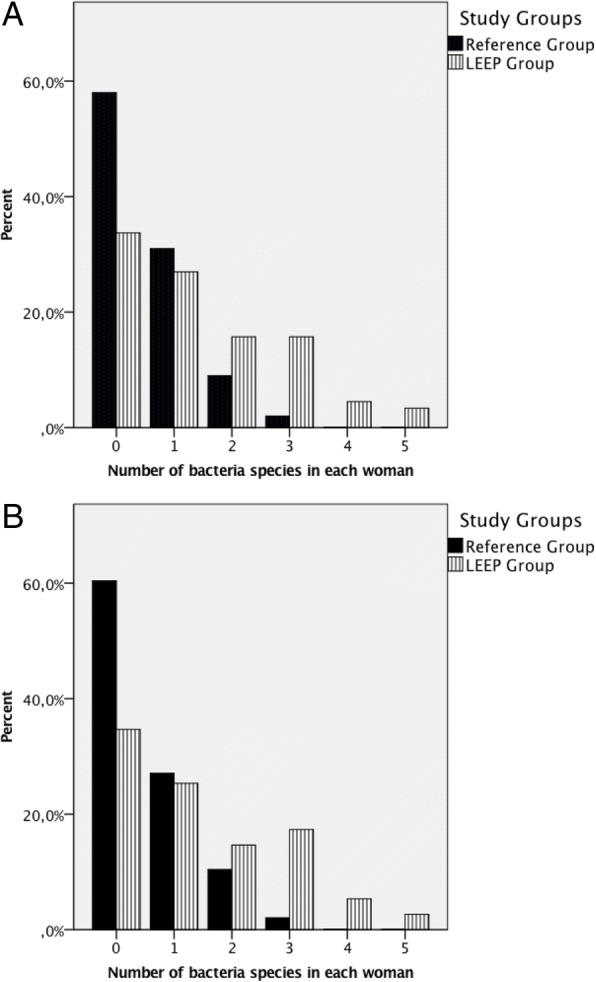
Results: There was a reduction in the number of non-Lactobacillus bacterial species six and 12 months after LEEP compared to before treatment and a tendency towards a concomitant increase in Lactobacillus. No association between the detection of cervical bacteria, HPV persistence or cone depth was found. Women planned for LEEP carried significantly more Bacteroides spp., Gardnerella vaginalis, Mycoplasma hominis and Ureaplasma parvum as well as a greater number of bacterial species than the references.
Conclusions: Local excisional treatment appears to alter the cervical microbiota towards a less diverse microbiota. Women with CIN have a more diverse cervical microbiota compared to women with normal cervical cytology.
Keywords: CIN; Cervical Intraepithelial Neoplasia; HPV; Human papillomavirus; LEEP; Lactobacillus; Vaginal microbiota.
Conflict of interest statement
Ethics approval and consent to participate
The study was approved by the Regional Committee for Ethics in Medical Research, East-Region, 2005-04-18, (622–05059). All included women consented to participate after oral and written information.
Consent for publication
Not applicable.
Competing interests
The authors have stated explicitly that there are no competing interest in connection with this article.
Publisher’s Note
Springer Nature remains neutral with regard to jurisdictional claims in published maps and institutional affiliations.
Figures
References
-
- IARC . WHO. Lyon: International agency for research on cancer (IARC) working group on the evaluation of carcinogenic risks to humans; 2007. Volume 90 Human Papillomaviruses.
-
- Castle PE, Giuliano AR. Chapter 4: Genital tract infections, cervical inflammation, and antioxidant nutrients-assessing their roles as human papillomavirus cofactors. J Natl Cancer Inst Monogr. 2003;31:29–34. - PubMed
