


Environmental factors associated with the distribution of Loa loa vectors Chrysops spp. in Central and West Africa: seeing the forest for the trees
- PMID: 30728063
- PMCID: PMC6366063
- DOI: 10.1186/s13071-019-3327-9
Environmental factors associated with the distribution of Loa loa vectors Chrysops spp. in Central and West Africa: seeing the forest for the trees
Abstract
Background: Loiasis is caused by the filarial parasite Loa loa, which is widespread through Central and West Africa and largely confined the tropical equatorial rainforests. The tabanid flies Chrysops silacea and Chrysops dimidiata are the main vectors driving transmission. This study aimed to better define the spatial distribution and ecological niche of the two vectors to help define spatial-temporal risk and target appropriate, timely intervention strategies for filariasis control and elimination programmes.
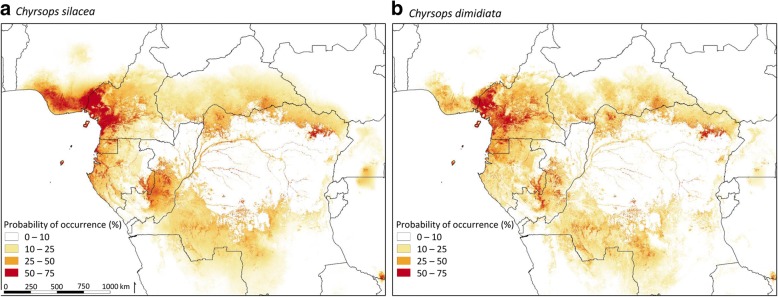
Methods: Chrysops spp. distributions were determined by collating information from the published literature into a database, detailing the year, country, locality, latitude/longitude and species collected. Environmental factors including climate, elevation and tree canopy characteristics were summarised for each vector from data obtained from satellite modelled data or imagery, which were also used to identify areas with overt landcover changes. The presence of each Chrysops vector was predicted using a maximum entropy species distribution modelling (MaxEnt) method.
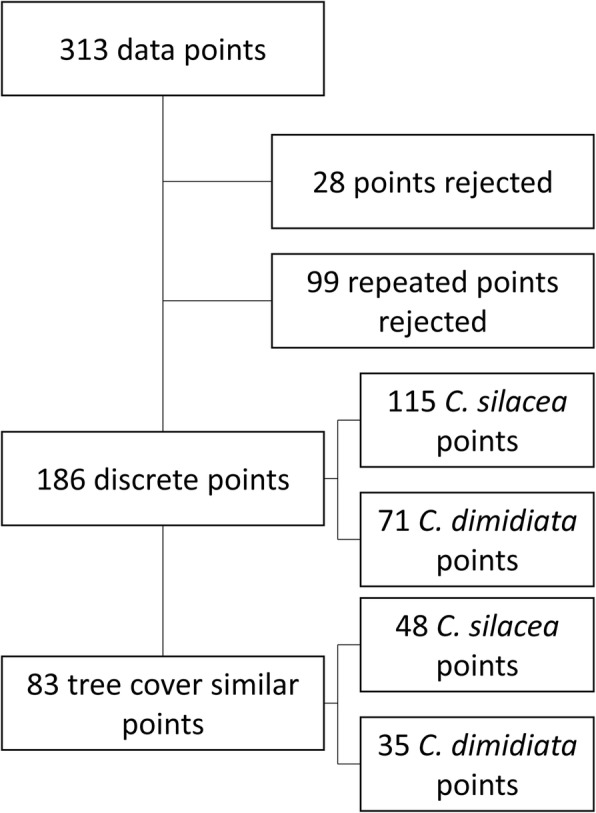
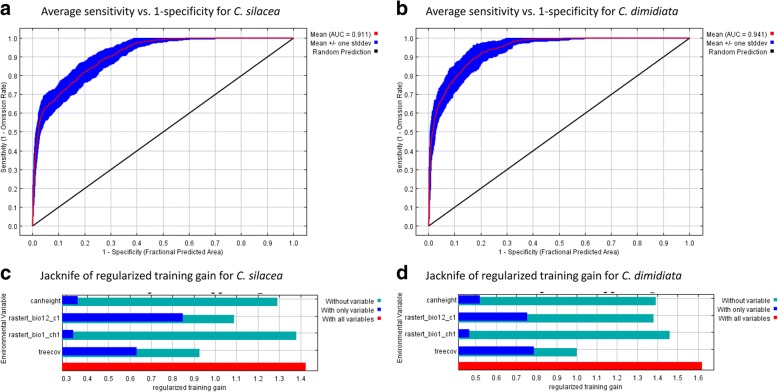
Results: A total of 313 location-specific data points from 59 published articles were identified across seven loiasis endemic countries. Of these, 186 sites were included in the climate and elevation analysis, and due to overt landcover changes, 83 sites included in tree canopy analysis and MaxEnt model. Overall, C. silacea and C. dimidiata were found to have similar ranges; annual mean temperature (24.6 °C and 24.1 °C, respectively), annual precipitation (1848.6 mm and 1868.8 mm), elevation (368.8 m and 400.6 m), tree canopy cover (61.4% and 66.9%) and tree canopy height (22.4 m and 25.1 m). MaxEnt models found tree canopy coverage was a significant environmental variable for both vectors.
Conclusions: The Chrysops spp. database and large-scale environmental analysis provides insights into the spatial and ecological parameters of the L. loa vectors driving transmission. These may be used to further delineate loiasis risk, which will be important for implementing filariasis control and elimination programmes in the equatorial rainforest region of Central and West Africa.
Keywords: Africa; Chrysops dimidiata; Chrysops silacea; Climate; Ecology; Environment; Loa loa; Loiasis; MaxEnt; Rainforest.
Conflict of interest statement
Ethics approval and consent to participate
Not applicable.
Consent for publication
Not applicable.
Competing interests
The authors declare that they have no competing interests.
Publisher’s Note
Springer Nature remains neutral with regard to jurisdictional claims in published maps and institutional affiliations.
Figures


References
-
- Zouré HGM, Wanji S, Noma MM, Amazigo UV, Diggle PJ, Tekle AH, et al. The geographic distribution of Loa loa in Africa: results of large-scale implementation of the rapid assessment procedure for Loiasis (RAPLOA) PLoS Negl Trop Dis. 2011;5:e1210. doi: 10.1371/journal.pntd.0001210. - DOI - PMC - PubMed
-
- Kelly-Hope LA, Paulo R, Thomas B, Brito M, Unnasch TR, Molyneux D. Loa loa vectors Chrysops spp.: perspectives on research, distribution, bionomics, and implications for elimination of lymphatic filariasis and onchocerciasis. Parasit Vectors. 2017;10:172. doi: 10.1186/s13071-017-2103-y. - DOI - PMC - PubMed
MeSH terms
Grants and funding
LinkOut - more resources
Full Text Sources
Miscellaneous
